Casa de Sarmiento
Ribadavia · Ribeiro · Ourense
Casa de Sarmiento
Counts of Ribadavia & Adelantados Mayores of Galicia
“From the castle walls they watched the wine flow down to the sea.”— The Sarmiento lords of Ribadavia
The Arms
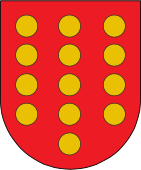
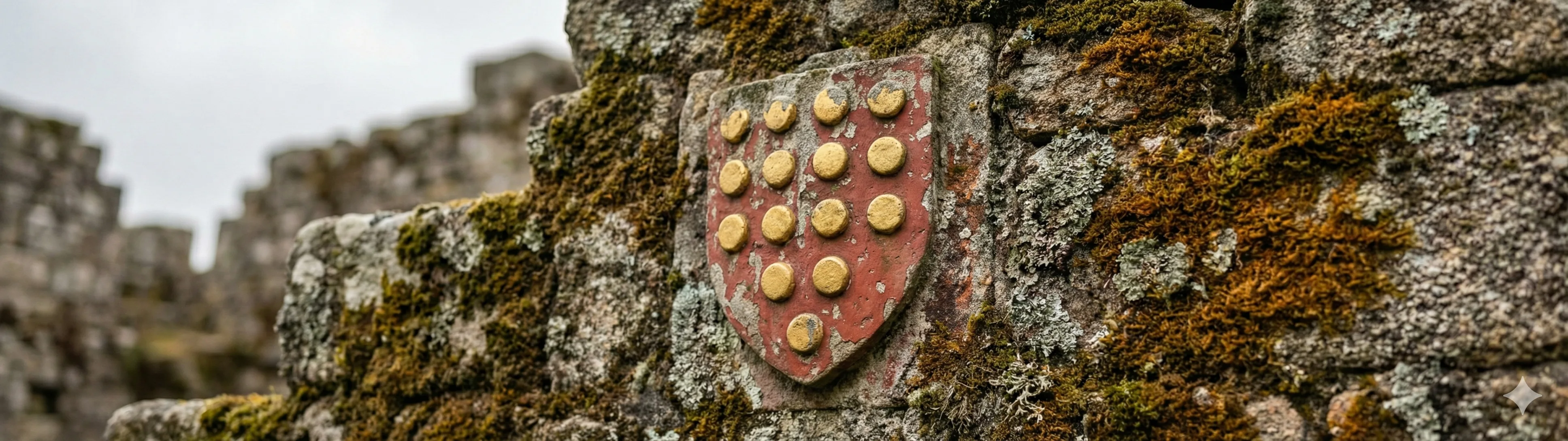
Thirteen gold bezants on a red field — the heraldic device of the Casa de Sarmiento, evoking crusading wealth and the currency of Byzantium.
From Burgundy to the Vine Shoots of Galicia
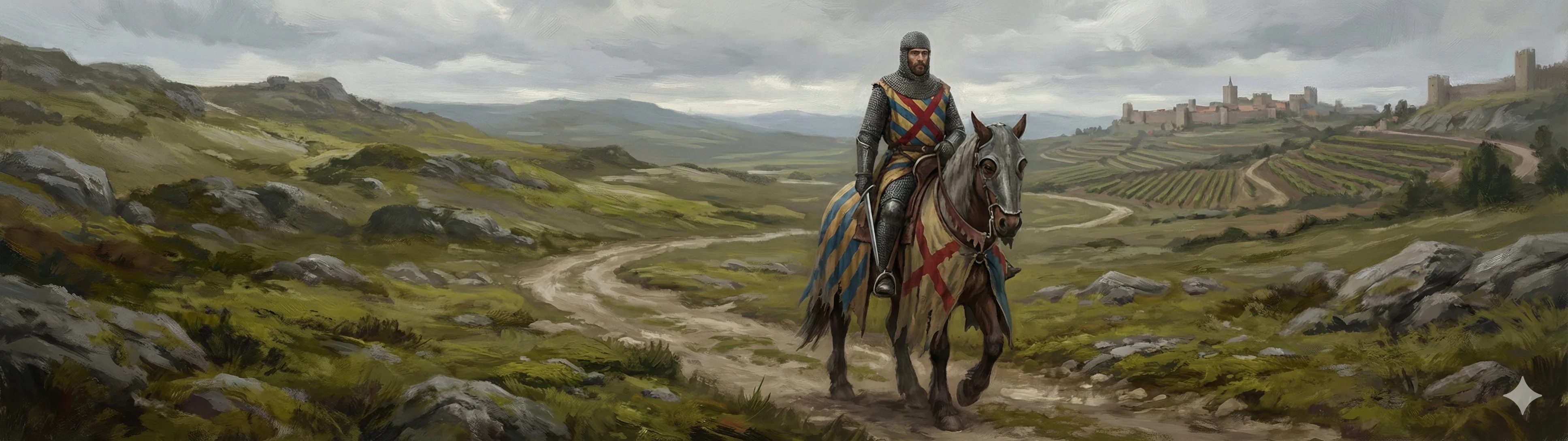
The Sarmiento name derives from the Latin *sarmentum* — a vine shoot or cutting — a fitting etymology for a dynasty that would come to dominate the Ribeiro, Galicia's oldest and most celebrated wine region. The family traced their origins to a Burgundian knight who accompanied the French dynasties into Iberia during the eleventh and twelfth centuries, part of the broader migration of Frankish aristocracy that reshaped the kingdoms of León and Castile. Early Sarmientos held lands in the Castilian heartland — around Carrión de los Condes and the Tierra de Campos — where Pedro Ruiz Sarmiento's father, Diego Pérez Sarmiento, served as Adelantado Mayor de Castilla and held the county of Castrojeriz under Pedro I.
The Sarmientos' fortunes turned on a single political gamble. During the Castilian civil war between Pedro I and his half-brother Enrique de Trastámara, the family backed the challenger. It was a shrewd wager. When Enrique's forces cornered Pedro I at Montiel in 1369, the war ended in fratricide — and the Sarmientos found themselves on the winning side of the revolution that remade Castile. The same Trastámara upheaval that redistributed former Templar and Hospitaller lands across Galicia would transform the Sarmientos from minor Castilian gentry into the dominant feudal power of the southern Galician valleys.
- *Sarmentum* (Latin): a vine shoot or pruning — the family name links directly to the viticulture that defined their future lordship
- Carrión de los Condes: the Sarmiento heartland in Old Castile before their westward expansion
- Trastámara allegiance: the same civil war that redistributed military order lands (see The Military Orders)
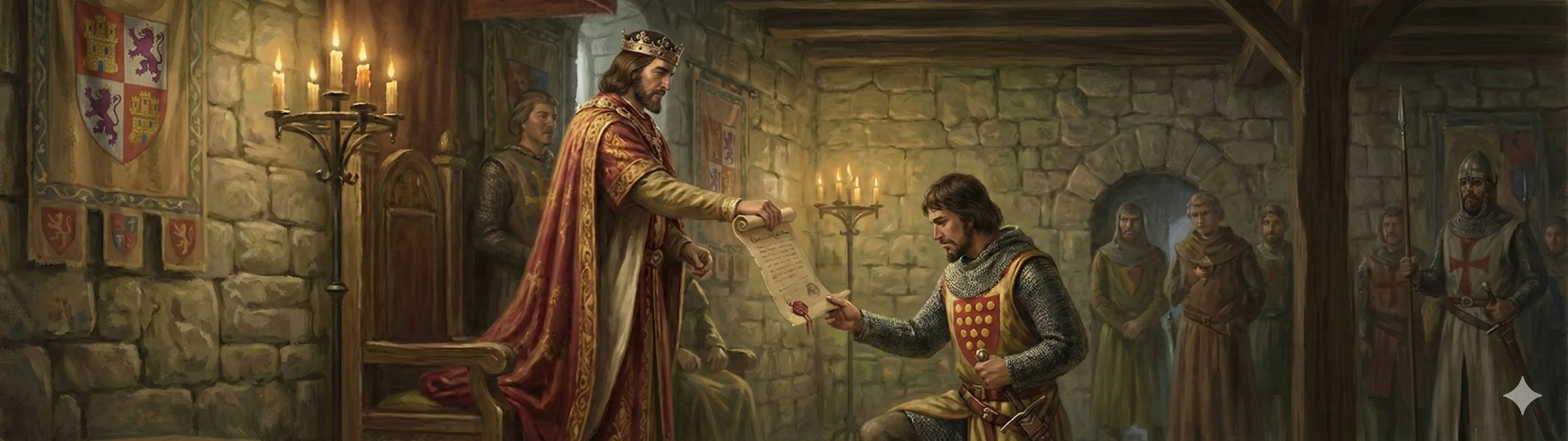
Pedro Ruiz Sarmiento: Adelantado Mayor of Galicia
On 30 July 1370, King Enrique II named Pedro Ruiz Sarmiento Adelantado Mayor del Reino de Galicia — the crown's chief military and judicial officer in the kingdom — and sent him west to crush the last Petrist loyalists. The mission was Fernando de Castro, the most powerful holdout, who still controlled much of Galicia. Sarmiento prosecuted the campaign with ferocity. He burned part of Tui during an assault, and in 1371, alongside Pedro Manrique, destroyed Fernando de Castro's forces at the battle of Porto de Bois near Lugo. The victory broke Petrist resistance and established Sarmiento as Enrique II's strongman in Galicia.
The rewards came in stages. In 1372, the king granted Sarmiento the Burgo do Faro. In 1375, Ribadavia and Santa Marta de Ortigueira followed. Ribadavia was no minor gift: it was the commercial heart of the Ribeiro wine region, the town whose market controlled the export of wine down the Miño to the Atlantic. Juan I later added Sobroso, Avión, the coto of Anllo, and the entire Ribeiro de Avia — extending Sarmiento control across the full breadth of southern Galicia's wine country.
Pedro Ruiz Sarmiento did not live to consolidate what he had won. In 1383, Juan I summoned him south to press the Castilian claim to the Portuguese throne. Sarmiento invaded Portugal from the northwest, reaching as far as Barcelos, where he defeated a Portuguese force. But when the Castilian army settled into its siege of Lisbon in the summer of 1384, plague swept the encampment. Pedro Ruiz Sarmiento died of pestilence during the siege, alongside much of the Castilian high command. A Castilian by birth, he asked to be buried in the chapel of Santa María de Sasamón in Burgos — but his lordship survived him, passing intact to his son Diego Pérez Sarmiento.
- The Adelantado Mayor was the highest royal authority in Galicia — combining military command, judicial oversight, and tax collection
- Porto de Bois (1371): the battle that broke Petrist resistance and secured Sarmiento dominance in Galicia
- Siege of Lisbon (1384): Pedro Ruiz Sarmiento died of plague, not at the Battle of Aljubarrota (1385), which occurred the following year
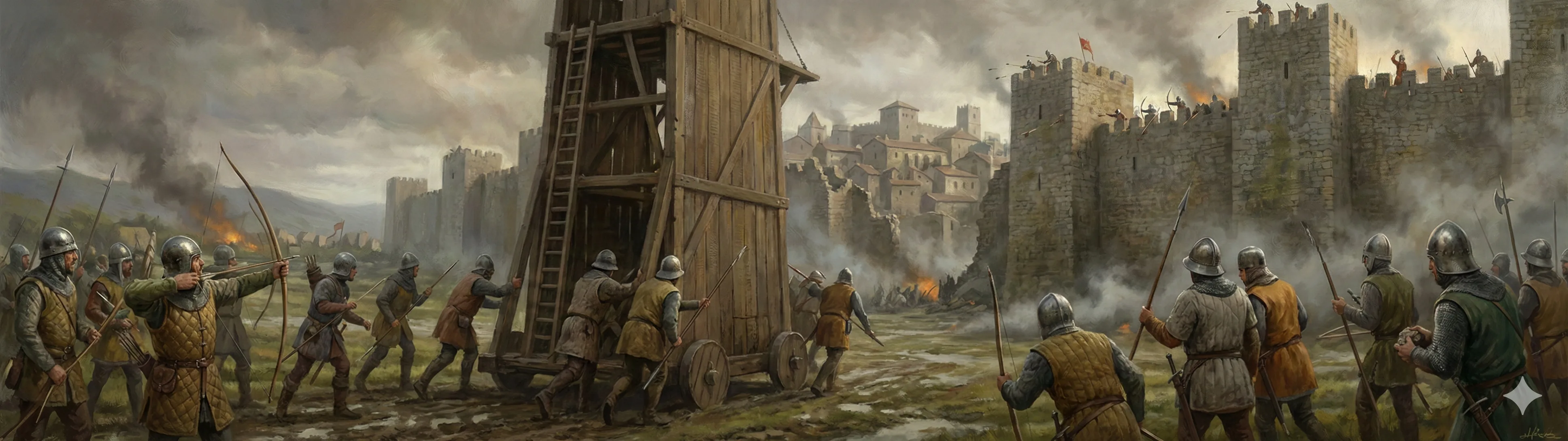
Lancaster at the Gates of Ribadavia
Two years after Pedro Ruiz Sarmiento's death, his lordship faced its first great test. In 1386, John of Gaunt, Duke of Lancaster — who claimed the Castilian throne through his marriage to Constanza, eldest daughter of the murdered Pedro I — invaded Galicia with an English army. Most Galician towns surrendered without a fight. Ribadavia did not.
An English force of over two thousand spearmen and archers laid siege to the town. The defenders held out until the English brought up a siege tower on wheels — a formidable piece of military engineering that allowed the attackers to overtop the walls. When the town finally fell, the contemporary French chronicler Jean Froissart recorded what happened next: the English killed indiscriminately and looted the town, targeting Jewish homes in particular for the gold and silver they found there. Froissart claimed fifteen hundred Jews lived in Ribadavia — an impossible exaggeration for a town of roughly five hundred inhabitants, but one that reflects how numerous the Jewish merchant community appeared to the invaders, probably as much as half the town.
What Froissart did not exaggerate was the fighting itself. The Jewish quarter's inhabitants mounted a fierce defence of the Magdalena and Porta Nova gates, fighting alongside their Christian neighbours on the walls. Ribadavia's resistance was the exception in a campaign that swept through Galicia with little opposition. The conflict was resolved diplomatically at the Treaty of Bayonne in 1388, but the scars — physical and economic — endured for a generation.
- John of Gaunt (Duke of Lancaster): claimed the Castilian throne through his wife Constanza, daughter of Pedro I
- Siege tower: the English deployed a mobile wooden tower on wheels to overtop Ribadavia's walls
- Froissart's *Chroniques*: the contemporary French source for the siege and the looting of the Jewish quarter
- The Jewish community defended the Magdalena and Porta Nova gates — they fought, not merely suffered
- Treaty of Bayonne (1388): the diplomatic settlement that ended Lancaster's Castilian campaign
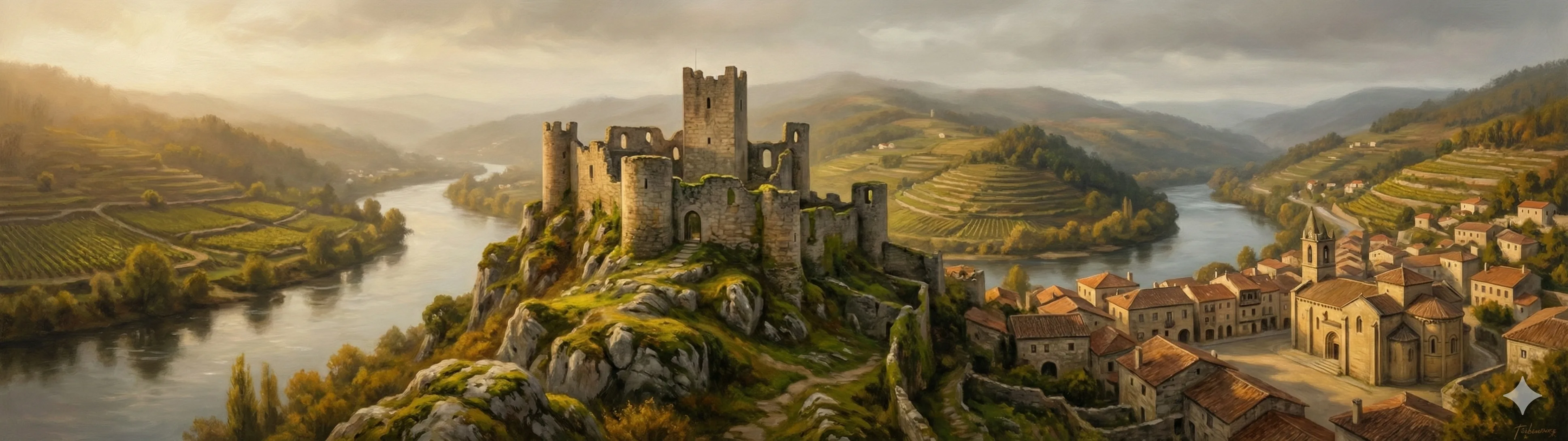
The Castle of the Counts: Commanding the Confluence
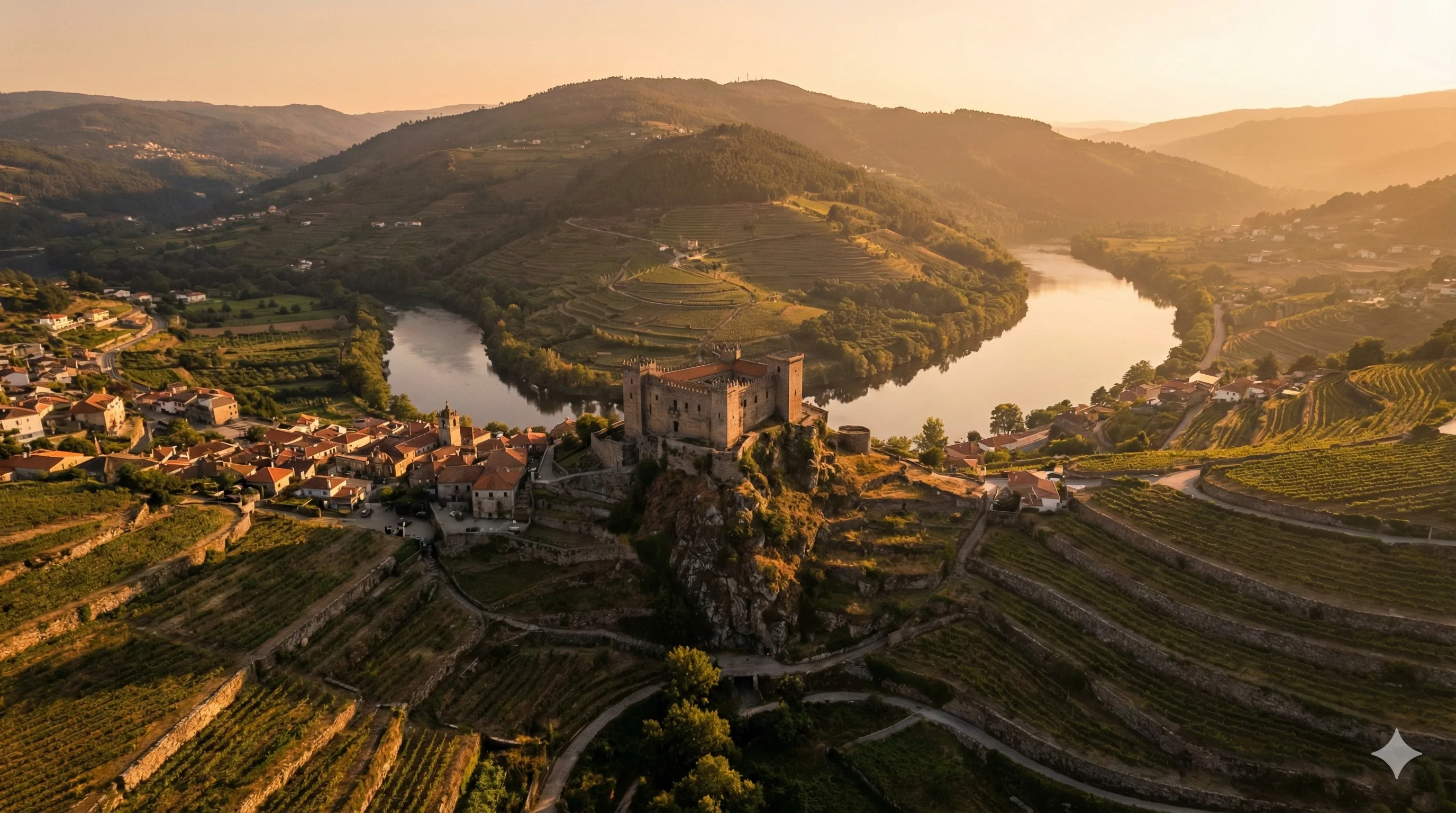
The Castillo de los Sarmiento stands on a rocky promontory at the southern edge of Ribadavia's old quarter, overlooking the point where the river Avia empties into the Miño. The position was chosen for total control: from the castle walls, the Sarmientos commanded both the river crossing and the market town below, monitoring the flow of wine barrels, merchant traffic, and tolls that were the economic lifeblood of their lordship. The present castle was begun around 1471, built on the site of an earlier church — San Xés de Francelos — and a pre-Romanesque necropolis with anthropomorphic tombs carved into the rock, dating from the ninth to twelfth centuries.
But the Sarmientos were not the first lords to control this ground. Before they arrived, the Order of St. John — the Knights Hospitaller — held a commandery headquartered in Ribadavia itself, one of four Hospitaller *encomiendas* in the province of Ourense. The Hospitallers had been producing and collecting wine revenues across the Ribeiro de Avia since the twelfth century, and their church — San Xoán — still stands in the town. When the Sarmientos secured the lordship in 1375, the Hospitallers found themselves squeezed. By the fifteenth century, the commandery's administrative seat had relocated to the village of Beade — likely under pressure from the Sarmiento lords, whose expanding jurisdiction left little room for a rival authority. The Sarmientos had not merely inherited former military order lands. They had displaced the last military order still operating in the valley (see The Military Orders).
- Castle site: built c. 1471 over the pre-Romanesque church of San Xés and a 9th–12th century necropolis
- San Xoán: the surviving Hospitaller church in Ribadavia, built by the Order of St. John
- Encomienda de Beade: the Hospitaller commandery, originally headquartered in Ribadavia, relocated to Beade under Sarmiento pressure
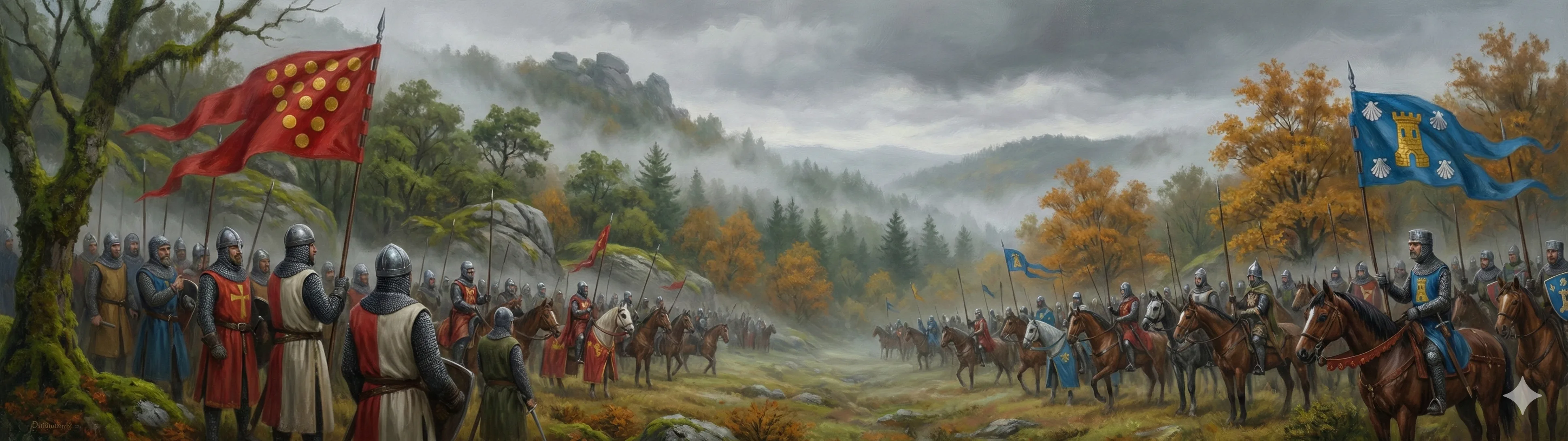
Pedro Madruga and the Wars of Southern Galicia
The Sarmientos did not rule southern Galicia unchallenged. Their great rivals were the Sotomayor — the lords of the fortress of Soutomaior — and no figure embodied the rivalry more vividly than Pedro Álvarez de Soutomaior, known to history as Pedro Madruga.
The nickname itself was born from a confrontation with the Sarmientos. In a boundary dispute with the Count of Ribadavia, the two men agreed to ride at the first cockcrow toward each other's castle, with the meeting point marking the new border. Pedro decided that first cockcrow was at midnight, rode through the darkness all night, and was standing at the Count's castle door by dawn. "*Madrugas, Pedro, madrugas!*" the Count exclaimed — "You're an early riser, Pedro!" The name stuck.
The rivalry escalated into open war. At Sobroso Castle — a Sarmiento stronghold granted by Juan I in 1379 — Pedro Madruga's brother Álvaro captured García Sarmiento during a raid, dragged him to the castle walls, held him bound on a table with a sword at his throat, and demanded the garrison surrender. The defenders refused, telling Álvaro he could kill their lord before they would open the gates. The Sarmiento-Sotomayor feud only ended with the pacification imposed by the Catholic Monarchs in the 1480s, when Isabella and Ferdinand broke the power of both houses as part of their campaign to centralise royal authority.
- Pedro Madruga (Pedro Álvarez de Soutomaior, c. 1430–1486): the most turbulent nobleman in fifteenth-century Galicia
- Sobroso Castle: Sarmiento stronghold near Mondariz, repeatedly fought over between the two families
- Pacification of Galicia: the Catholic Monarchs dismantled noble autonomy across the kingdom in the 1480s
The Irmandiño Revolts and the Son of Úrsula
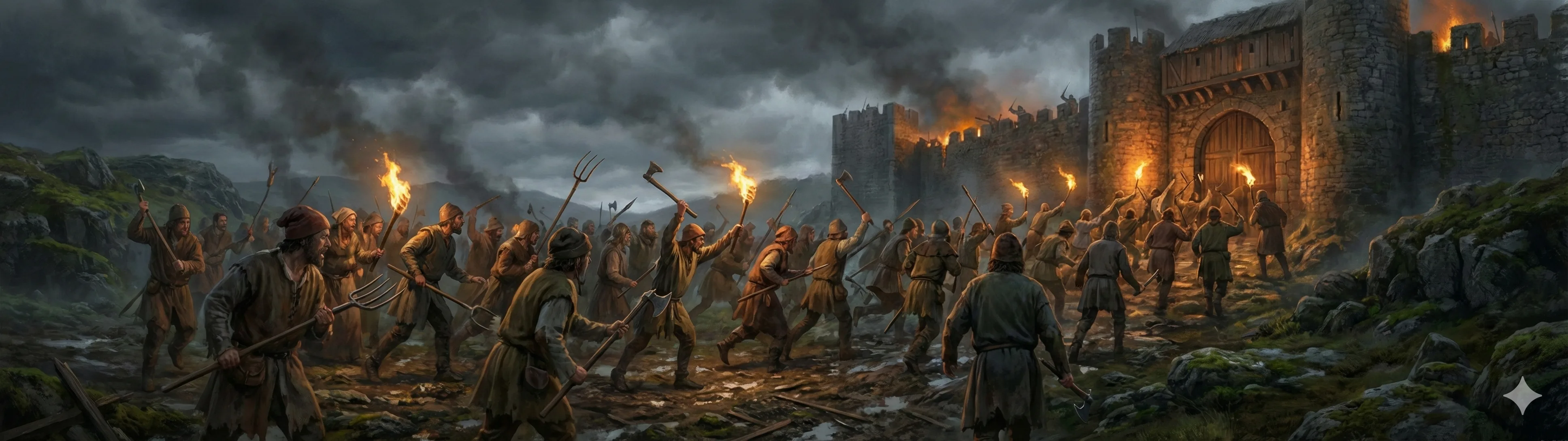
The Sarmiento lordship met its greatest crisis during the Irmandiño revolts of 1467–1469, when Galician peasants, townspeople, and minor gentry rose against the great feudal lords. The *irmandiños* — the "little brothers" — attacked noble castles throughout the kingdom, and the Castillo de Ribadavia was among their targets. The revolt struck at the worst possible moment: Diego Pérez Sarmiento, the first Count of Santa Marta, had died in 1466, and the succession was contested. His designated heir was not a legitimate son, but Bernardino — a child born of Diego's relationship with a slave named Úrsula, legitimized by royal decree in 1457.
Bernardino was a teenager when the *irmandiños* came. He fled Galicia entirely, taking refuge in the Castilian town of Mucientes. His stepmother Teresa de Zúñiga was killed by the rebels in 1470. When Bernardino returned, he found a shattered inheritance — destroyed castles, hostile vassals, and a nephew named Francisco who disputed his right to rule. The two reached a settlement in 1476: Bernardino kept Ribadavia, the Adelantamiento, and the bulk of the family's holdings; Francisco received Santa Marta de Ortigueira.
Two years later, on 20 April 1478, the Catholic Monarchs rewarded Bernardino for his support during the War of the Castilian Succession — against Juana la Beltraneja and her Galician ally Pedro Madruga — by creating the formal Condado de Ribadavia. The son of a slave, a refugee from revolution, a man who negotiated his own inheritance at swordpoint — and now, by royal decree, the legitimate count of the richest wine town in Galicia. The monasteries of the region named him one of the most voracious *encomenderos* in Galicia. He died in Valladolid in 1522, having donated his estates to his daughters.
- Irmandiño revolts (1467–1469): Galician peasants and townspeople attacked noble castles across the kingdom
- Bernardino Pérez Sarmiento (c. 1452–1522): legitimized son of a slave, first Count of Ribadavia
- Condado de Ribadavia created 20 April 1478 by the Catholic Monarchs
- *Portazgos*: toll revenues from Galician roads and river crossings, granted to Bernardino in 1488
Thirteen Bezants on a Field of Blood
The arms of the Casa de Sarmiento bear thirteen gold bezants (*bezantes de oro*) on a red field (*gules*). The bezant — a gold roundel — recalls the currency of Byzantium, a symbol carried home by crusading families and perpetuated in the heraldry of lineages that claimed descent from the warriors of the eastern Mediterranean. Whether the Sarmientos' Burgundian ancestors actually fought in the East is uncertain, but the claim mattered: in medieval Castile, crusading symbolism was the currency of legitimacy, and thirteen gold coins on a blood-red field announced a house that traced its honour to the Holy Land.
Today the castle of Ribadavia stands in ruins above the old town. The Sarmientos abandoned it in the seventeenth century, relocating to a Baroque palace on the Plaza Mayor — the Pazo de los Condes — before the family's leading representatives left Galicia altogether to seek influence at court in Madrid and Valladolid, following the pattern of noble absenteeism that hollowed out Galician lordships across the early modern period. Each year on the last weekend of August, the *Festa da Istoria* transforms the medieval streets below the castle into a living recreation of the town's Sarmiento-era past.
- Arms: thirteen gold bezants (*bezantes de oro*) on a red field (*gules*)
- Bezant: a heraldic gold roundel evoking the *bezantinus*, the gold coin of Byzantium
- Pazo de los Condes: the Baroque palace on Ribadavia's Plaza Mayor, built when the Sarmientos abandoned the castle
- *Festa da Istoria*: annual medieval festival in Ribadavia, held the last weekend of August
Key Figures
Kings, adelantados, and lords who shaped the Sarmiento lordship in the Ribeiro
First Sarmiento lord of Ribadavia. Appointed Adelantado Mayor in 1370; received Ribadavia in 1375. Died of plague at the Siege of Lisbon in 1384 — not at Aljubarrota (1385), which occurred the following year.
Consolidated the lordship over two generations. His will named a Jewish physician; Abraham de León served as his mayordomo. Father of Bernardino by the slave Úrsula.
Son of Diego and the slave Úrsula, legitimised by royal decree in 1457. Fled Galicia during the Irmandiño revolts. Created I Count of Ribadavia by the Catholic Monarchs on 20 April 1478. Died at Valladolid.
The Sarmientos' great rival. Lord of the fortress of Soutomaior, whose nickname — *Madruga* ("early riser") — was born from a boundary dispute with the Count of Ribadavia. His brother Álvaro captured García Sarmiento at Sobroso.
Founder of the House of Trastámara. Appointed Pedro Ruiz Sarmiento Adelantado Mayor in 1370 and granted Ribadavia in 1375 — the same king who redistributed former Templar properties (see The Military Orders).
Son of Enrique II. Expanded the Sarmiento lordship with Sobroso, Avión and the Ribeiro de Avia (1379). His campaign to claim the Portuguese throne led to the Siege of Lisbon (1384) where Pedro Ruiz Sarmiento died of plague.