O Ribeiro
Wine region
O Ribeiro
One of Europe's oldest wine regions, where Celtic castros, Roman roads, medieval monasteries, and Sephardic merchants shaped a viticultural tradition spanning three millennia.
“The English discovered the wines of Ribadavia and drank so freely that when morning came, they could scarcely stand in their ranks.”— Jean Froissart, Chronicles, c. 1386, on the Duke of Lancaster's army in Galicia
Where Three Rivers Meet
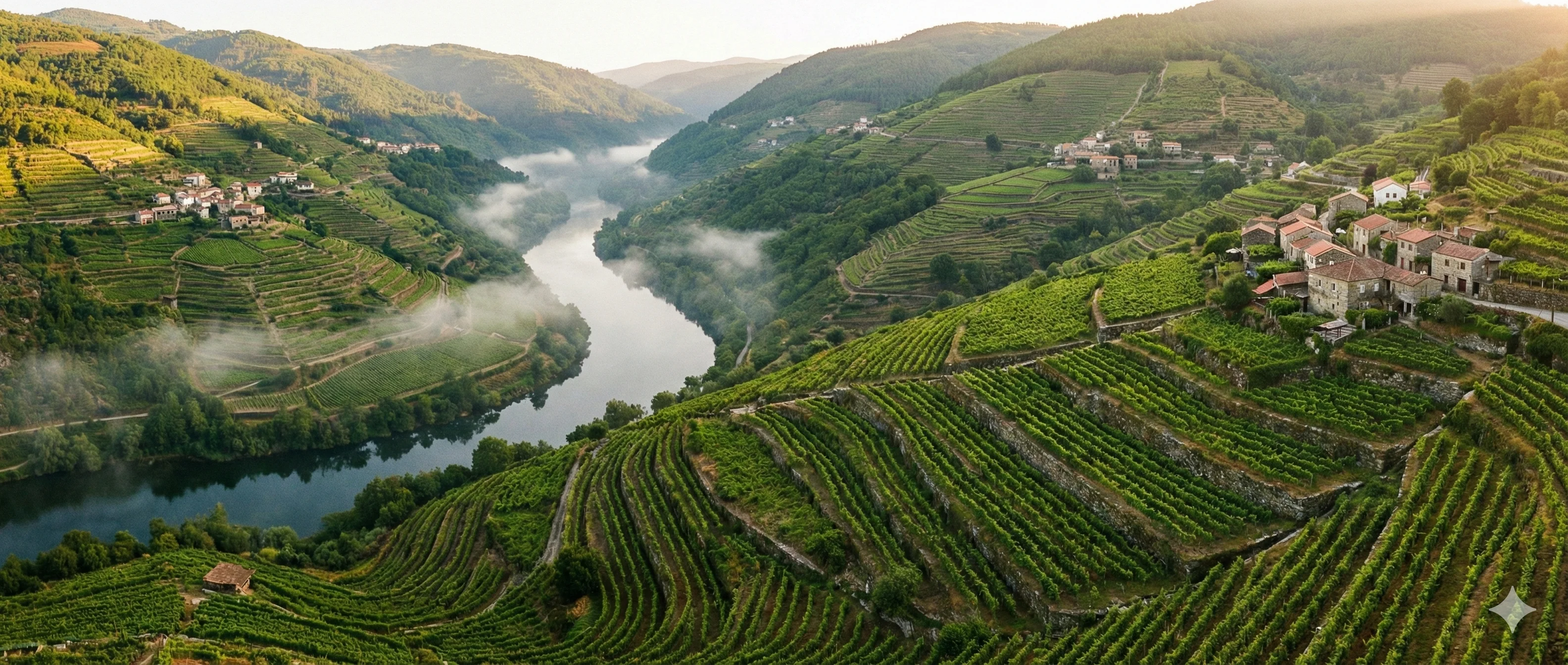
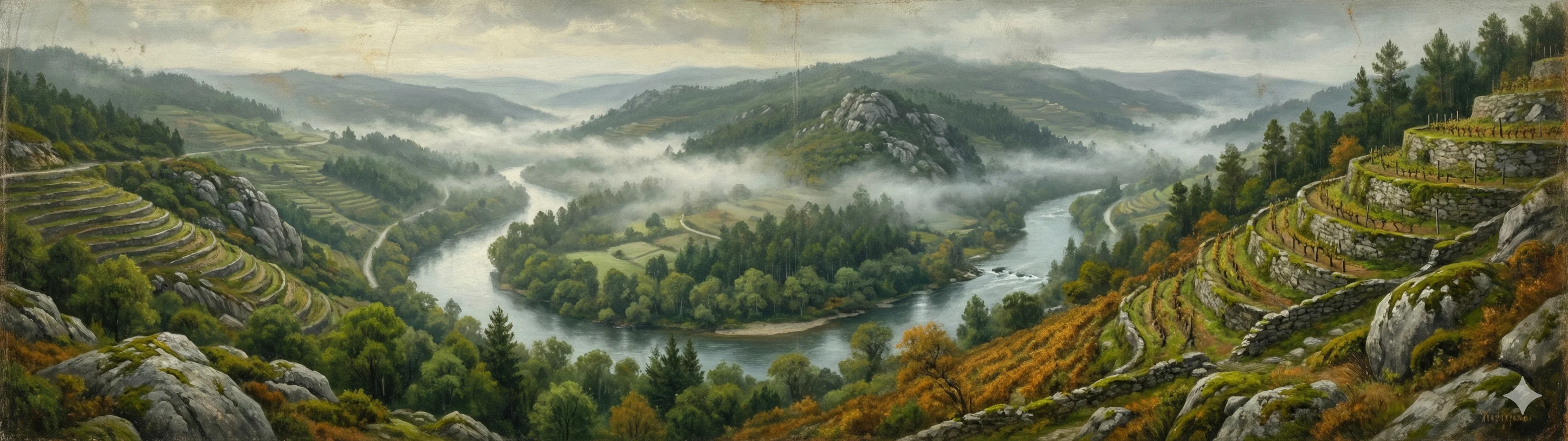
The Ribeiro wine region lies in the heart of Galicia's Ourense province, where the valleys of the Miño, Avia, and Arnoia rivers converge to create a unique microclimate. Sheltered by mountains on all sides, this inland basin traps warm air rising from the river valleys, producing conditions far warmer and drier than the rest of Atlantic Galicia.
Terraced vineyards — known locally as "socalcos" — cascade down steep granite hillsides at elevations between 75 and 400 metres. These ancient stone terraces, many built over centuries by hand, represent one of Europe's most dramatic viticultural landscapes. The granitic and alluvial soils, combined with exceptional sun exposure on south-facing slopes, give Ribeiro wines their distinctive minerality and aromatic complexity.
- The comarca encompasses 2,974 hectares of vineyards across 13 municipalities
- Average annual rainfall is 800-1,000mm — roughly half that of coastal Galicia
- Summer temperatures regularly exceed 35°C, earning Ourense the nickname "the Spanish oven"
- The Miño runs for over 300km, forming the natural border with Portugal
The First Inhabitants
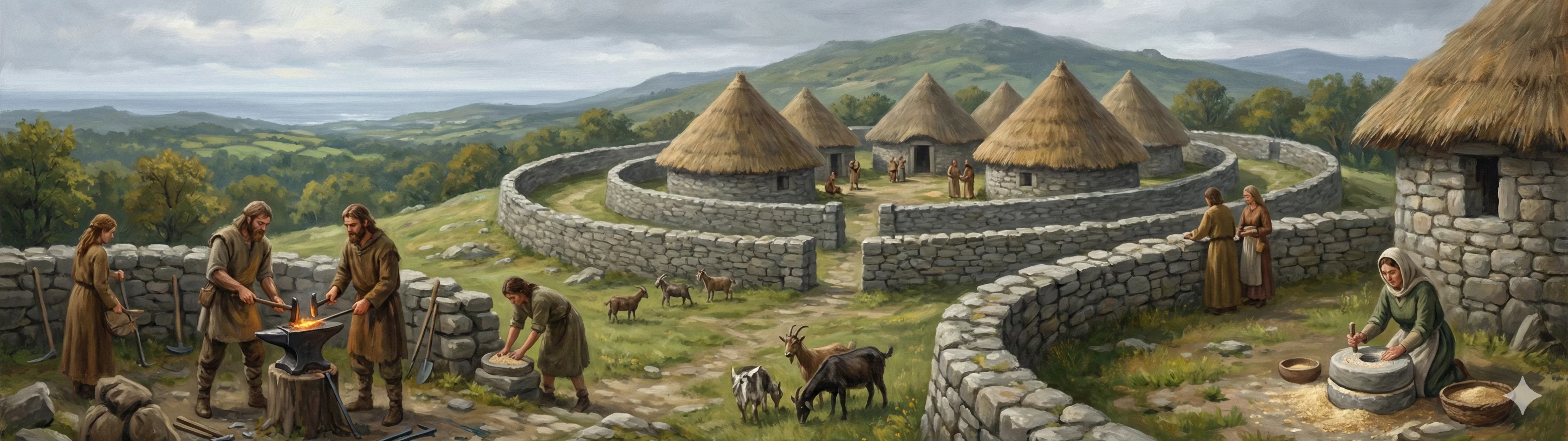
Long before written records, the river valleys of the Ribeiro were home to Neolithic communities who left behind megalithic monuments — dolmens and burial mounds — scattered across the hillsides. These early settlers were drawn to the same qualities that would later make the region famous: fertile river terraces, abundant water, and a sheltered climate.
By the Bronze Age (2000-800 BC), the region's inhabitants had developed sophisticated metalworking techniques. Gold ornaments and bronze tools found in the Miño valley attest to trade networks stretching across the Iberian Peninsula. The famous castro settlements — fortified hilltop communities — began appearing during the late Bronze Age, many strategically positioned above the river confluences.
- Megalithic monuments near Ribadavia date to approximately 4000-3000 BC
- Castro culture sites dot the landscape, with notable examples at Castromao and throughout the Avia valley
- Wild grape vines (Vitis vinifera sylvestris) were native to these river valleys
Vine & Road
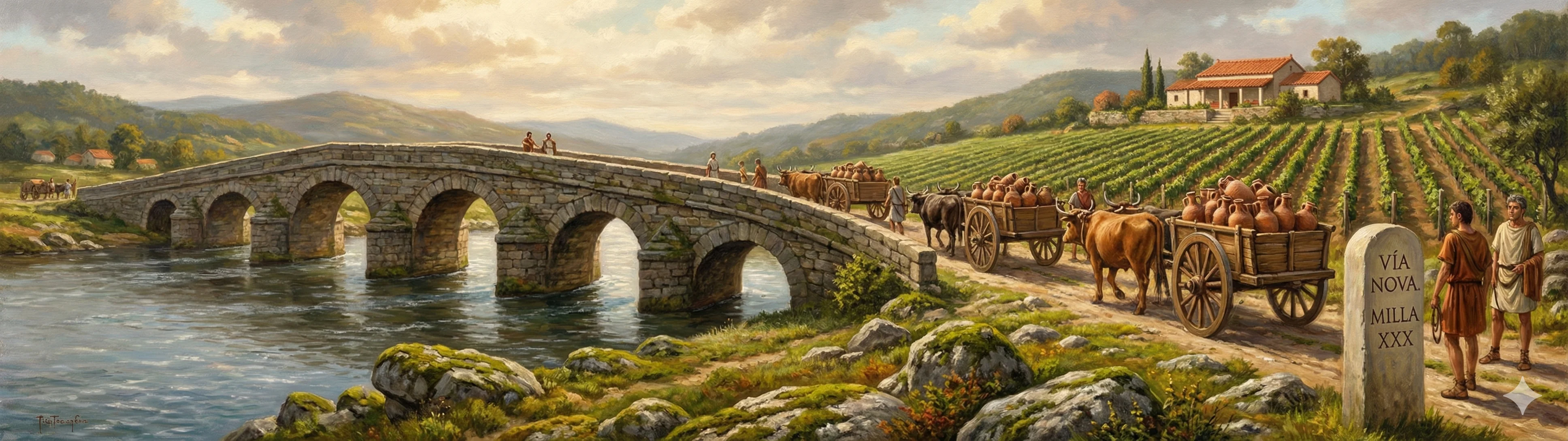
The Roman conquest of Gallaecia in the 1st century BC transformed the Ribeiro forever. Under Roman administration, the region was incorporated into the province of Gallaecia, with its capital at Bracara Augusta (Braga). The Romans recognised the potential of the native wild vines and introduced systematic viticulture — bringing Mediterranean grape varieties, pruning techniques, and winemaking knowledge that would form the foundation of Ribeiro's wine culture.
Roman roads connected the region to the broader empire, with Via XVIII, the Via Nova passing nearby, linking Bracara Augusta to Asturica Augusta (Astorga). Archaeological evidence — including wine amphorae fragments, pressing stones, and Roman villa remains — confirms that organised wine production was well established by the 2nd century AD. Strabo described the wine-drinking customs of the Gallaeci, while Pliny the Elder catalogued the peoples and wines of the Spanish provinces.
- Strabo wrote of the Gallaeci: *"They also drink beer; but they are scarce of wine, and what wine they have made they speedily drink up in merry feastings with their kinsfolk"* — Geography III.3.7, early 1st century AD
- Roman bridges in the area, like those over the Miño, facilitated trade in wine and other goods
- The thermal springs at Ourense (As Burgas) were already prized by the Romans
- Place names with Latin roots — Vinum, Vinea — persist throughout the comarca
The Suevi Kingdom
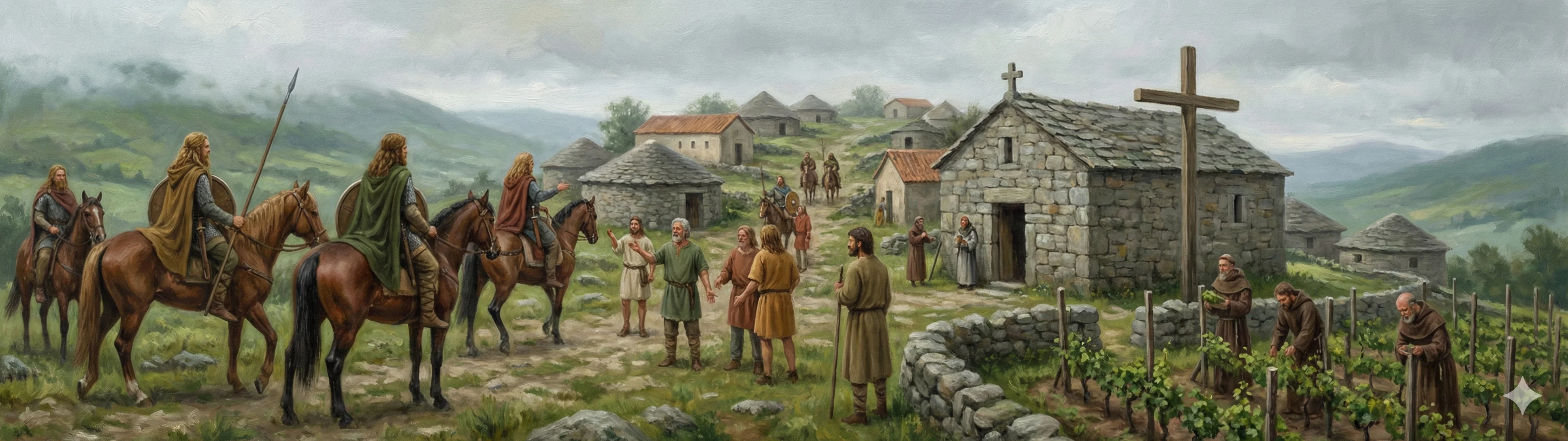
In 409 AD, the Suebi crossed the Pyrenees and established what would become the first independent Christian kingdom in Europe — the Kingdom of the Suebi, with Gallaecia as its heartland. For over 170 years (409-585 AD), this Germanic people ruled from Bracara Augusta and later Portucale, fundamentally shaping the culture of the region.
Under the Suebi, viticulture not only survived but grew in importance. The conversion of King Rechiar to Catholicism (around 448 AD) and the influence of the Church meant monasteries became centres of agricultural knowledge and wine production. The Suebi adopted local farming practices while introducing their own traditions of land management. Their legacy can be traced in place names, local customs, and perhaps most remarkably, in the genetic heritage of the modern population of the Ribeiro.
- The Kingdom of the Suebi was the first Germanic kingdom to convert to Catholicism
- The Parochiale Suevorum (c. 572) is the earliest surviving parish list in Western Europe
- The Visigothic Kingdom absorbed the Suebi in 585 AD under King Liuvigild
- After the Muslim invasion of 711, Galicia was reconquered early, preserving its Christian and viticultural traditions
Monasteries & the Birth of Ribeiro Wine
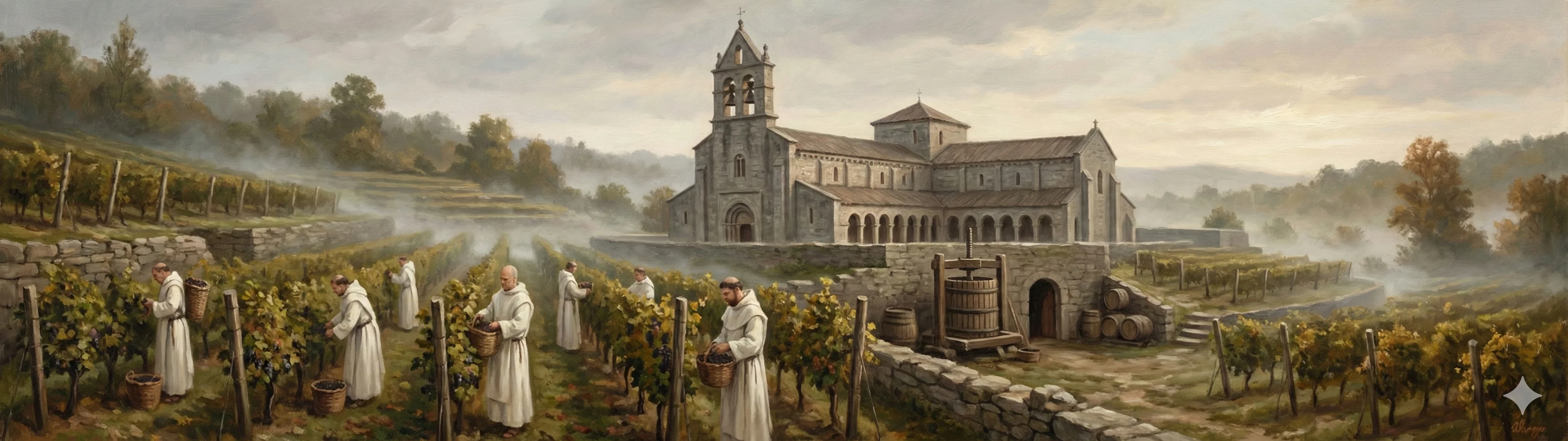
The medieval period saw the Ribeiro emerge as one of Europe's most celebrated wine regions, driven largely by the monastic orders. Cistercian monks at monasteries like San Clodio (founded 1225), Oseira, and Melón perfected viticultural techniques on the steep valley slopes, developing the terraced landscape that defines the Ribeiro today. The Benedictines at Celanova, founded in 936 by Saint Rudesind, also played a crucial role in preserving and advancing winemaking knowledge.
Ribeiro wine first appears in documented records in the 10th century, and by the 12th century it was already exported beyond Galicia. The growth of Ribadavia as the commercial capital of the region — granted its founding charter (fuero) around 1065 under King Garcia II of Galicia, who chose it as the capital of his Kingdom of Galicia — created a thriving market town where wine, trade, and diverse cultures intersected. Garcia II was himself a descendant of Ordoño II and Elvira Menéndez through the Leonese royal line — Elvira being the daughter of Count Hermenegildo Gutiérrez, traditional ancestor of the Casa de Sande. The town's strategic position at the confluence of the Avia and Miño rivers made it a natural hub.
- The monastery of San Clodio became one of the largest wine producers in medieval Galicia
- Monks introduced careful vine selection and cellar management techniques
- Ribadavia's medieval fairs attracted merchants from across Iberia and beyond
- The Camino de Santiago pilgrimage route passed through the Ribeiro, spreading its fame
- King Garcia II of Galicia chose Ribadavia as capital of Galicia (1065–1071) — a descendant of Ordoño II and Elvira Menéndez, whose father Hermenegildo Gutiérrez was ancestor of the Casa de Sande
When Ribeiro Conquered the World
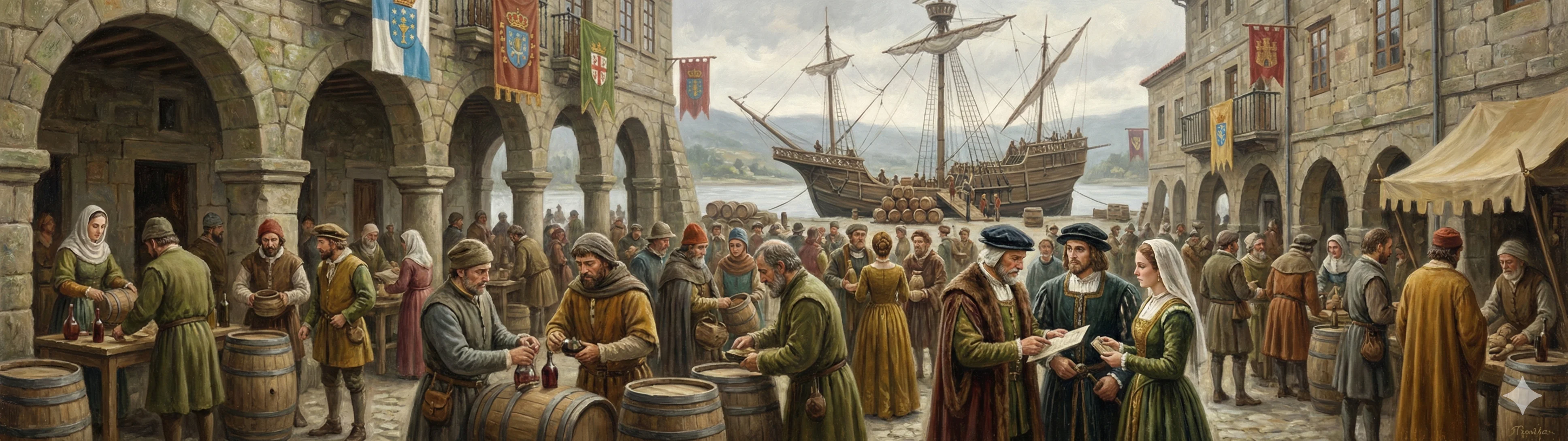
The 14th to 16th centuries represent the absolute zenith of Ribeiro wine. In 1386, John of Gaunt, Duke of Lancaster, arrived in Galicia with an English army to press his claim to the Castilian throne. The chronicler Jean Froissart recorded that the English soldiers discovered the wines of Ribeiro and were so enchanted — and so devastated by the resulting hangovers — that they could barely march. This episode opened the English market to Ribeiro wine, which became known in London as "Ribadavia".
The most remarkable chapter came in 1492: documents preserved in the General Archive of Simancas prove that Ribeiro wine was loaded aboard Christopher Columbus's caravels for the voyage that discovered America — making it the first European wine to cross the Atlantic. Meanwhile, in 1579, the Ordinances of Ribadavia established what may be the world's oldest wine denomination of origin — predating Portugal's Douro by 177 years.
- Ribeiro wine was exported to England, Flanders, Italy, and the Americas
- The Jewish community of Ribadavia — one of the largest in Iberia — controlled much of the wine trade
- The 1579 Ordinances of Ribadavia are recognised by WIPO as possibly the world's oldest denomination of origin
- Prices for Ribeiro wine in medieval England rivalled those of Bordeaux wine
- Columbus's wine cargo is documented in the Simancas archive records
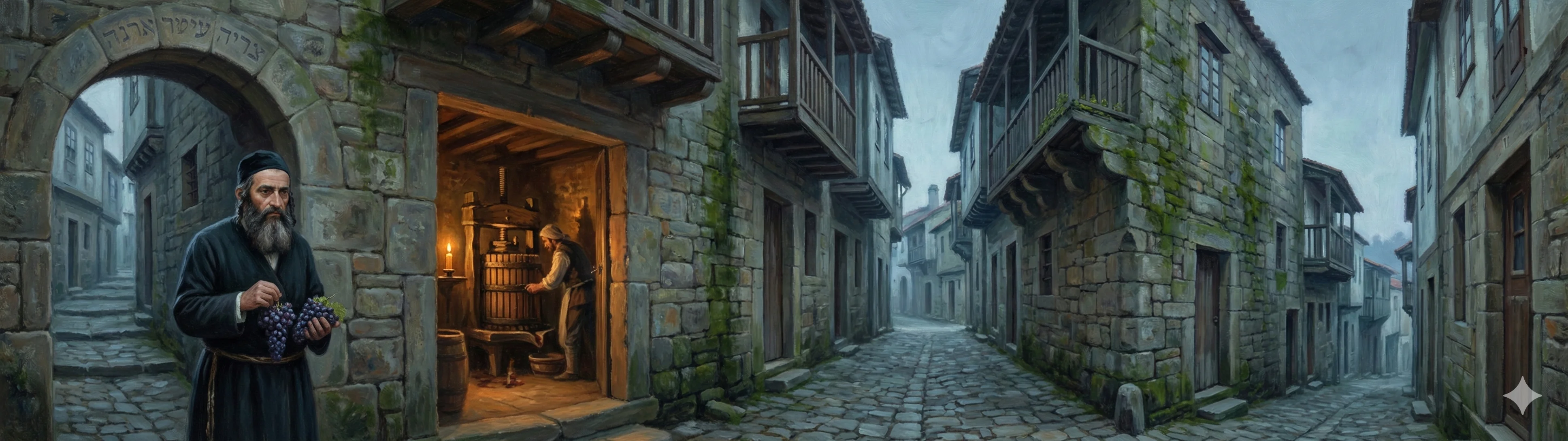
How the Jews Transformed Ribeiro Wine
The Jewish community of Ribadavia didn't just trade wine — they revolutionised how it was made and sold. Jewish viticulturists perfected the cultivation of vines on steep hillsides by cutting terraces (socalcos) into the granite slopes and expanding the irrigation network across the river valleys. Their kosher wine traditions demanded exceptional purity: no additives, natural fermentation from wild yeasts on grape skins, and rigorous cleanliness of all equipment — standards that produced wines of remarkable quality.
Jewish merchants virtually monopolised the Ribeiro wine trade, leveraging Jewish diaspora networks across Europe to export wine to England, Flanders, Italy, and beyond. Wine was transported in pelexos — goatskin containers treated with oil and pine pitch — by mule trains along the Avia river to the ports of Pontevedra and Vigo, then shipped across the Atlantic. Tax collectors like Abraham de León (1438-1444) controlled the alcabalas on wine commerce, giving the community intimate knowledge of every aspect of the trade. The houses of the judería themselves were integrated production facilities: ground-floor bodegas for winemaking with arcaded storefronts opening directly onto the street for retail.
- Jewish families perfected terraced viticulture (socalcos) and expanded irrigation systems across the Ribeiro
- Kosher wine demanded no additives, natural fermentation, and single-variety purity — producing superior wines
- Diaspora trade networks connected Ribadavia to merchants in England, Flanders, Italy, Germany, and Ireland
- Wine traveled by mule train in goatskin pelexos to the ports of Pontevedra and Vigo for export
- The Alhambra Decree of 1492 devastated the Ribeiro — the loss of Jewish merchant networks collapsed international exports
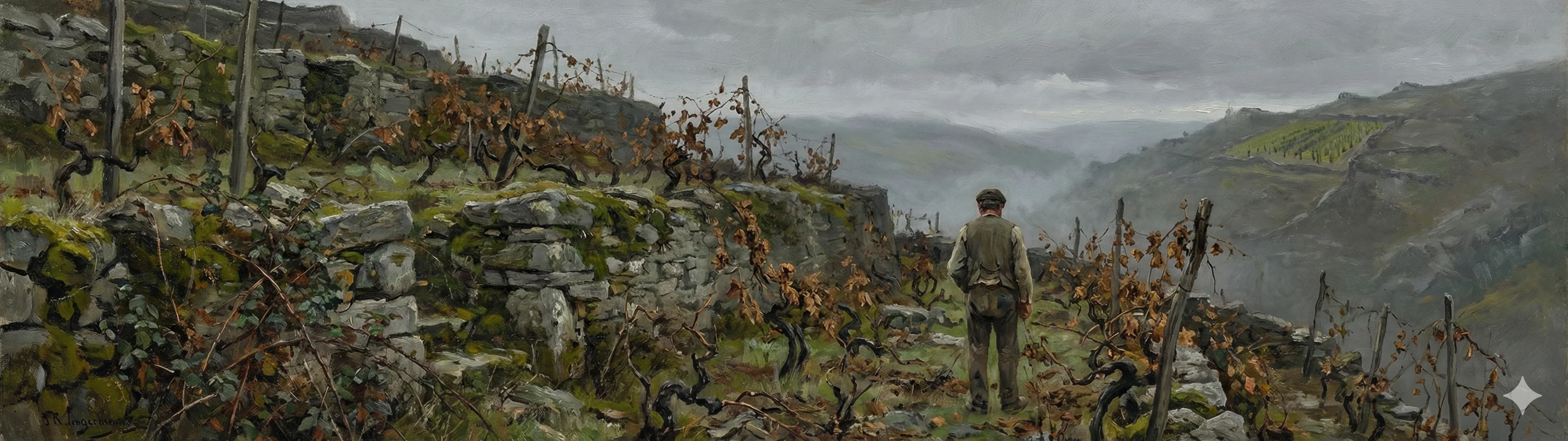
Decline, Phylloxera & Transformation
The 17th and 18th centuries brought gradual decline to the Ribeiro. The expulsion of the Jews, increasing competition from wines of other regions, and the general economic stagnation of Galicia eroded the region's former glory. The loss of the Jewish merchant networks that had driven international exports was particularly damaging. Many vineyards were abandoned as rural poverty drove emigration.
The final blow came in the 1880s when the phylloxera plague — a devastating vine louse from North America — reached the Ribeiro and destroyed virtually all the vineyards. Unlike more prosperous regions that could afford immediate replanting with resistant American rootstock, the Ribeiro's recovery was slow and painful. When vines were finally replanted, many growers chose high-yielding but inferior varieties like Palomino (known locally as Jerez) over the traditional indigenous grapes — a decision that would haunt the region's reputation for decades.
- Phylloxera arrived in the Ribeiro around 1882-1886, devastating the entire region
- The Palomino grape came to dominate, producing thin, characterless wines
- Over 80% of the historic terraces were abandoned and never replanted
- Mass emigration to Latin America depleted the rural population
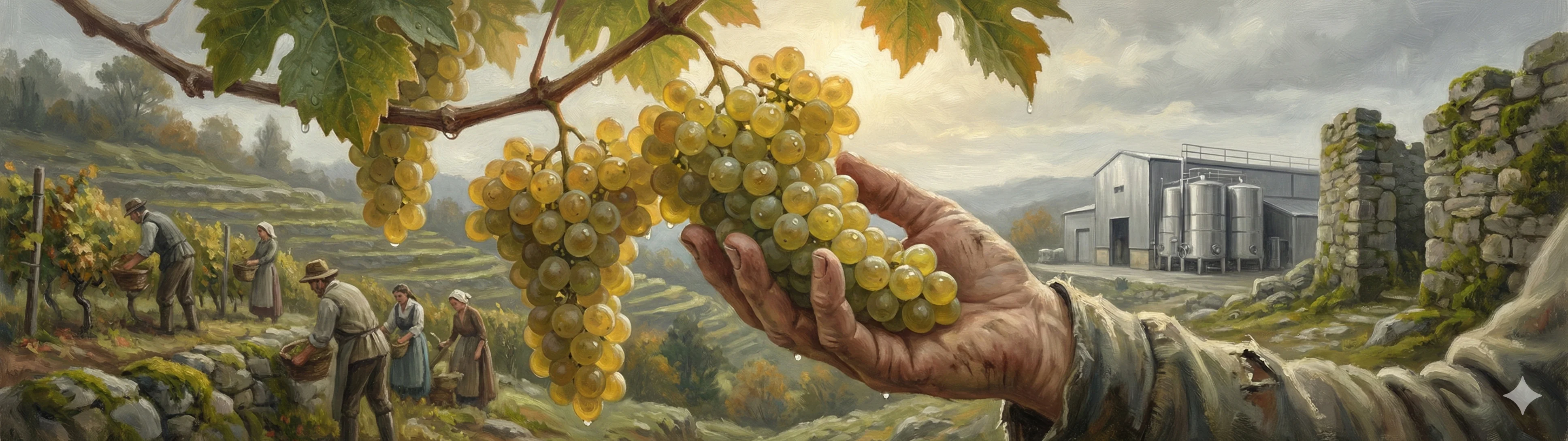
Renaissance of Ribeiro
The modern renaissance of Ribeiro wine began with the official recognition of Ribeiro D.O. status in 1957 — making it one of the oldest protected wine appellations in Spain. However, the true transformation came in the 1980s and 1990s, when pioneer winemakers like Emilio Rojo, Luis Anxo Rodríguez Vázquez, and others began the painstaking work of recovering the indigenous grape varieties that had made Ribeiro famous in the Middle Ages.
Today, Ribeiro D.O. is experiencing a genuine golden age of quality. The white wines — built around the magnificent Treixadura grape, often blended with Torrontés, Godello, Loureira, and Albariño — are aromatic, mineral, and complex, rivalling anything produced in Galicia. Red wines from Caíño, Sousón, Ferrón, and Brancellao offer distinctive expressions of the terroir. A new generation of winemakers is restoring abandoned terraces, practising organic viticulture, and producing some of Spain's most exciting wines.
- Ribeiro D.O. was officially established in 1957, with the Consello Regulador founded in 1956
- Treixadura is considered the "queen" grape of Ribeiro — aromatic, elegant, with notes of stone fruit and flowers
- Annual production is approximately 18-20 million litres from ~2,900 hectares
- Around 5,500 growers and 100+ bodegas produce wine under the D.O.
- The D.O. allows 13 white and 12 red grape varieties, preserving exceptional diversity
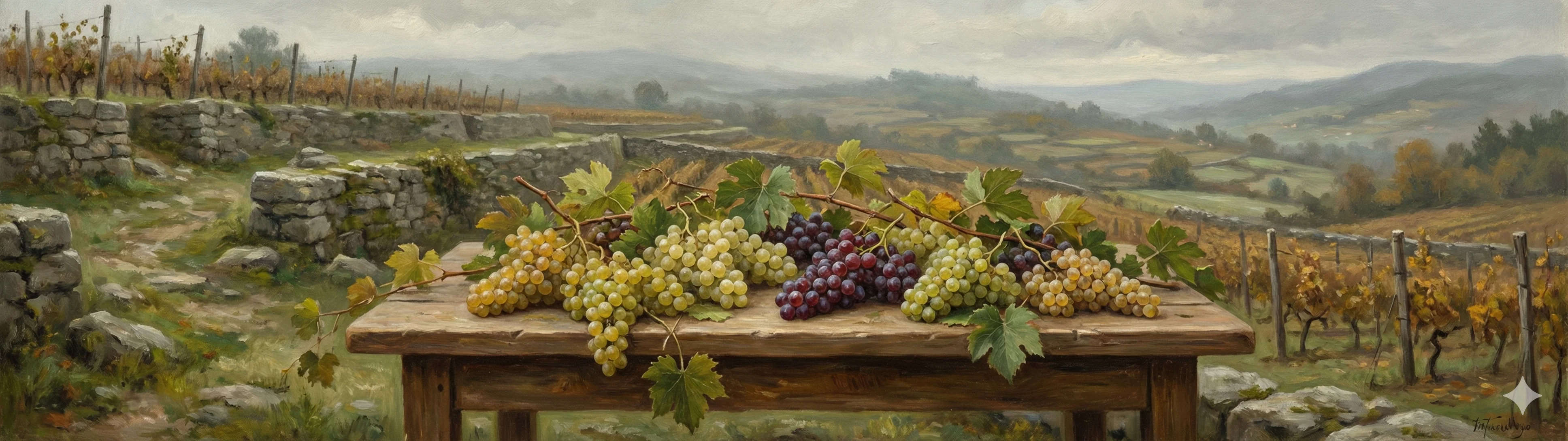
Indigenous Varieties
The Ribeiro's greatest treasure is its extraordinary diversity of indigenous grape varieties — many unique to this small corner of Galicia. The white Treixadura, considered the emblematic grape of the denomination, produces wines of remarkable aromatic complexity: white flowers, ripe stone fruits, and a distinctive mineral backbone. Alongside it, Torrontés (not to be confused with the Argentine variety) brings citrus and herbal notes, while Godello adds structure and body.
The red varieties are equally compelling. Caíño Tinto, Sousón, Ferrón, Brancellao, and Mencía create wines of surprising depth and character. Many of these varieties nearly disappeared during the Palomino era, and their recovery by dedicated growers represents one of the great conservation stories of European viticulture. The D.O. regulations now recognise and protect this diversity, ensuring that the Ribeiro's viticultural heritage continues for future generations.
- White: Treixadura, Torrontés, Godello, Loureiro, Albariño, Lado, Macabeo
- Red: Caíño Tinto, Sousón, Ferrón, Brancellao, Mencía, Tempranillo
- Treixadura accounts for approximately 40% of white grape plantings
- Many varieties are trained on traditional pergola ("emparrado") systems
- Some centenarian pre-phylloxera vines survive on their own roots in isolated plots
The Grapes of Ribeiro
An extraordinary diversity of indigenous varieties — many found nowhere else on earth — preserved across centuries of viticultural tradition.
Key Dates
“O viño do Ribeiro non ten comparación: bébese coa garganta, quéntache o corazón.”— The wine of Ribeiro has no equal: it drinks through the throat and warms the heart.