The Military Orders
Cartelle · Castrelo de Miño · Ourense

The Military Orders
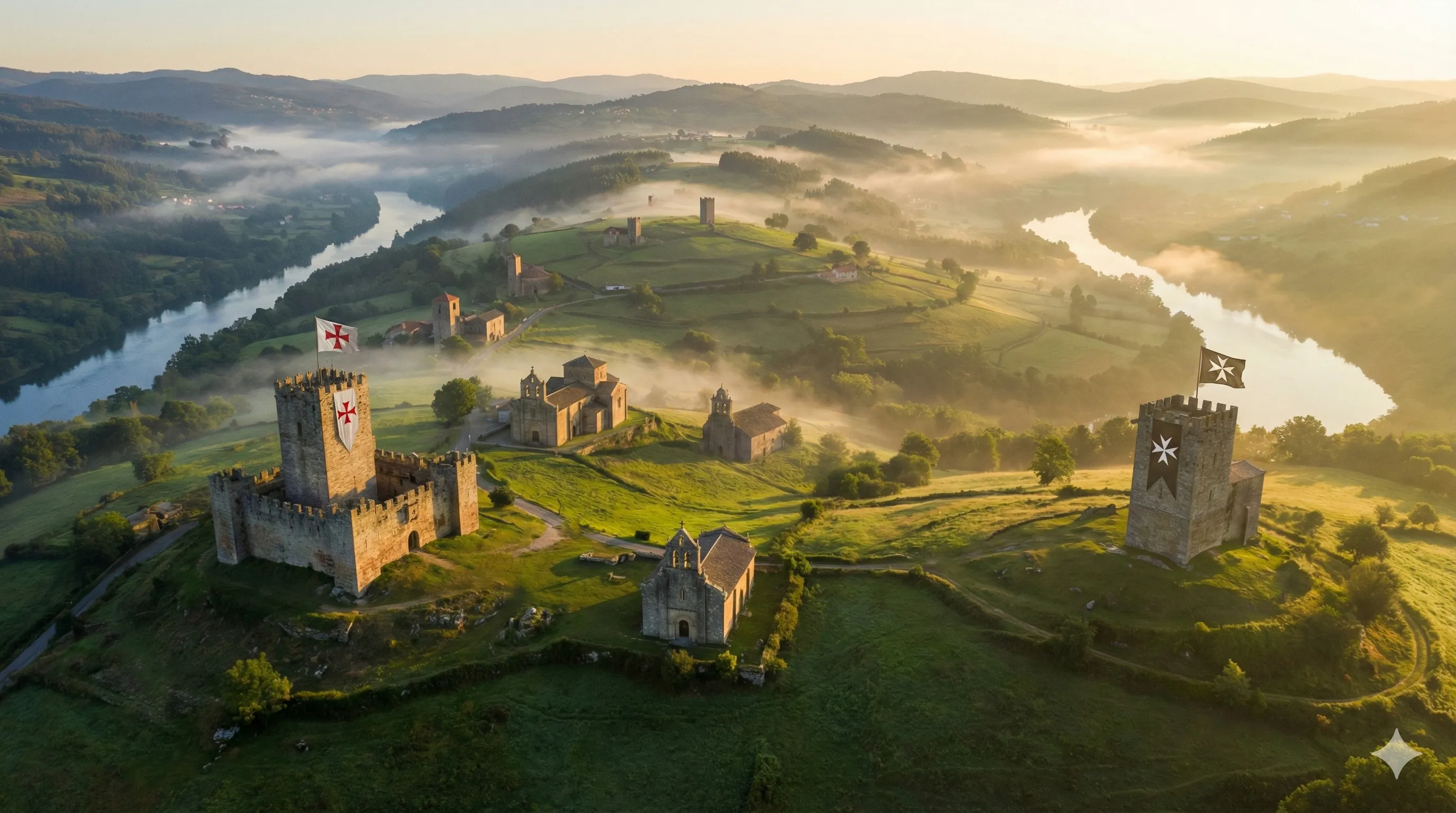
Templars, Hospitallers in the Arnoia and Miño Valleys
“Non nobis, Domine, non nobis, sed nomini tuo da gloriam.”— Psalm 115:1 — Motto of the Knights Templar
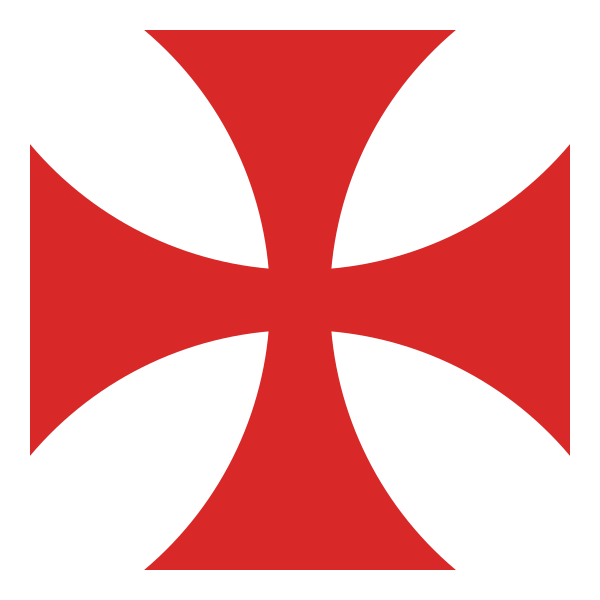
The Crosses
The red cross pattée of the Temple and the eight-pointed white cross of the Hospital — two symbols of faith and warfare that still mark the churches and shields of the Miño Valley.
Soldiers of Christ on the Road to Compostela
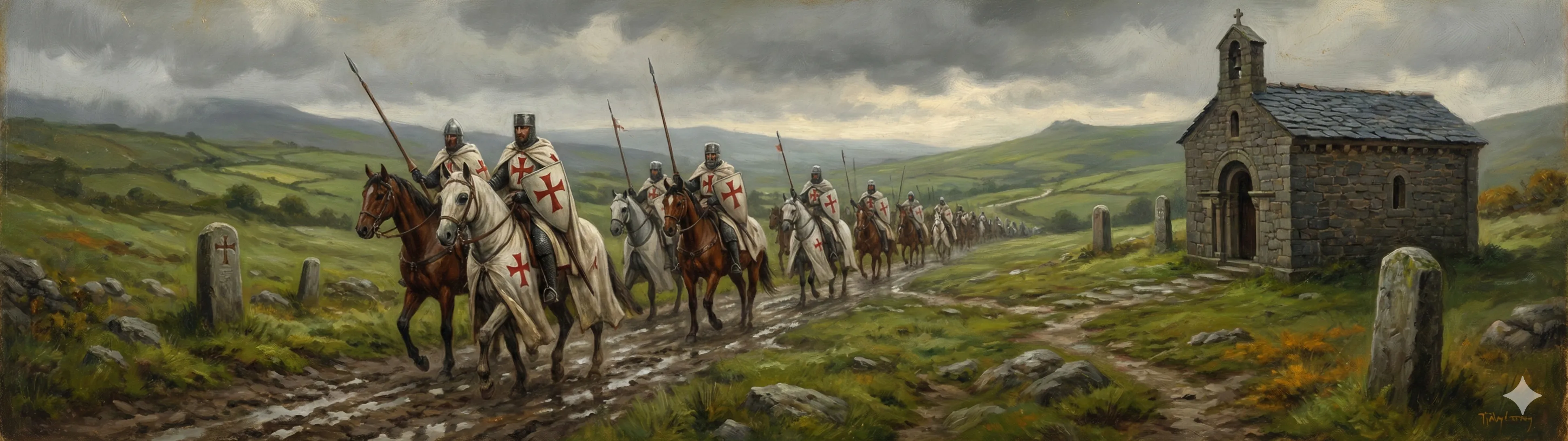
The Knights Templar arrived in Galicia around the middle of the twelfth century, drawn by the strategic importance of the Camino de Santiago pilgrimage routes and the Atlantic trade networks that connected the peninsula's northwestern coast to the wider Christian world. The earliest documented reference to their presence in the region dates to 1142, when a charter from the Benedictine monastery of Celanova mentions figures styled "seniores cavallaria de Iherusalem" — seniors of the cavalry of Jerusalem — confirming that the order had established a foothold in the province of Ourense within two decades of their formal recognition by the Council of Troyes in 1129.
In Galicia, the Templars organized their holdings into a network of bailías (commanderies) — at least six are documented, at Faro, Amoeiro, Coia, Canabal, San Fiz do Ermo, and Neira — encompassing dozens of churches and monasteries. These were not mere religious foundations: each bailía was a self-sustaining economic unit that combined agricultural estates, mills, fisheries, and toll revenues with the spiritual duties of protecting pilgrims and maintaining the road infrastructure. The commanderies formed a network stretching from the coast to the interior, with major houses at Faro, Neda, and Canabal in the north, and Amoeiro in the province of Ourense — the closest major Templar base to the Arnoia and Miño river valleys where Cartelle and Castrelo de Miño sit. The lands typically came through royal donations: Galician kings and nobles granted territories to the military orders in exchange for their service defending the realm and safeguarding the pilgrimage.
- Source: 1142 charter, Archivo Histórico Nacional, Monastery of Celanova — the earliest documentary evidence for the Temple in Galicia
- Documented commanderies: Faro, Amoeiro, Coia, Canabal, San Fiz do Ermo, Neira (source: Recreación Historia)
- Each bailía combined agricultural estates, mills, fisheries, and toll revenues — a self-sustaining economic unit, not a purely religious foundation
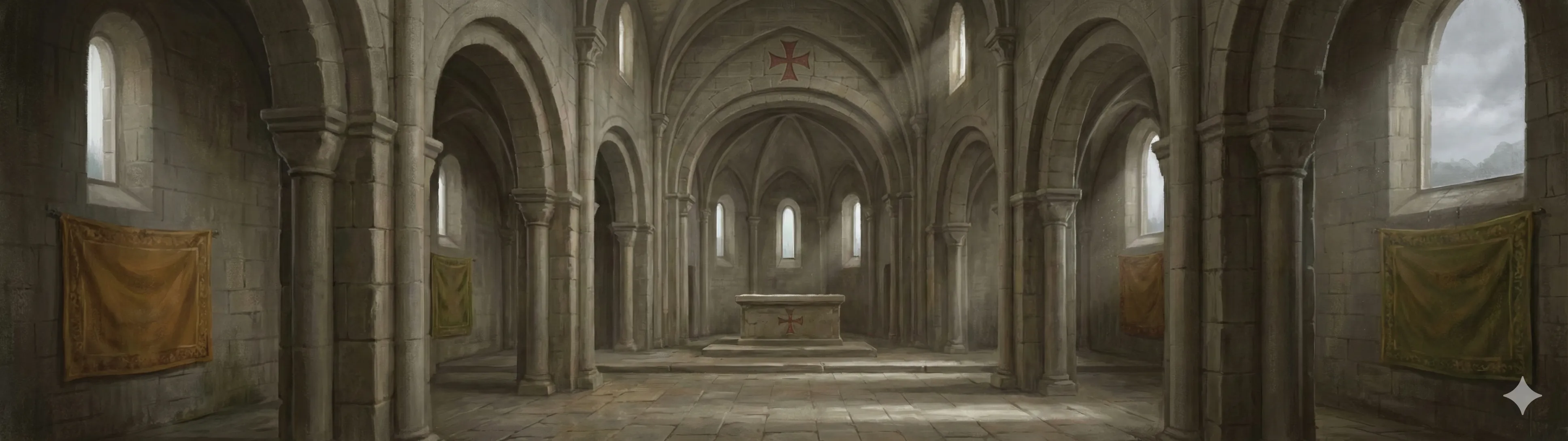
Santa María de Cartelle: A Temple in the Arnoia Valley
The church of Santa María de Cartelle stands as the most tangible surviving link to the Templar presence in the Arnoia valley. Built on a basilical plan with three naves — a layout characteristic of Templar churches across Europe, designed for both liturgical ceremony and the accommodation of the armed brotherhood — the church belonged to the Knights Templar throughout their period of operation in Galicia. Administratively, Santa María de Cartelle fell under the jurisdiction of the commandery of Quiroga in the province of Lugo, one of the important Templar bailías in the region, demonstrating the order's capacity to manage properties across considerable distances from their command centres.
The Templar connection situates the church within a broader strategic landscape. Cartelle sits at the confluence of the Arnoia and Miño rivers, a position that controlled access to the fertile valleys of the Ribeiro wine region and the trade routes connecting the interior of Ourense to the coast. The Templars' choice of this location was no accident: it placed them at a key crossing point where agricultural wealth, pilgrimage traffic, and commercial exchange converged. The church's current appearance is largely Baroque, the result of eighteenth-century renovations, but beneath the ornamental plasterwork the original Templar ground plan endures — three naves oriented east-west, the proportions of a fortress church built to last.
- Administered under the Templar commandery of Quiroga (Lugo) — properties could be managed across considerable distances from command centres

Castrelo de Miño: Fortress of the Knights of St. John
While the Templars held Cartelle, the neighbouring municipality of Castrelo de Miño belonged to a different military order from the very beginning. On 6 December 1172, King Fernando II of León formally donated the church of Santa María de Castrelo and its surrounding lands to the Knights Hospitaller — the Order of St. John of Jerusalem, later known as the Knights of Malta. This donation was part of Fernando II's broader strategy of distributing Galician territories to the military orders: in 1158 he had already ceded Santa Mariña to the Order of St. John at Portomarín, and in 1170 he founded the Order of Santiago at Cáceres. The 1172 grant placed Castrelo squarely within the Hospitaller network alongside Portomarín, which became the most important House of the Order in all of Galicia.
The logic of the donation was geographic. The Hospitaller monk-knights had a consistent tendency to seek key positions on rivers in order to protect and control human traffic — pilgrims, merchants, and military columns alike. Castrelo de Miño, sitting right on the Miño river crossing, was a textbook Hospitaller strategic position, just as Portomarín controlled the Miño further north. The castle that gave the municipality its name had already demonstrated its military value: in the early twelfth century it served as a barrier against Archbishop Diego Gelmírez of Santiago de Compostela in his attempts to cross the river, and during one dramatic episode it was the site where King Alfonso VII himself was captured along with the bishop and the Countess of Traba. The Hospitaller encomienda at Castrelo eventually held full ecclesiastical and civil lordship over the territory, a jurisdictional authority that endured for centuries.
- Source: 1172 donation charter of Fernando II of León — Castrelo was Hospitaller from the start, never a Templar transfer
- Related grants: Santa Mariña to St. John at Portomarín (1158); Order of Santiago founded at Cáceres (1170)
- Castle episode source: Historia Compostelana — capture of Alfonso VII, the bishop, and the Countess of Traba

Ibn Ferruziel: The Little Cid and the Origins of the Benveniste
The late medieval *Crónica del famoso cavallero Cid Ruydiez Campeador* — a 1512 compilation by Juan de Velorado drawing on earlier sources — records a Jewish commander among the Campeador's retinue at Nájera, identified as commanding fifty knights under the banner of Rodrigo Díaz de Vivar. Genealogical tradition has identified this figure, listed as "Felez Ferruz," with Mar Solomon Shealtiel, father of Joseph ibn Ferruziel, though this identification rests on later reconstruction rather than contemporary documentation. Joseph ibn Ferruziel himself is far better attested. As personal physician and principal counselor to Alfonso VI of Castile — the king who conquered Toledo in 1085 — Ferruziel wielded extraordinary influence over the Jewish communities of the kingdom and bore the title *ha-Nasi* (prince). Contemporaries called him *Cidellus*, "the Little Cid," a diminutive of the same Arabic honorific *sīdī* (lord) that gave the great Campeador his own title. It was no idle comparison: Ferruziel moved through the highest circles of Reconquista power with an authority that Pope Gregory VII found alarming enough to write to Alfonso in 1081, warning against permitting Jews to exercise authority over Christians. In June 1110, roughly a year after Alfonso VI's death, the signature *"Citiello iudeo"* appeared alongside the kingdom's highest dignitaries on a charter of immunities granted by Queen Urraca — a document notable as a rare instance in Christian Iberia of a Jewish figure standing among the royal signatories.
The poet Yehuda Halevi — the greatest voice of the Sephardic golden age — found refuge under Ferruziel's protection in Toledo and dedicated to him a *muwashshaḥa* whose closing *jarcha* in Mozarabic Romance is among the most celebrated early examples of verse in a peninsular vernacular: *"Respond(e) meu Cidiello / venid con buena albixara / como rayo de sol exid / en Wad-al-ḥajara"* — "Answer, my Little Cid! Come with good tidings, like a ray of sun shine forth in Guadalajara." Ferruziel's kinsman Solomon — also a Nasi — was killed in 1108 while reportedly returning from a diplomatic mission to Aragon. Halevi set aside the victory ode he had been composing and wrote instead an elegy ending with a curse against the "Daughter of Edom" — rabbinic code for Christendom — suggesting it was Christian hands, not Muslim, that bore responsibility for the murder. According to genealogical tradition preserved in later sources, the Ferruziel line continued through Joseph's son Meshulam to a figure documented as Joseph Benveniste (d. c. 1205), establishing the direct lineage of the Benveniste family. This connection, while widely repeated in genealogical compilations, has not been confirmed by modern academic scholarship and should be treated with appropriate caution. What is better established is the broader pattern linking both dynasties: both the Ferruziel and Benveniste families held the *ha-Nasi* title, both claimed descent from the House of David through the Exilarchs, and both had deep roots in Narbonne — a city whose Jewish *nesi'im* traced an ancient lineage of communal leadership. The arc from Cidellus to the *homines templi* of Aragon traces what tradition presents as a single dynasty's passage from the battlefield to the counting house — from riding under El Cid's banner to administering the treasuries of the Temple.
- The *Crónica del famoso cavallero Cid Ruydiez Campeador* (1512) records a Jewish commander of fifty knights at Nájera; the identification with Solomon Shealtiel, father of Ferruziel, is traditional rather than established in the chronicle itself
- Ferruziel's signature *"Citiello iudeo"* appears on a 1110 charter of Queen Urraca — a rare instance of a Jewish signatory among Castilian royal dignitaries
- Yehuda Halevi's *muwashshaḥa* to Ferruziel contains one of the most notable early examples of Mozarabic Romance literary verse, though it is not the earliest known *jarcha*
- Gregory VII's letter to Alfonso VI (1081) is documented in the papal registers
- Genealogical tradition traces Benveniste descent through Ferruziel's son Meshulam to Joseph Benveniste (d. c. 1205); this lineage is attested in genealogical compilations but awaits academic verification
- Both the Ferruziel and Benveniste families held the *ha-Nasi* title and claimed Davidic descent through the Exilarchs of Narbonne

The Benveniste: Jewish Financiers of the Military Orders
The military orders could not function without sophisticated financial administration, and across medieval Iberia it was Jewish families who most often filled this critical role. The Benveniste were among the most prominent Sephardic lineages involved. In the Crown of Aragon, the connection runs deep: documents refer to members of the family as *homines templi* — men of the Temple — a formulation that went beyond honorific title to describe a structural relationship. From their base in Zaragoza, the Benveniste-Cavallería managed tax farming operations and administered the complex financial flows that sustained Templar commanderies across the kingdom. But the family's reach extended beyond the Temple: Judah Benveniste (d. 1411) farmed the church revenues of the archdiocese of Saragossa *and* of the Order of St. John — meaning the family served as financial infrastructure for both great military orders simultaneously. By 1372, Vidal de la Cavallería had moved beyond tax farming altogether: he and Perpinyán Blan received the right to mint the gold coin of Aragon, sovereign-level financial agency.
In Galicia, Abraham Benveniste appears in royal tax records in A Coruña as late as 1435, demonstrating the family's enduring presence well into the fifteenth century. The Ourense-Ribadavia corridor — home to the largest Jewish communities in medieval Galicia — sat directly adjacent to the Templar and Hospitaller territories at Cartelle and Castrelo de Miño. Jewish arrendadores (tax farmers) are documented throughout the region, managing ecclesiastical and seigneurial revenues. The convergence of converso history and military order history in this narrow stretch of the Miño valley is no coincidence: where the orders needed financial expertise, Jewish families provided it.
- Documents refer to the Benveniste-Cavallería as *homines templi* — men of the Temple (source: *Encyclopaedia Judaica*, "Cavalleria, De la")
- Judah Benveniste (d. 1411) farmed revenues for both the archdiocese of Saragossa and the Order of St. John
- 1372: Vidal de la Cavallería receives the right to mint the gold coin of Aragon — sovereign-level financial agency
- Abraham Benveniste documented in royal tax records in A Coruña, 1435
- The Ourense-Ribadavia Jewish community sat adjacent to the Templar (Cartelle) and Hospitaller (Castrelo) territories
When the Templars Fell: The Dissolution and Its Aftermath
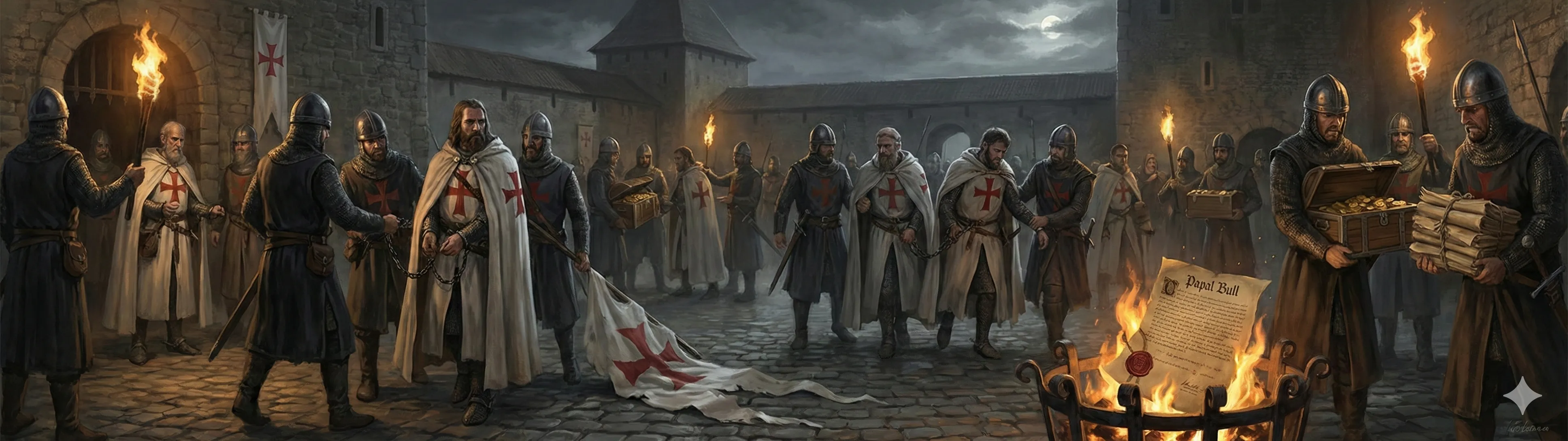
Philip IV of France — "Philip the Fair" — had already rehearsed the playbook before he turned it on the Templars. In July 1306 he expelled every Jew from his kingdom in a single stroke: property seized, goods auctioned, outstanding debts redirected into royal coffers. Fifteen months later, on Friday 13 October 1307, he ran the same operation against the Knights Templar, ordering the simultaneous arrest of every member of the order in France.
It took five years for the papacy to catch up. On 22 March 1312, Clement V formally dissolved the order at the Council of Vienne with the bull Vox in excelso, and a companion decree, Ad providam, directed that all former Templar properties should pass to the Knights Hospitaller — the Order of St. John, the Templars' old rivals and their chief rival among the military orders. In Portugal and Aragon the transfer largely took effect, enriching the Hospitallers overnight. But in Castile-León, the Crown had other ideas. Fernando IV simply began helping himself to the choicest Templar holdings, diverting to the throne what the Pope had intended for the Hospital.
Galicia was no exception. What followed was not a single act of confiscation but decades of piecemeal redistribution. Alfonso XI initially honoured the papal directive, granting certain former Templar properties to the Order of San Juan — but in 1340 he handed the greatest prize to Pedro Fernández de Castro, known as *o da Guerra*, Lord of Lemos and Sarria and the king's own chief steward: the town and castle of Ponferrada — the iconic Templar fortress on the Camino de Santiago. (Pedro was also the father of Inês de Castro, the tragic queen whose story became one of the great legends of Iberian history.) The decisive break came with the Trastámara revolution: after Enrique II seized the throne in 1369, he granted the Tenca do Temple — a significant bloc of former Templar land — to the Cathedral of Santiago de Compostela. But even that grant did not settle matters: Pedro Enríquez de Trastámara, Count of Lemos, subsequently seized the cathedral's new holdings through his agent Gonzalo López de Goyanes, keeping the revenues for himself. By the time the dust settled, the Hospitallers had received only a fraction of what Ad providam had promised them; the rest had been carved up between the Crown, the nobility, and the Church — and was still being fought over decades later. Meanwhile, the Hospitaller encomienda at Castrelo de Miño, having never been Templar property in the first place, continued undisturbed — a quiet survivor amid the upheaval.
- July 1306: Philip IV expels all Jews from France, seizing their property and debts to fill the royal treasury
- Friday 13 October 1307: Philip IV applies the same method to the Templars, arresting every member of the order in France
- Fernando IV of Castile seized former Templar properties rather than transferring them to the Hospitallers as the papal bull directed
- 1340: Alfonso XI grants Ponferrada Castle to Pedro Fernández de Castro — *o da Guerra*, Lord of Lemos and father of Inês de Castro
- 1371: Enrique II grants the Tenca do Temple to Santiago Cathedral — later seized by the Count of Lemos (source: *Estudios Gallegos*, CSIC)
- The Hospitaller encomienda at Castrelo de Miño continued undisturbed throughout the Templar dissolution
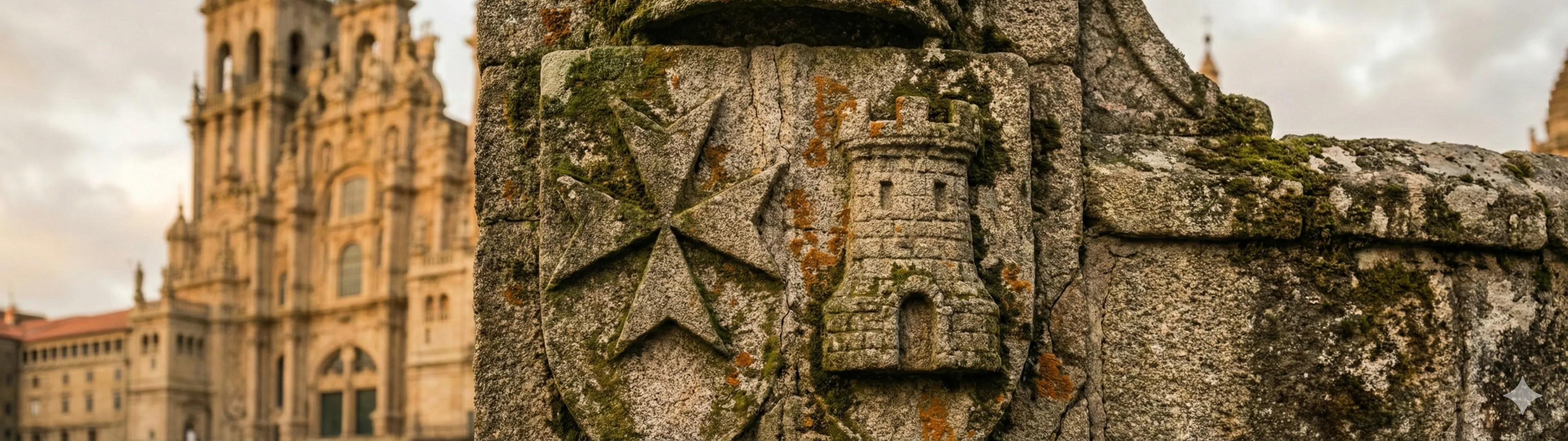
Crosses in Stone: The Enduring Mark of the Military Orders
The coat of arms of Castrelo de Miño bears the eight-pointed Maltese cross — not as a decorative flourish but as a direct emblem of the Hospitaller encomienda that governed the territory for centuries. At Santa María de Cartelle, the Templar ground plan of three naves endures beneath the Baroque exterior, a palimpsest of sacred architecture that records the transition from warrior-monk to parish church. Together with the commandery of San Juan de Portomarín further north on the Miño, these are not relics of a vanished past but the living infrastructure of communities that have worshipped, traded, and governed themselves in these buildings for eight hundred years.
- The Maltese cross on Castrelo de Miño's coat of arms directly commemorates the Hospitaller encomienda
- Santa María de Cartelle preserves the original Templar three-nave ground plan beneath its Baroque exterior
- San Juan de Portomarín — the most celebrated Hospitaller monument in Galicia — completes the triangle of military order sites along the Miño
Key Figures
Kings, warrior-monks, and financiers who shaped the military orders in Galicia
The great patron of the military orders in Galicia. Donated Portomarín to the Hospitallers (1158), founded the Order of Santiago (1170), and granted Castrelo de Miño to the Knights of St. John (1172).
French knight who founded the Knights Templar in Jerusalem c. 1120 to protect Christian pilgrims in the Holy Land. The order he created would reshape the landscape of rural Galicia.
Powerful churchman who transformed Santiago de Compostela into an archdiocese. His conflicts with Galician lords are recorded in the Historia Compostelana.
Dissolved the Knights Templar at the Council of Vienne on 22 March 1312 through the bull Vox in excelso, triggering the redistribution of Templar properties across Iberia.
Traditionally identified as the son of a Jewish commander listed in the 1512 *Crónica* among El Cid's retinue. Personal physician and principal counselor to Alfonso VI. His nickname "Cidellus" — Little Cid — marked his extraordinary influence. The signature "Citiello iudeo" appears on the 1110 charter of Queen Urraca — a rare instance of a Jewish figure among royal signatories. Genealogical tradition identifies him as the ancestor of the Benveniste family, though this awaits academic verification.
Jewish financiers documented as *homines templi* in Aragon. Judah Benveniste (d. 1411) farmed revenues for both the archdiocese of Saragossa and the Order of St. John. Vidal de la Cavallería held minting rights for the gold coin of Aragon (1372).
Alfonso XI's chief steward, governor of Andalusia, Galicia, and Murcia. Received Ponferrada Castle — the iconic Templar fortress on the Camino — in 1340. Father of Inês de Castro, the tragic queen of Portugal.
Founded the Trastámara dynasty. Granted the Tenca do Temple to Santiago Cathedral in 1371 — properties later seized by the Count of Lemos.
Documented in royal tax records in A Coruña in 1435, representing the enduring presence of the Benveniste family in Galician financial administration.