Skip to content

Álvarez Family Emblem

Artistic emblem · Not historical arms

An Artistic Tribute

Five symbols. One remembered landscape.

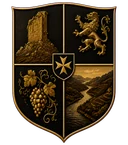
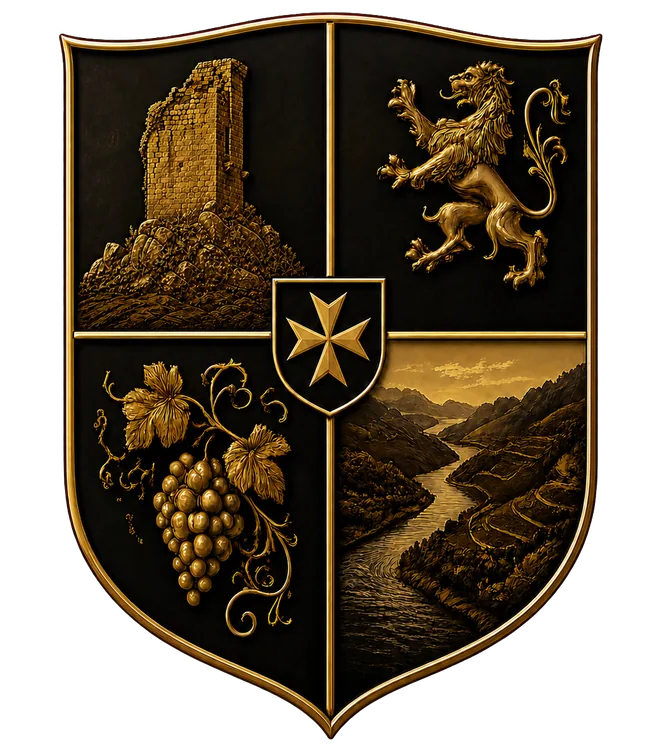
This contemporary emblem brings together five symbols inspired by the family archive’s landscape: a tower, a lion, a vine, a river valley and a cross. Read each detail to discover the place or idea behind it.

Artistic emblem · Not historical armsInterpretive illustration
A note on provenance

Artistic emblem · Not historical arms

A note on provenance

This contemporary emblem was created for the family archive. It is not a registered or historically documented Álvarez coat of arms. Its quarters and symbols form a visual narrative of places and themes in O Ribeiro; they do not establish noble status, marriage alliances, or descent from the armigerous houses discussed elsewhere on this site.

Detail 01

The Torre de Sande

Granite above the Arnoia

Burnished-gold interpretation of the ruined rectangular Torre de Sande granite keep
Interpretive illustration

The tower is the Torre de Sande: a late-Gothic rectangular granite keep rising from a solitary outcrop at San Salvador de Sande in Cartelle, between the Arnoia and Miño valleys. Around thirteen metres high, it has endured destruction, rebuilding, and present-day decay. Here it represents rootedness, endurance, and the duty to preserve a vulnerable landmark.

In this artworkA landmark to preserve—not a lineage claim
Explore the Torre de Sande

Detail 02

The Lion

Resolve in motion

Burnished-gold rampant lion from the contemporary Álvarez emblem
Interpretive illustration

The rampant lion stands upright, one forepaw raised. Its pose gives the composition movement and expresses vigilance, courage and resolve. Here the figure is a modern artistic symbol, chosen for the energy it brings to the shield.

In this artworkCourage and resolve
Compare documented Ribeiro heraldry

Detail 03

The Grapevine

The living vine

Burnished-gold grape cluster, leaves, and curling vine
Interpretive illustration

The vine roots the emblem in O Ribeiro. Across the connected Miño, Avia, and Arnoia valleys, hand-built socalcos carry vineyards down granite slopes, while growers and monastic communities transmitted viticultural knowledge across centuries. The cluster stands for cultivation: patient work, harvest, renewal, and knowledge handed forward.

In this artworkA living landscape, tended over time
Discover Ribeiro’s wine landscape

Detail 04

The River Valley

Where the Avia meets the Miño

Gold-and-black river valley inspired by the Avia–Miño confluence at Ribadavia
Interpretive illustration

The river quarter points first to Ribadavia, where the Avia flows into the Miño. Beyond that confluence lie the connected Miño, Avia, and Arnoia valleys that bind Ribadavia, Castrelo de Miño, and Cartelle into the wider Ribeiro landscape. The water represents homeland, movement, and connection—not rank.

In this artworkThe confluence as common ground
Visit “Where the Avia Meets the Miño”

Detail 05

The Maltese Cross of Castrelo

The Hospitaller memory

Burnished-gold eight-pointed Maltese cross based on the arms of Castrelo de Miño
Interpretive illustration

The eight-pointed cross recalls the Order of St John and the cross in Castrelo de Miño’s municipal arms. A donation of Santa María de Castrelo to the Hospitallers in 1172 forms part of the local history explored on the military-orders page. The artwork uses this connection to remember a place central to the family archive.

In this artworkCastrelo and its Hospitaller history
Read Castrelo’s Hospitaller history

Light and depth

Gold & Black

Gold brings light to the relief; black gives the symbols depth. This limited palette connects the five scenes and makes their different textures — stone, leaves, water and metal — part of one composition.

Memory in light#C79A38
Depth and continuity#0B0906

Artistic emblem · Not historical arms

Five memories in one shield

The divided shield brings the five scenes into one frame. Stone and water recall familiar places; the vine evokes work across generations; the lion gives the composition movement. Together they form a modern tribute to a shared landscape.