Cartelle
Family roots
Cartelle
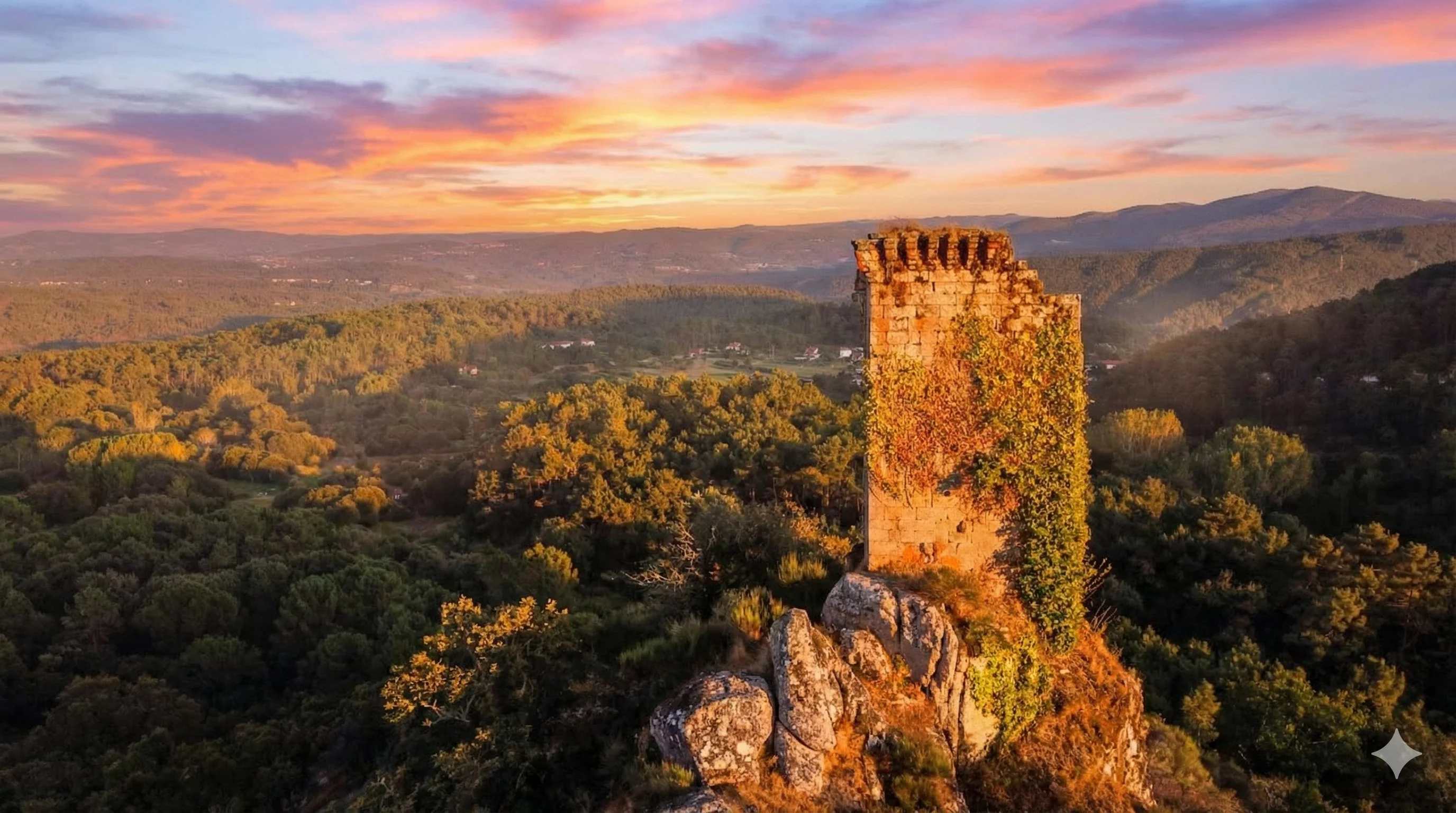
A land of medieval fortresses, Roman bridges, and Baroque churches in the Terra de Celanova — where the Tower of Sande has watched over the valleys of the Mino and Arnoia for nearly nine centuries.
“Alfonso IX confirms to the Monastery of San Salvador de Celanova the donation of the Castle of Sande made by his grandfather Alfonso VII in Zamora on the 5th of May 1141.”— Royal Charter, National Historical Archive of Spain (SIGIL-SELLO, C.7, N.1)
Between the Mino and the Arnoia
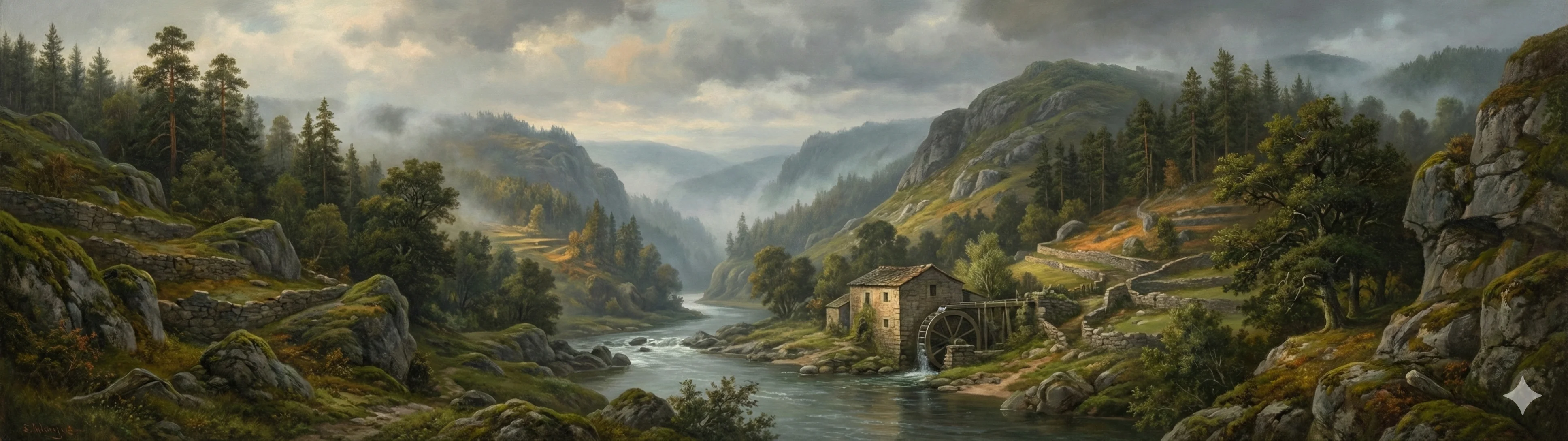
Cartelle lies in the southwestern reaches of the Ourense Depression, a municipality of 94 square kilometres where the valleys of the Minho and Arnoia rivers define the landscape. The territory belongs to the comarca of Terra de Celanova, a land of granite outcrops, dense conifer forests, and terraced hillsides that still bear the marks of centuries of viticulture and subsistence farming.
The Arnoia river — the longest river entirely within the Province of Ourense at 84.5 kilometres — carves a deep, enclosed valley through the municipality’s southern sector, creating the dramatic "Cartelle canyon" of significant scenic value. Along its banks, abandoned terraces testify to past wine and corn cultivation, while ancient flour mills stand as silent witnesses to a vanished way of life.
- The municipality comprises 12 parishes (parroquias) containing 98 population entities
- Elevation ranges from the river valleys to 718 metres at Coto de Novelle, offering panoramic views across the Ribeiro wine region
- The Rio Gato flows through the territory, its canyon featuring abandoned terraces and a waterfall at the end of a 6.7km hiking route
- Geology is dominated by schist and granite formations, creating heavily eroded landscapes with numerous watercourses
The Bridge and the Road
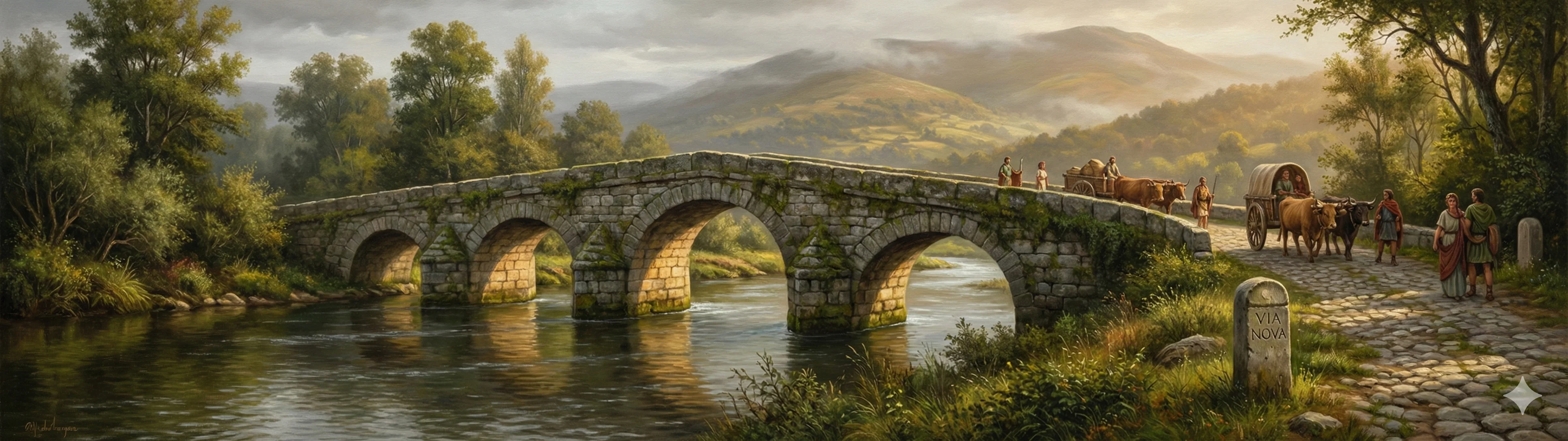
Long before the medieval fortress or the Baroque churches, Roman engineers left their mark on Cartelle. The Ponte do Freixo — a magnificent four-arched bridge spanning the Arnoia river between Cartelle and Celanova — is one of the few genuinely Roman bridges surviving in Galicia. Built with cushioned ashlar blocks, semicircular arches, and a horizontal slope, it carried travellers along a secondary route of the Via Nova (Via XVIII of the Antonine Itinerary), connecting Aquis Querquennis to Lucus Augusti.
Further evidence of Roman presence lies embedded in the very walls of the Church of Santa María de Couxil, where a Roman altar (ara romana) with inscriptions was incorporated into the building’s exterior — a remarkable survival of pre-Christian worship repurposed by later generations. These traces suggest that the territory of Cartelle was not merely passed through but actively settled during the centuries of Roman Gallaecia.
- The Ponte do Freixo measures 57 metres long with arches spanning 7.70 and 4.70 metres
- The bridge was declared a Historic-Artistic Monument in 1984 and included in the Inventory of Historic Bridges of Galicia in 1985
- After falling into total ruin in the 20th century, the bridge was restored in 1989
- The Via Nova connected Aquis Querquennis (near Bande) to Lucus Augusti (modern Lugo), passing through Cartelle’s territory
Under the Shadow of Celanova
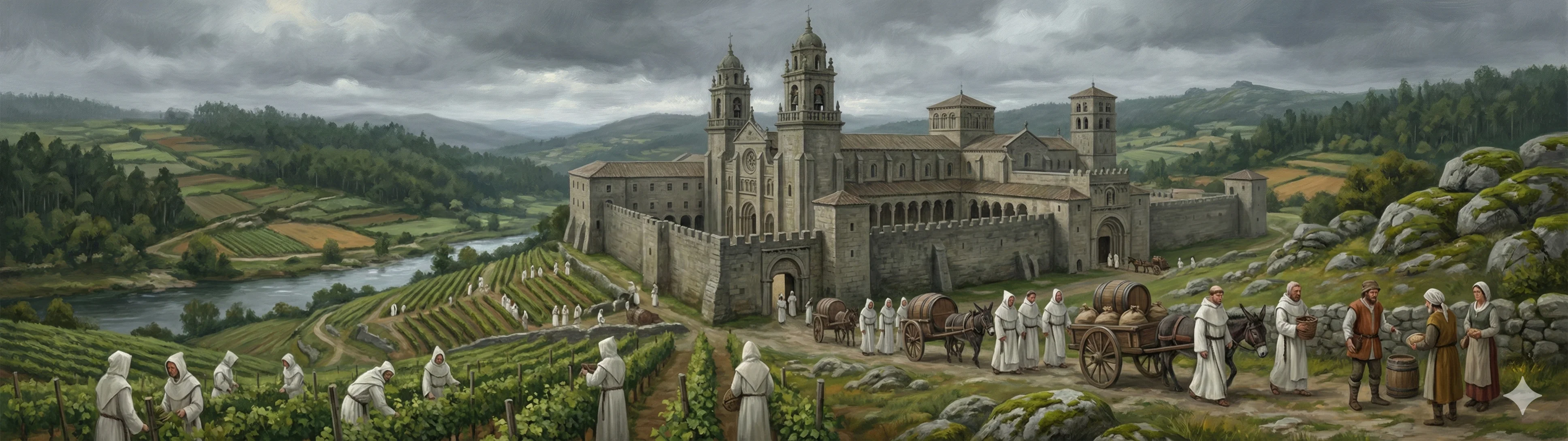
The history of Cartelle is inseparable from the Monastery of San Salvador de Celanova, one of the most powerful Benedictine abbeys in all of Galicia. Founded in 936 AD by San Rosendo (Saint Rudesind) — nobleman, Bishop of Dumio and Iria-Santiago, and Viceroy of Galicia — the monastery accumulated vast domains between the rivers Mino, Arnoia, and Limia, exercising jurisdiction over the entire Terra de Celanova.
Through generous royal donations, the monastery established dependent priories across the region, collecting rents and taxes, managing farms, 42 parochial granaries, grain stores, wine presses, and cellars. Near the Mino river, the monks actively promoted viticulture, contributing to what would later become the Ribeiro wine tradition. The monastery’s abbot accumulated prestigious titles: Count of Bande, Marquis of the Tower of Sande, and Chaplain of the Royal House — directly linking Cartelle’s most famous landmark to the highest ecclesiastical authority in the region.
- San Rosendo (907–977) founded Celanova after serving as Bishop and Viceroy of Galicia
- The Terra de Celanova encompassed present-day Celanova, Cartelle, Verea, Gomesende, Ramiras, Arnoia, and many more municipalities
- The monastery held jurisdiction from the Mino river to the Portuguese border
- Monks promoted viticulture near the river valleys, establishing the wine culture that persists today
The Tower of Sande
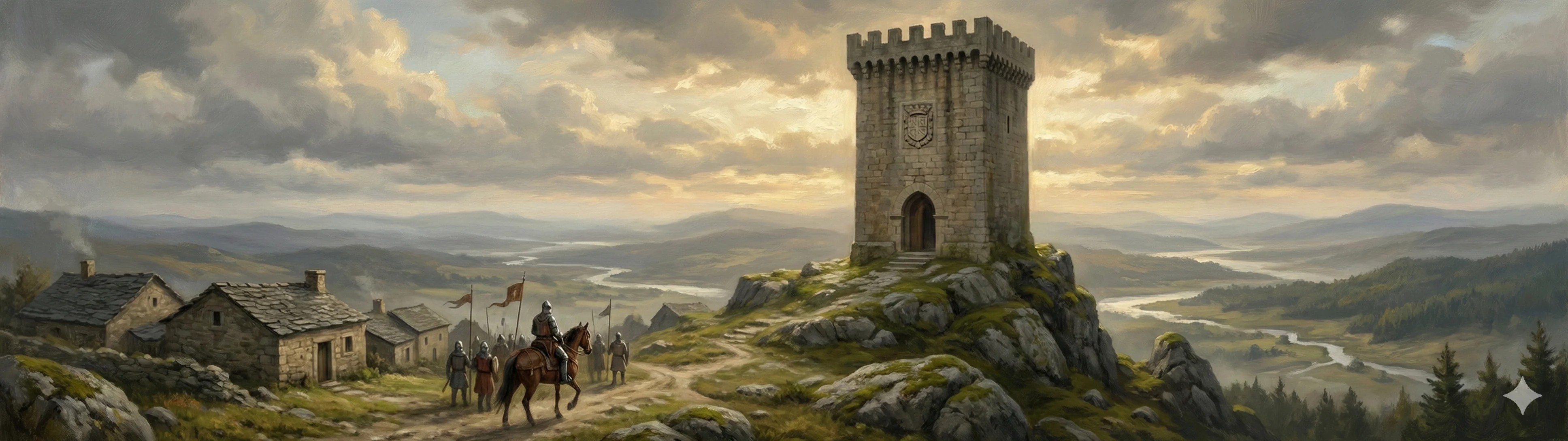
Rising 13 metres from a granite outcrop at 506 metres elevation, the Torre de Sande commands the landscape between the Arnoia and Mino river valleys. Its silhouette is visible from many kilometres around — a deliberate statement of power over the surrounding territory. This medieval fortress, with its rectangular base of 6.4 by 5.8 metres and crenellated parapet, controlled communication routes and defended the territory of "Limiam" against Portuguese incursions.
The first documented mention dates to 1141, when King Alfonso VII "The Emperor" and Queen Berengaria of Barcelona donated the Castle of Sande — with all its properties, rights, and jurisdiction — to the Monastery of San Salvador de Celanova in a charter issued at Zamora on 5 May. This donation was later confirmed by Alfonso IX. By the 14th century, the fortress had passed to Paio Rodríguez de Araujo, a vassal of King Juan I of Castile who also controlled the lands of Lobios, Xendive, and Milmada.
- The tower is built of granite ashlar with an east-facing entrance bearing the Casa de Sande coat of arms
- Its strategic position may have been linked to controlling the border with Portugal after the battle between Ferdinand II of León and Alfonso Henriques in 1165
- The abbot of Celanova held the title of Marquis of Torre de Sande
- Declared a Bien de Interés Cultural (BIC) and of National Tourist Interest in 1949
The Irmandino Revolt
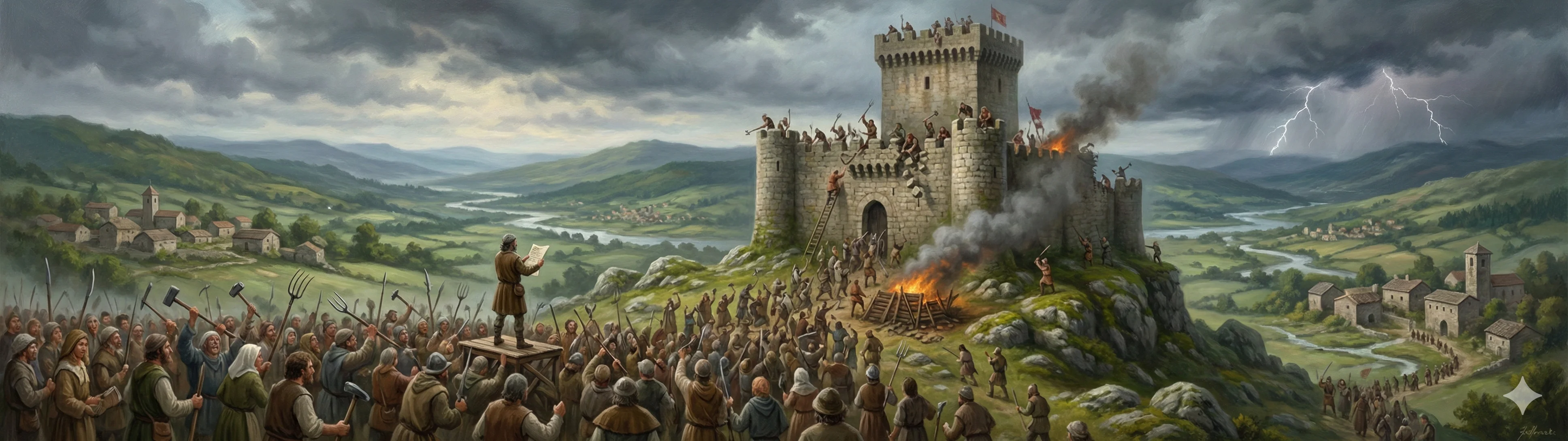
In the 15th century, Galicia erupted in one of the most remarkable social uprisings in medieval Europe. Driven by hunger, epidemics, and the relentless abuses of the feudal nobility, approximately 80,000 commoners rose up in arms during the Great Irmandino War (1467–1469). Across Galicia, the enraged populace demolished between 130 and 140 castles, fortresses, towers, and manor houses — the very symbols of their oppression.
The peasants of Sande played their part. They sent representatives and formal letters of complaint to the Junta de Medina, documenting the abuses committed from the fortress. When the revolt reached its climax, the Irmandinos destroyed the Torre de Sande — though it was subsequently rebuilt, likely in the late Gothic style visible today. This episode reveals that even in this remote corner of Galicia, the people were willing to rise against injustice, leaving a legacy of resistance that echoes through the centuries.
- The Irmandino Revolt (1467–1469) was the largest peasant uprising in medieval Galicia
- Approximately 130–140 fortresses were destroyed across Galicia during the revolt
- The peasants of Sande formally complained about abuses to the Junta de Medina
- The current tower structure likely dates from its reconstruction after the revolt, in late Gothic style
The Knights Hospitaller
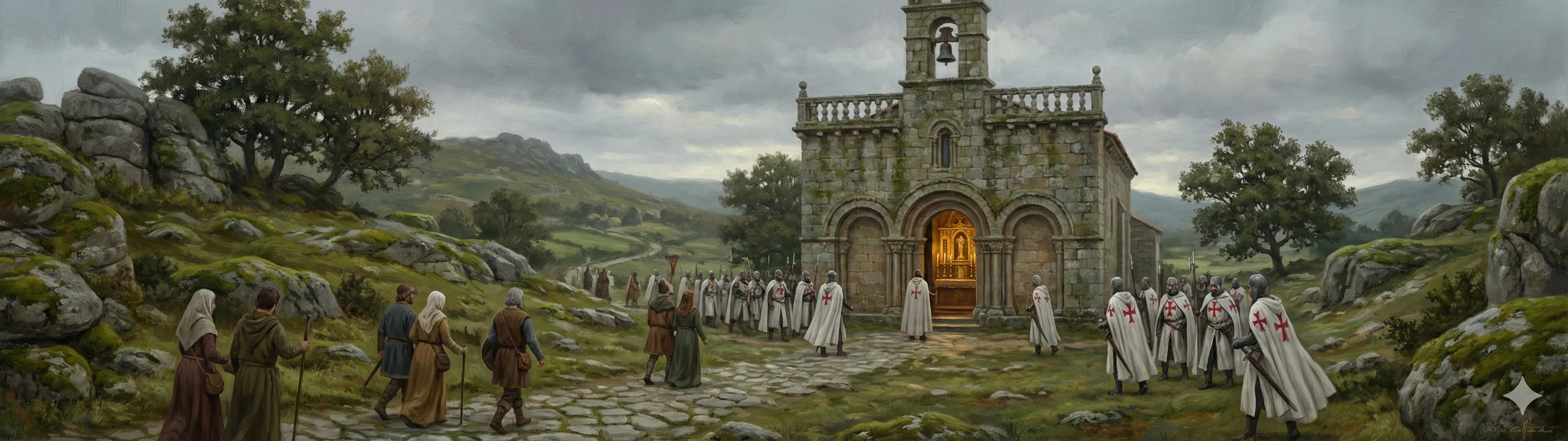
While most churches in the region fell under the jurisdiction of the Celanova monastery, the Church of Santa María de Cartelle tells a different story. This 18th-century basilica with three naves and three doors on its main façade belonged to the Knights Hospitaller, the Order of Saint John of Jerusalem, and was under the ecclesiastical jurisdiction of Quiroga (Lugo), rather than Celanova.
Some local historians have speculated that the church may have originally been a Knights Templar property before the Order’s dissolution in 1312, after which Templar holdings across Iberia were transferred to the Hospitallers and other orders. While no definitive proof of Templar origins has been found, the Hospitaller connection itself is remarkable, placing Cartelle within a broader network of military order properties across Galicia and the Iberian Peninsula. Their presence here, distinct from the Benedictine sphere of Celanova, speaks to the complexity of medieval ecclesiastical politics and the overlapping jurisdictions that shaped these communities.
- The church features a basilica floor plan with three naves — unusual for a rural parish church
- A single-body tower with balustrade crowns the façade, alongside a two-body campanile with buttresses
- The interior contains a main altarpiece by Castro Canseco from the first quarter of the 18th century
- Some speculate the church had earlier Templar origins before their dissolution in 1312, but no definitive proof exists
- After 1312, Templar properties across Iberia were transferred to the Knights Hospitaller and other orders
The Art of Castro Canseco
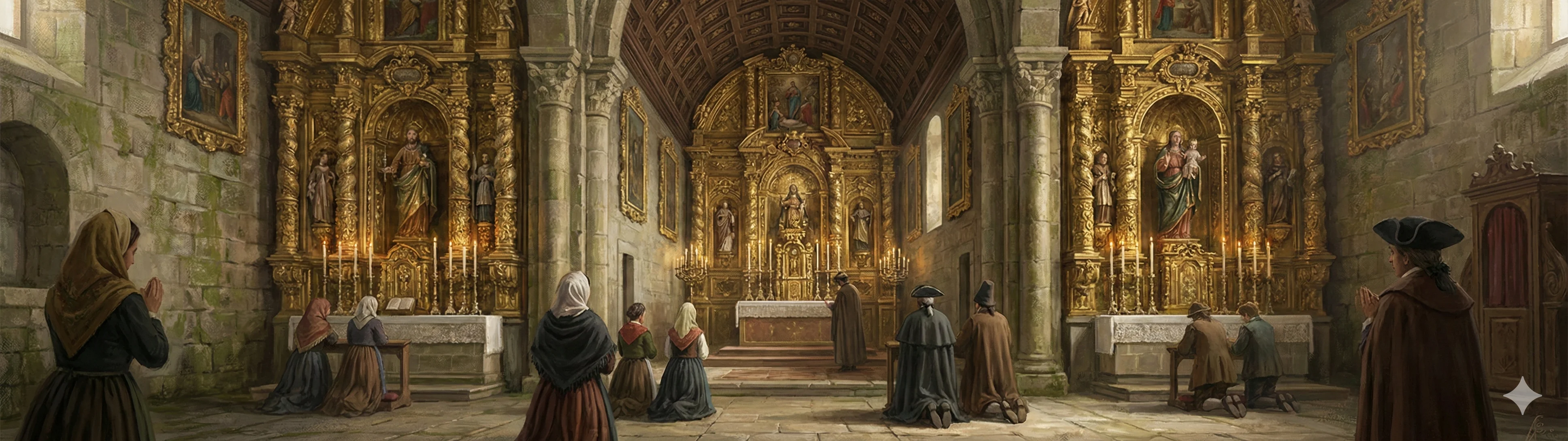
The 17th and 18th centuries saw Cartelle’s parishes transformed by a distinctive Galician Baroque idiom that married the exuberance of the Counter-Reformation with the austere beauty of Galician granite. At the heart of this transformation was Francisco de Castro Canseco (c. 1655–1724), known as "el Churriguera gallego" — perhaps the most prolific sculptor in Galicia of his era.
Castro Canseco’s masterpiece in the municipality is the stunning main altarpiece (retablo mayor) at the Church of San Salvador de Sande, created between 1700 and 1710. The church itself is a remarkable architectural palimpsest: while the visible construction is predominantly 17th-century Baroque, it conceals Romanesque origins — evidenced by a partially covered window by the sacristy, Romanesque lintels in the main chapel, and enormous exterior buttresses. The interior features an exquisite coffered ceiling (artesonado) that complements Castro Canseco’s ornate altarpiece.
- Castro Canseco arrived in Galicia around 1693 and settled near Celanova by 1696
- His major works include the retablo mayor and choir of the Monastery of San Salvador de Celanova and the facade of the Monastery of Santa María de Oseira
- The Church of San Salvador de Sande preserves both Romanesque foundations and Baroque renovation
- Around the church, large secular stone houses from the 17th–18th centuries form a remarkable Baroque architectural ensemble
The Sanctuary of As Marabillas
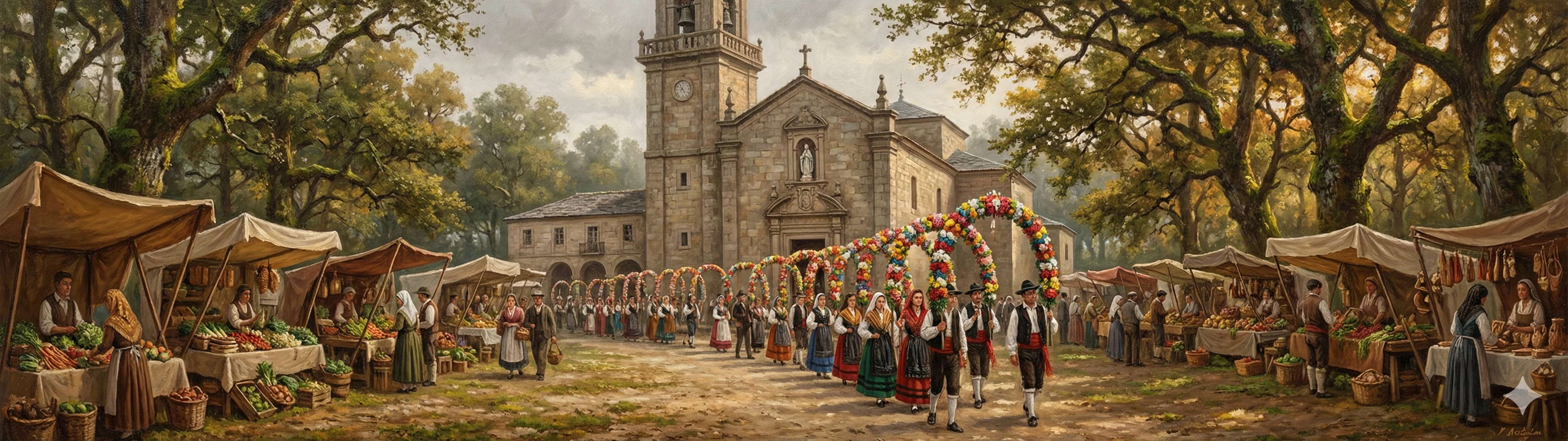
In 1646, according to tradition, the Virgin Mary appeared three times at a site in the parish of As Marabillas, leading to the construction of one of the most important Marian sanctuaries in the province of Ourense. The Santuario de Nosa Señora das Marabillas stands imposingly within a centuries-old oak grove, its façade crowned by a large two-body tower with a niche above the main door housing the figure of the Virgin.
Every year on Whit Monday (the Monday after Pentecost), the sanctuary hosts the Romería da Virxe das Marabillas — a spectacular romería and celebration that is one of the province’s most important Marian festivals. The procession is distinguished by magnificent ramos de bolas — large floral arches and bouquets fashioned from multicoloured paper balls — accompanied by a fair with over 100 stalls. Nearby stands a poignant sculpture dedicated to Galician emigrants, a reminder of the deep connection between faith and the experience of those who left.
- The sanctuary’s devotion dates to three apparitions of the Virgin in 1646
- June 1st (Virxe das Marabillas) is a local holiday in Cartelle
- The oak grove surrounding the sanctuary creates a natural cathedral setting
- A sculpture dedicated to Galician emigrants stands near the sanctuary
The Entroido of Sande: As Bonitas
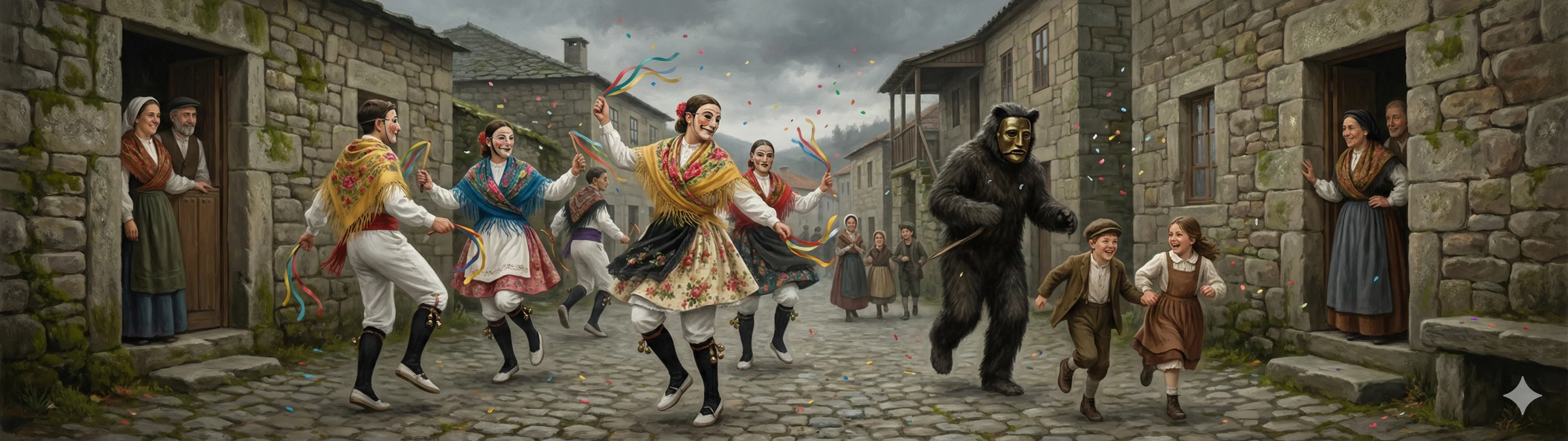
The most distinctive cultural tradition of Cartelle is the Entroido de Sande — a carnival celebration whose signature characters, As Bonitas, emerged from the aftermath of the Spanish–American War (1896–1898). When soldiers returned from the Philippines and Cuba, they brought back exotic Manila shawls — silk garments embroidered with flowers. These shawls became the centrepiece of a carnival costume that is unique in all of Galicia.
The Bonitas wear white pants and shirt as a base, with two silk Manila shawls draped over each shoulder and tied at the waist, a flower-fringed overskirt, black gaiters adorned with small bells, and a wire mask painted to match the wearer’s character. They are accompanied by other figures: O Oso (the Bear), a figure with brass face and fur covering symbolising untamed nature; A Vaca (the Cow), chasing children through the streets; and the mysterious Avutardas who parade as heralds of disorder. The tradition disappeared for years but was recovered in 2001, and in 2026 gained international recognition at the Surva Festival in Bulgaria.
- As Bonitas originated after 1898 when soldiers brought Manila shawls from the Philippines
- Os Números — satirical recitations addressing local conflicts — serve as "symbolic justice" through collective laughter
- The Queima do Meco (burning of a straw figure) concludes the festival, symbolising purification and renewal
- The tradition was recovered in 2001 by the Asociación Vecinos Castelo de Sande
Emigration and Resilience
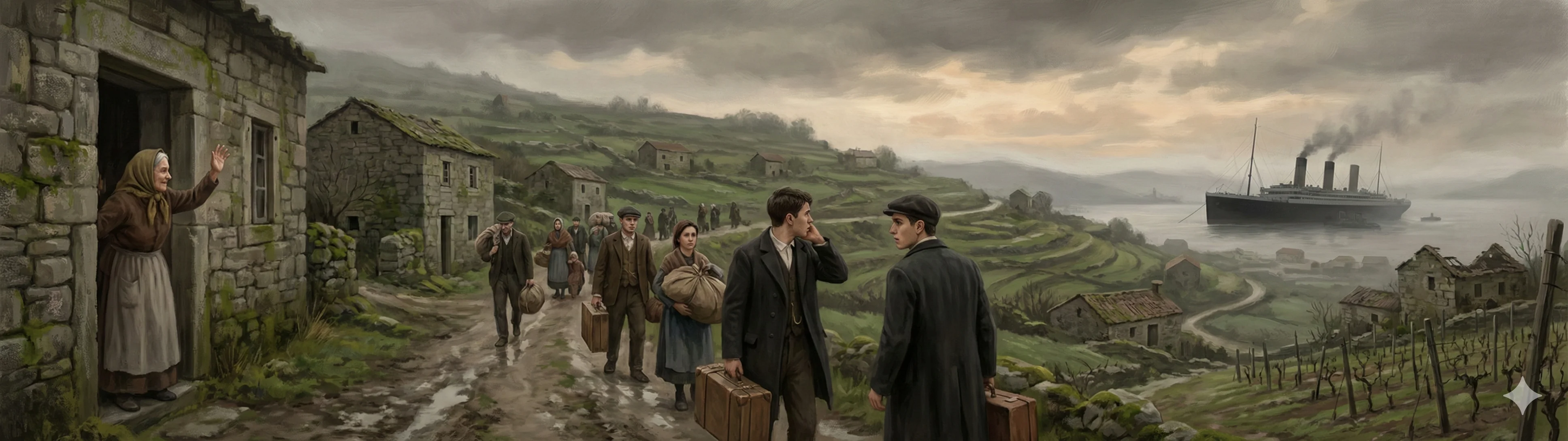
Like much of rural Ourense, Cartelle has experienced a dramatic demographic transformation over the past century. From nearly 9,000 inhabitants in 1950, the population has declined to approximately 2,500 today — a reflection of the massive Galician emigration that saw over two million people leave for the Americas between 1850 and 1960, with Buenos Aires becoming known as the "Fifth Province of Galicia."
The second wave of emigration, between 1960 and 1990, took over 130,000 people from the province of Ourense alone to France, Germany, Switzerland, the Netherlands, and the United Kingdom. Today, Cartelle’s aging population — with seniors comprising approximately 45% of residents — faces the challenge of preserving its extraordinary heritage. Yet the community endures: the recovery of the Entroido de Sande, ongoing efforts to restore the Torre de Sande, and the vitality of festivals like As Marabillas speak to a resilience that defines these communities.
- Population declined from ~9,000 (1950) to ~2,500 (2025), a loss of over 70%
- The Torre de Sande was added to the Hispania Nostra Red List in 2020 due to collapse danger
- In 2017, the Concello de Cartelle unanimously approved restoration proceedings for the tower
- Many workers now commute daily to Ourense city, primarily in the services sector
Heritage Sites of Cartelle
From Roman bridges to Baroque sanctuaries — an extraordinary concentration of heritage across twelve parishes.
Key Dates
“Quen ten terra en Cartelle, ten terra para sempre.”— Who has land in Cartelle, has land forever — Galician saying