Castrelo de Miño
Land of ancestors
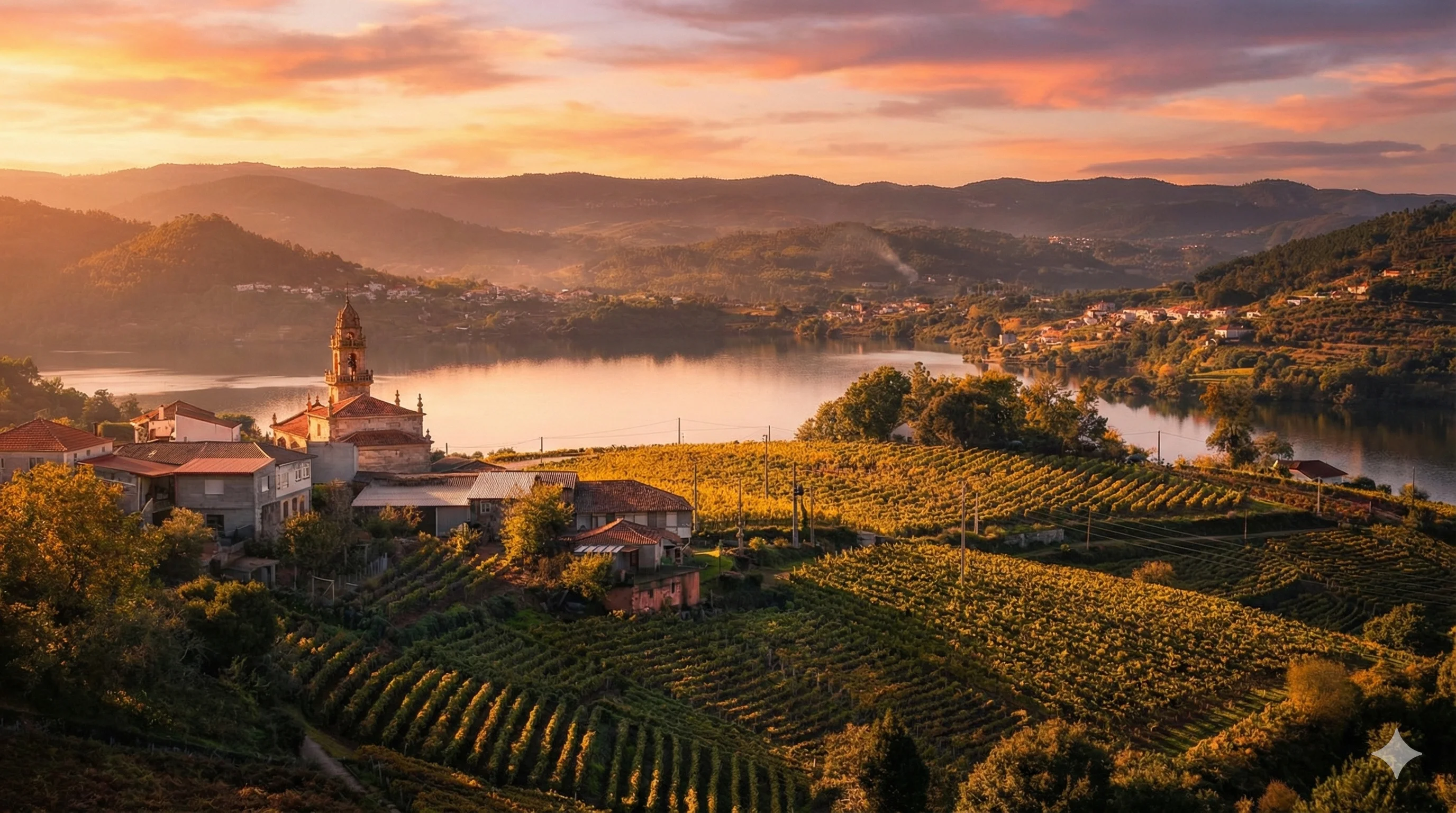
Castrelo de Miño
Where Celtic castros, a medieval monastery that buried kings, Roman wine presses, and thermal springs beneath a lake tell the story of nearly six millennia of human settlement on the banks of the Miño.
“Castrelo de Miño: Struggle, repression, plunder, ecological disaster, human disaster.”— Arturo Reguera, on the impact of the 1968 dam construction
On the Banks of the Miño
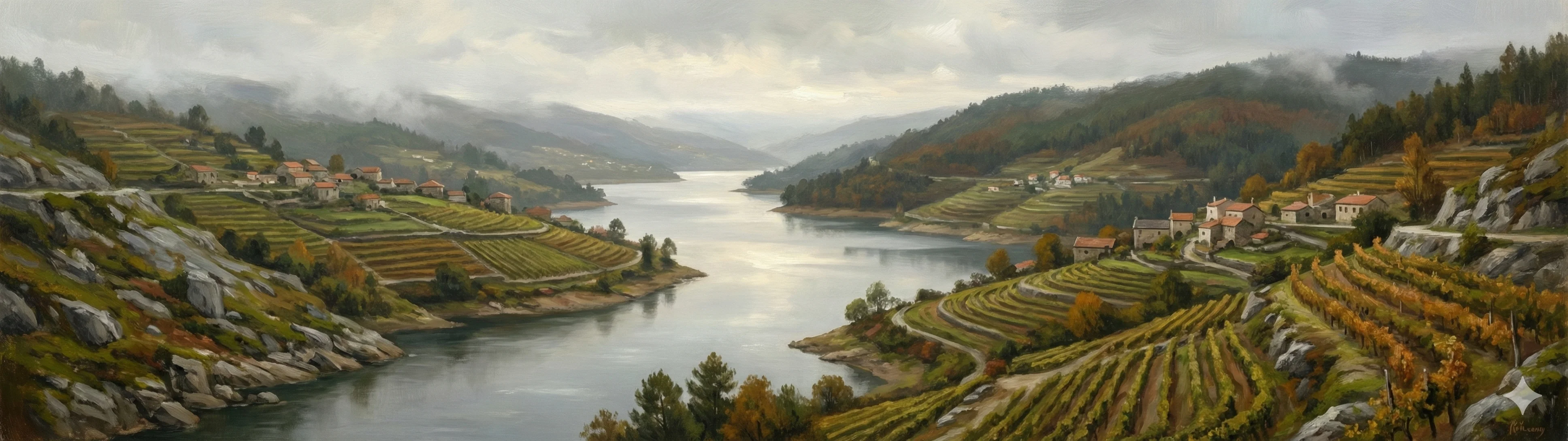
Castrelo de Miño sits on the left bank of the River Miño, the great artery of Galicia, in the heart of the Ribeiro wine comarca of Ourense province. The municipality encompasses 39.74 square kilometres of gentle hills, mountainous reliefs, and extensive vineyards that cascade down sheltered slopes toward the river. Its name derives from the Latin "castrum" — a small fortress — recalling the ancient Celtic fortification, Castrum Minei, that once commanded the river crossing.
The landscape is defined by its relationship with the Miño. The Castrelo Reservoir, created when the river was dammed in 1968, now stretches over 10 kilometres, fundamentally transforming the terrain from fertile agricultural valley to a vast inland lake flanked by vineyards and forest. The municipality lies at the intersection of Atlantic and Mediterranean climates, with mountains providing a protective microclimate ideal for viticulture — warm summers averaging 14.5°C annually, with 1,915 hours of sunshine.
- Seven parishes: Astariz, Barral, Castrelo de Miño, Macendo, Ponte Castrelo, Prado de Miño, and Vide de Miño
- 43 population centres across the municipality at an altitude of 159 metres
- Monte de Santa Lucía reaches 295 metres, offering panoramic views of the reservoir and vineyards
- Approximately 25 km from Ourense city; 5 minutes from the historic capital Ribadavia
Megaliths, Petroglyphs & Castros
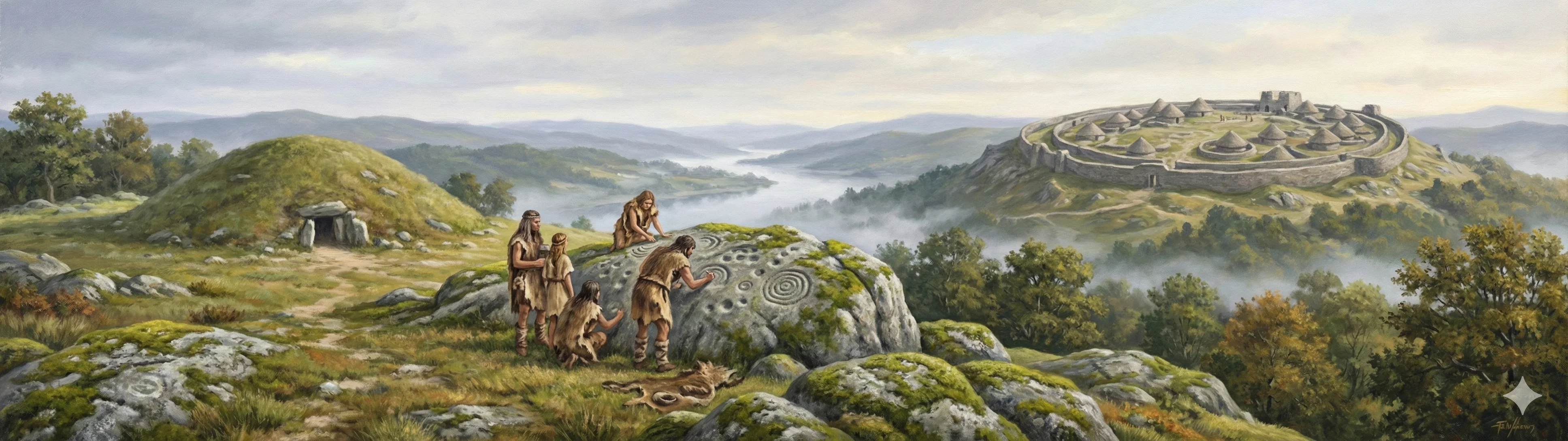
Human presence in Castrelo de Miño stretches back to the Neolithic, evidenced by the megalithic burial mounds (mámoas) at Veiga de Arriba in Reigoso — a necropolis of five tumuli — and the Vedado do Roxón in Macendo with three more. These ancient tombs, dating to roughly 4000-3000 BC, speak of communities already drawn to these fertile river terraces and their sheltered microclimate.
The Bronze Age (1800-700 BC) left remarkable petroglyphs at Reigoso, featuring geometric designs — cup marks, cruciform shapes, circles, and aligned patterns carved into the granite outcrop. During the Iron Age (700-19 BC), the Castro culture flourished across the municipality. Fortified hilltop settlements including Castro de Las Cavadas (the legendary Castrum Minei), Castro de Macendo, Castro de Outeiro, and the archaeologically significant Castro de Santa Lucía stood as a defensive network guarding the banks of the Miño between Ourense and Ribadavia.
- Mámoas da Veiga de Arriba: necropolis of 5 megalithic tumuli near the village of Reigoso
- Bronze Age petroglyphs at Reigoso display cup marks, cruciform shapes, and circular motifs
- Castro de Santa Lucía spans 2.75 hectares — first excavated in 2016 by the University of Vigo
- Rock shelters at Santa Lucía (Astariz) and La Cantera (Santo Estevo) evidence earlier habitation
Gold, Roads & the First Wine
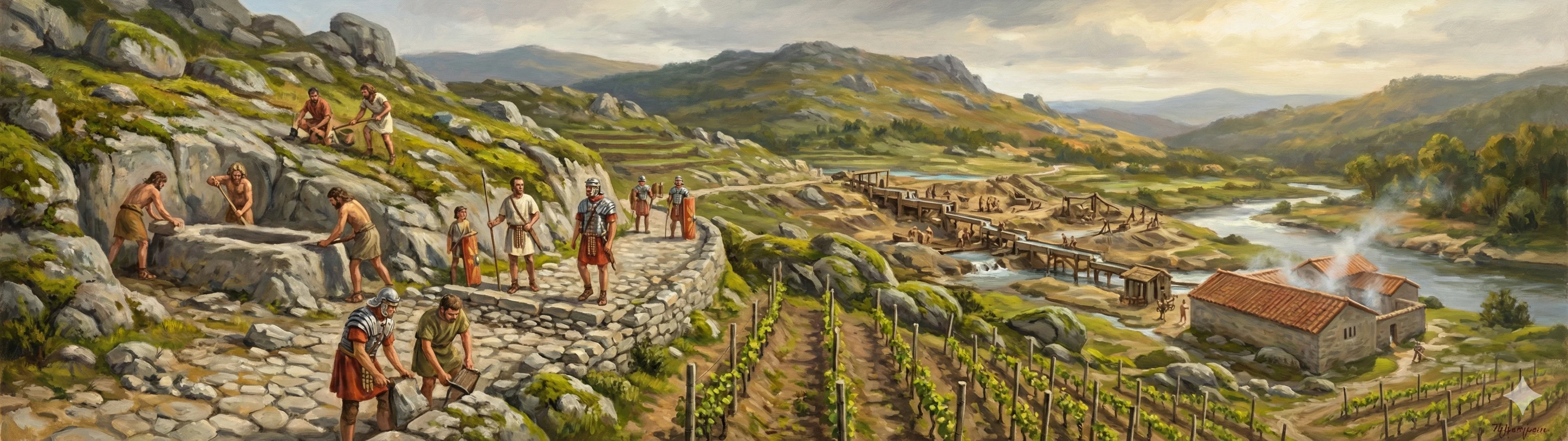
Roman conquest in the late 1st century BC brought Castrelo de Miño into the province of Gallaecia, transforming the landscape through mining, road-building, and the introduction of systematic agriculture. Gold mining operations were established at Los Cotos (between Prado and Astariz), Monte Rosario (Macendo), and the Lavadero de Prado de Miño. Four Roman roads crossed the territory, connecting Castrelo to Ourense, Arnoia, Celanova, and beyond — roads that would serve as medieval pathways for centuries.
The most extraordinary discovery came in 2016-2017, when archaeologists from the University of Vigo excavated the Castro de Santa Lucía in Astariz. Among circular Castro dwellings and Roman-era structures, they uncovered a Galician-Roman rock-cut wine press (lagar rupestre), dated using a coin from 235 AD. This proved that vine cultivation and winemaking in Castrelo de Miño dates back to at least the 1st-3rd centuries AD — making it one of the oldest documented wine-producing sites in all of Galicia. The Romans also established thermal baths at El Diestro, exploiting the natural hot springs that bubble up along the Miño.
- Rock-cut wine press at Castro de Santa Lucía: proof of winemaking from at least 235 AD
- Gold mining sites at Los Cotos, Monte Rosario, and Lavadero de Prado de Miño
- Four Roman roads crossed the territory, later serving as medieval routes
- Thermal baths at El Diestro exploited natural hot springs along the Miño river
- Archaeological finds include coins, roof tiles, and inscribed tombstones
Kings, Queens & the Monastery
The arrival of the Suebi in the 5th century established the Suebic Kingdom of Gallaecia, and by the 9th century — following the discovery of the tomb of Saint James the Great — the region entered a new era of splendour. Castrelo de Miño gained fame as part of "A Castela Auriense" (the Fortress Land of Ourense), named for the quantity of fortifications guarding the Miño valley, chief among them Castrum Minei.
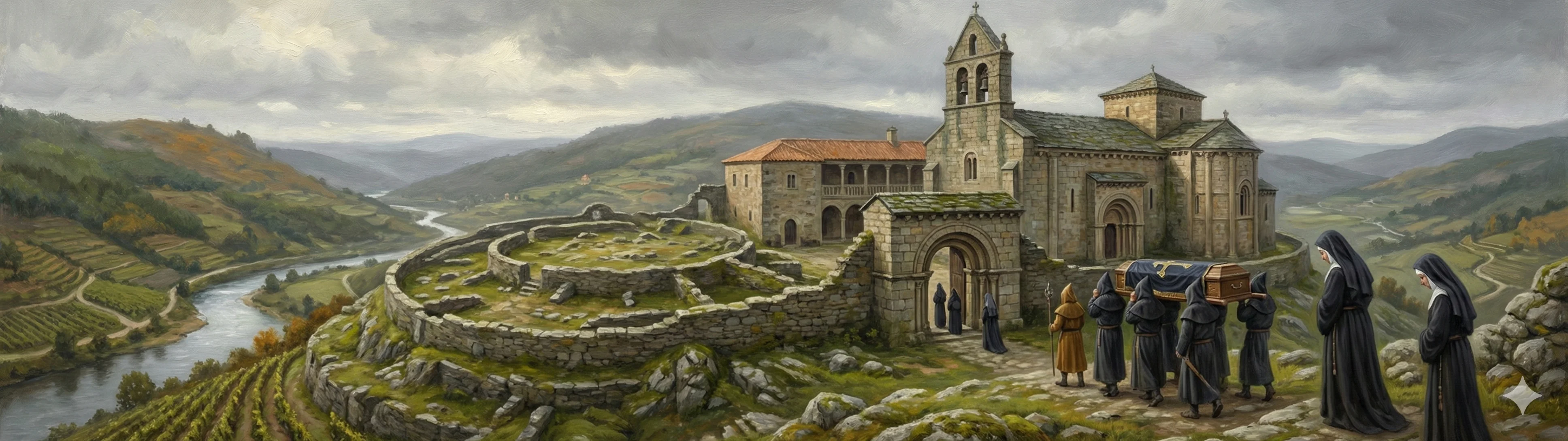
At the heart of Castrelo's medieval identity stood its monastery — a "duplex" house for both monks and nuns, built on the site of an ancient castro. King Sancho Ordóñez (c. 895-929), son of Ordoño II of León and Elvira Menéndez — and grandson of the powerful Count Hermenegildo Gutiérrez, traditional ancestor of the Casa de Sande — became King of Galicia from 926 until his death. Like most medieval monarchs, his court was itinerant, but the Miño valley remained closely tied to his royal household. He was buried in the Monastery of Castrelo de Miño. His widow, Doña Goto Muñiz (c. 900-964), entered the monastery and became its abbess — she is documented in this role in 947 when King Ramiro II of León made a donation to the community. The monastery later witnessed another royal death: King Sancho I of León, known as "El Craso" (The Fat), was reportedly poisoned here by the rebel Count Gonzalo Menéndez, who offered him a toxic apple.
- King Sancho Ordóñez, King of Galicia (926-929), was buried at the monastery — grandson of Count Hermenegildo Gutiérrez, ancestor of the Casa de Sande
- His widow Doña Goto became abbess — documented in 947 receiving a royal donation
- King Sancho I of León allegedly poisoned at the monastery by Count Gonzalo Menéndez
- The monastery was a "duplex" house for both monks and nuns, later exclusively female
- The monastery later belonged to the Order of Saint John of Jerusalem
The Lost Fortress
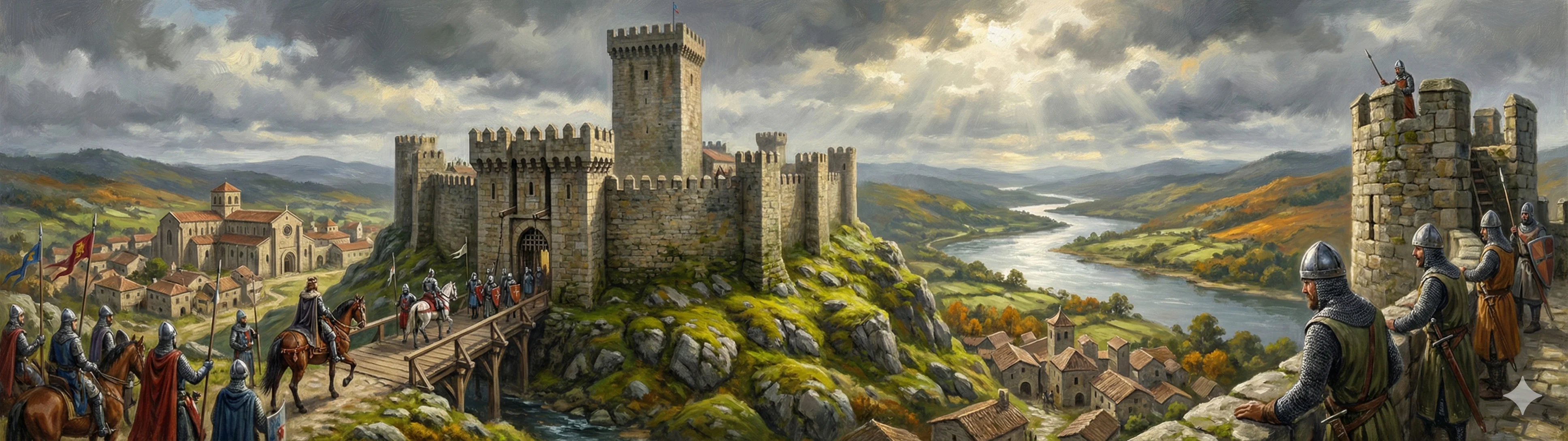
Two fortified positions guarded the river crossing at Castrelo — one at the monastery site, another across the Miño. This strategic crossing became the stage for some of the most dramatic episodes in Galician medieval history. In 1110-1111, following King Alfonso VI's death, civil war erupted between supporters of his daughter Queen Urraca and those backing her young son Alfonso. Count Pedro Froilaz de Traba seized the fortress of Castrelo de Miño and installed the six-year-old prince under his protection. When Archbishop Diego Gelmírez of Santiago de Compostela arrived to negotiate, he was briefly arrested by Arias Pérez. Released shortly after, Gelmírez personally crowned the boy as King Alfonso VII of Galicia on September 17, 1111 in Santiago de Compostela Cathedral. A famous legend tells of an eagle that warned the Archbishop of the betrayal.
A decade later, in 1121, Queen Urraca had the Archbishop arrested again at Castrelo de Miño while he was returning from Portugal — episodes documented in the Historia Compostelana. The medieval bridge, reputedly built by Saint Peter González ("San Telmo") and said to have had eight arches, was destroyed by flooding in the mid-16th century when a massive walnut tree lodged in one of its arches. The 15th century brought the Irmandiño revolts (1467-1469), when approximately 80,000 peasants, fishermen, and artisans rose against the feudal nobility across Galicia, transforming the social order.
- 1111: Archbishop Diego Gelmírez arrested at Castrelo, then crowned Alfonso VII King of Galicia
- 1121: Queen Urraca ordered Gelmírez's arrest again while camped at Santa María
- The medieval bridge of San Telmo destroyed by flooding in the mid-16th century
- The Irmandina Revolt (1467-1469) transformed Galicia from fortress territories to manor estates
- Loss of the bridge shifted commercial importance away from Castrelo for centuries
Heart of the Ribeiro
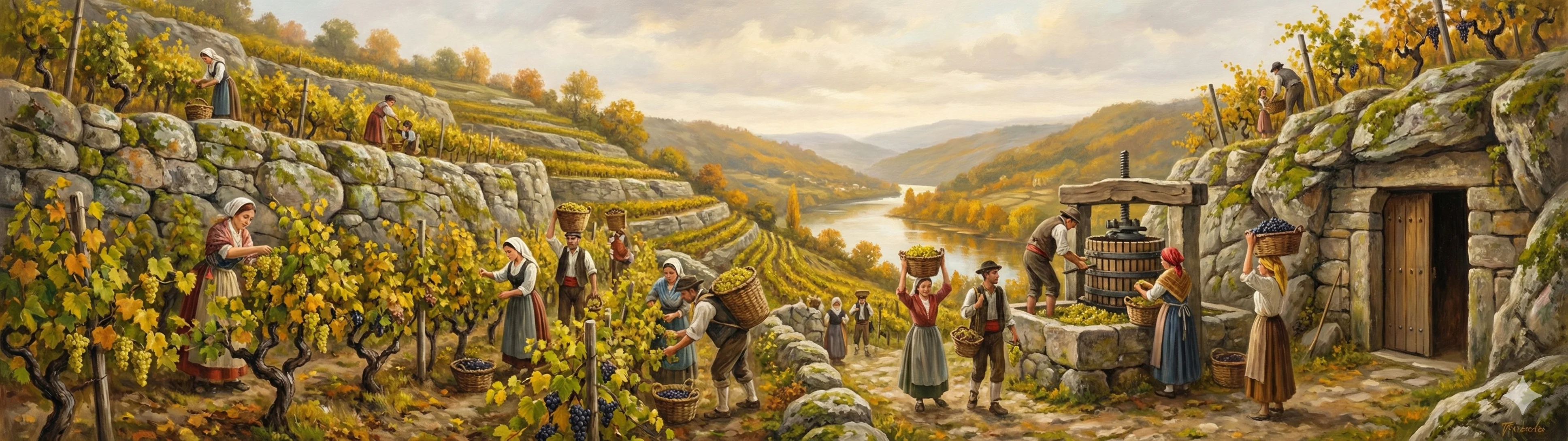
Castrelo de Miño sits at the very heart of the D.O. Ribeiro, one of Spain's oldest protected wine appellations. The discovery of the 3rd-century rock-cut wine press at Castro de Santa Lucía proves that this municipality has been producing wine for nearly two millennia — among the oldest documented winemaking sites in Galicia. Viticulture is the economic engine of Castrelo, with 10 bodegas and 14 grape growers tending vineyards on the sheltered hillsides surrounding the reservoir.
The wines of the Ribeiro achieved "worldwide renown" in the 16th century, mentioned by Miguel de Cervantes himself and exported to Flanders, Germany, and across Europe. In 1592, 127 barrels of Ribeiro wine shipped from Ferrol sailed with Christopher Columbus to America. Today, Castrelo's wineries continue this legacy: Bodegas Eduardo Peña won the Acio de Ouro (Golden Cluster) for the best white wine in all of Galicia. The predominant grape is Treixadura, the "Queen of Ribeiro," producing elegant whites characterised by high acidity, floral notes, honey, and aromatic herbs.
- Rock-cut wine press at Castro de Santa Lucía dates winemaking to at least 235 AD
- 10 bodegas and 14 grape growers operate within the municipality
- Bodegas Eduardo Peña: awarded best white wine in Galicia (Acio de Ouro)
- Bodegas Cunqueiro pioneered one of the first Treixadura single-varietals in Galicia
- White wines dominate (90% of production), led by the Treixadura grape variety
- The D.O. Ribeiro's 1579 Ordinances may be the world's oldest wine denomination of origin
Churches, Pazos & Stone Crosses
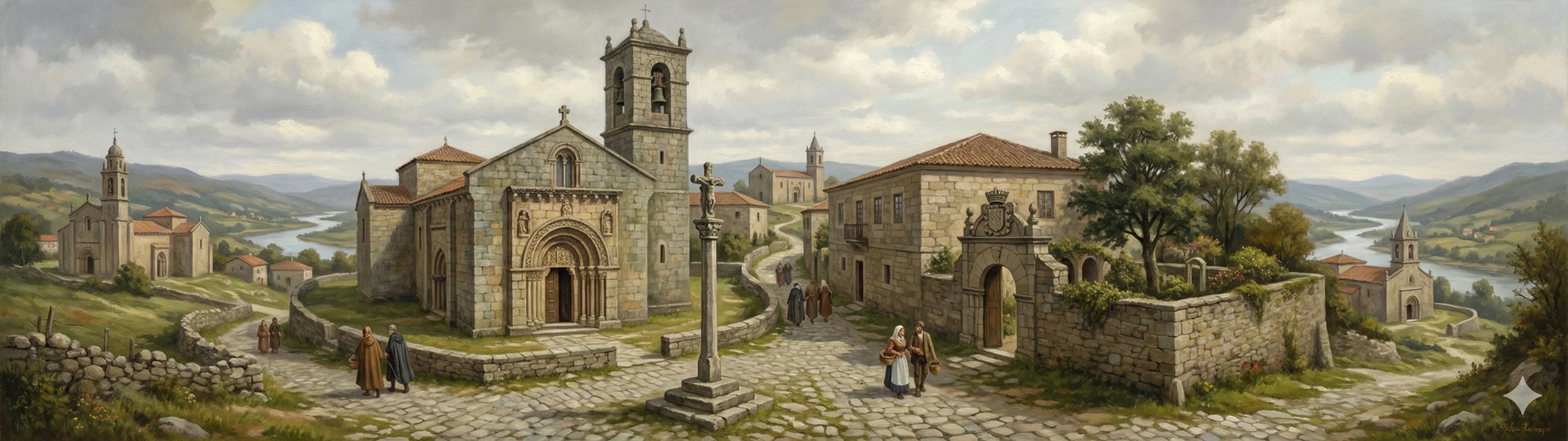
The Church of Santa María de Castrelo de Miño is the municipality's most important monument — built on the very site of the ancient Castrum Minei, where the monastery once stood. Its origins trace to the 10th century, and the surviving Romanesque apse from the 12th century is exceptional: semicircular, divided by three attached columns, with windows of semicircular arches. The corbels and metopes feature extraordinary reliefs depicting Christ, Saint Peter and Saint Paul, alongside monks, dogs, wolves, an eagle, and a donkey. The tower, unusual for the region, shows curious similarities with the Romanesque of Catalonia and Lombardy.
Inside the church, 16th-century Renaissance murals (c. 1560) depict the Last Judgement, Christ before Pilate, the Flagellation, and the Road to Calvary — the vices personified as a procession heading toward the jaws of Hell. The church was rebuilt in Baroque style in 1763. Other notable monuments include the Baroque Church of Santa María de Astariz with its 1748 altarpieces by sculptor Antonio Salvador Carmona, the Romanesque Church of Prado de Miño, the Church of Santo Estevo de Ponte Castrelo, and the manor houses Pazo de Troncoso and Casa da Capela.
- Church of Santa María: Romanesque apse (12th c.), Renaissance murals (1560), Baroque nave (1763)
- Romanesque reliefs depict Christ, Saints Peter and Paul, monks, and animals
- Church of Astariz: altarpieces by Antonio Salvador Carmona (1748), donated by the Count of Troncoso
- Pazo de Troncoso and Casa da Capela: traditional Galician manor houses
- Stone cruceiros (crosses) at Macendo and Vide reflect deep religious tradition
When the Waters Rose
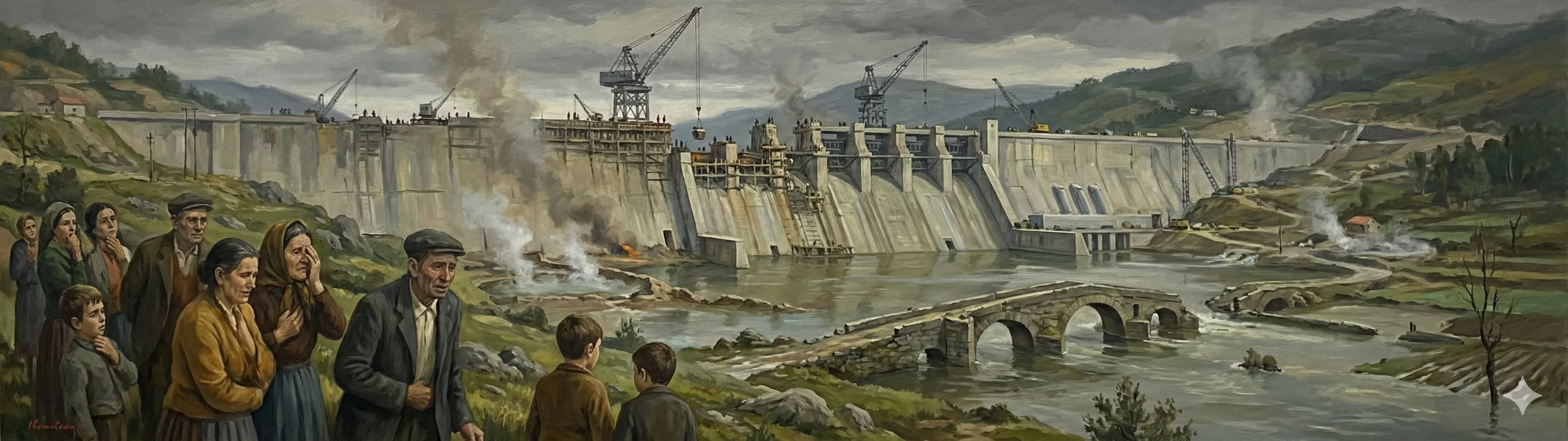
The construction of the Castrelo dam stands as one of the most dramatic chapters in the municipality's history — a story of struggle, displacement, and irreversible change. In 1945, the project was declared of public utility, but fierce local opposition delayed construction for decades. In 1965, assault police forces arrived to enforce the works. After a 1967 agreement between the energy company Fenosa and affected residents, the reservoir was finally filled in November 1968, permanently flooding 350 hectares of the most fertile farmland in the valley.
The dam transformed every aspect of life. The thermal baths of Santa María, active since Roman times, vanished beneath the waters. Fish migration patterns were permanently disrupted. The iron bridge of 1907 — itself the culmination of centuries of demand for a permanent river crossing — was rendered less significant as the landscape changed beyond recognition. Scholar Arturo Reguera titled his account: "Castrelo de Miño: Struggle, repression, plunder, ecological and human disaster." Yet from this devastation emerged something unexpected: the reservoir became one of Galicia's premier water sports centres, offering up to 25 kilometres of rowing in still water — considered one of the best rowing courses in Spain.
- 1945: Public utility declaration for dam construction
- 1965: Assault police forces arrived to enforce construction
- November 1968: Reservoir filled, flooding 350 hectares of prime farmland
- The hydroelectric plant generates 112 MW of power
- The reservoir stretches over 10 km long and up to 1.5 km wide near the dam
- Now home to Club Náutico Castrelo do Miño, one of Galicia's top rowing centres
Thermal Springs Beneath the Lake
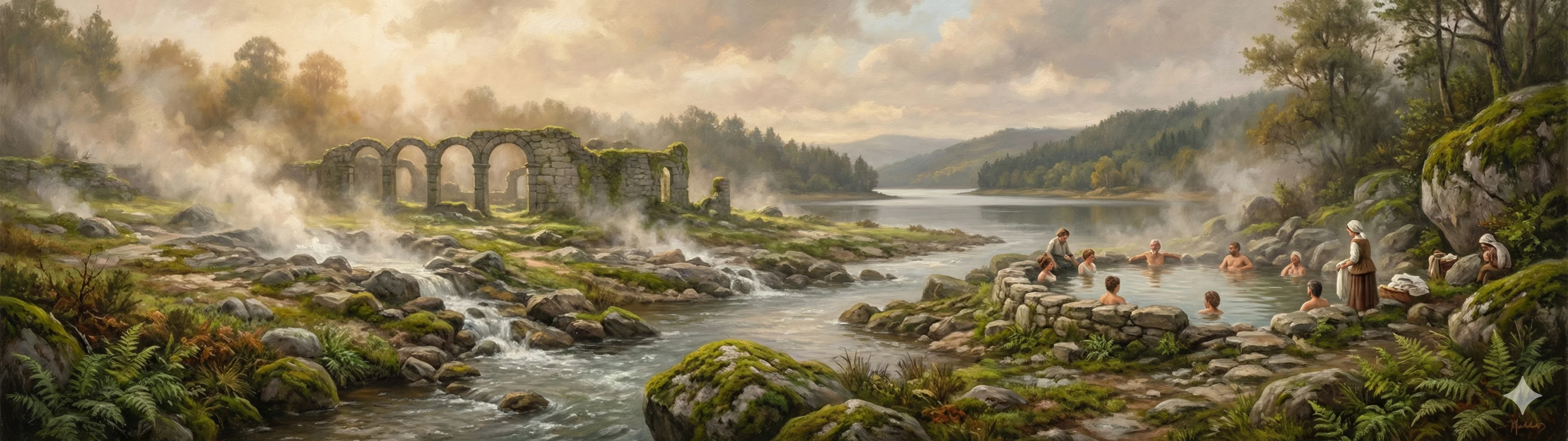
Castrelo de Miño's thermal springs have been known since Roman times, when baths at El Diestro served travellers along the Miño valley. By 1772, the Baths of Santa María were formally constructed over the remains of a Castro-Roman settlement, featuring two springs: the Burga Alta (60°C) and the Burga de Abaixo (47°C). The sulphurous-chloride-sodium waters were contained in small granite bathing pools, just 178 centimetres long and 50 centimetres deep. In 1888, these waters represented Ourense province at the 1888 Barcelona Universal Exposition.
When the reservoir was filled in 1968-1969, the thermal baths of Santa María vanished beneath the waters — but remarkably, the springs remain active. During dry seasons when the reservoir level drops, the original stone pools emerge from the lake and can still be used, the hot water bubbling up as it has for millennia. Local authorities have installed wooden walkways to facilitate access during these periods. The Termas de O Diestro near the power station also remain accessible, their curative waters a living link to the Roman past. Ourense province, known as the "Capital of Thermalism" in Spain, counts these among its most evocative thermal sites.
- Burga Alta: 60°C spring, 0.1 litres/second; Burga de Abaixo: 47°C, 0.1 litres/second
- Water composition: sulphurous-chloride-sodium with ferruginous elements
- The 1772 baths were built over Castro-Roman foundations
- Represented Ourense at the 1888 Barcelona Universal Exposition
- Original granite bathing pools re-emerge when reservoir levels drop in dry seasons
- Wooden walkways installed to facilitate access during low-water periods
A Living Heritage
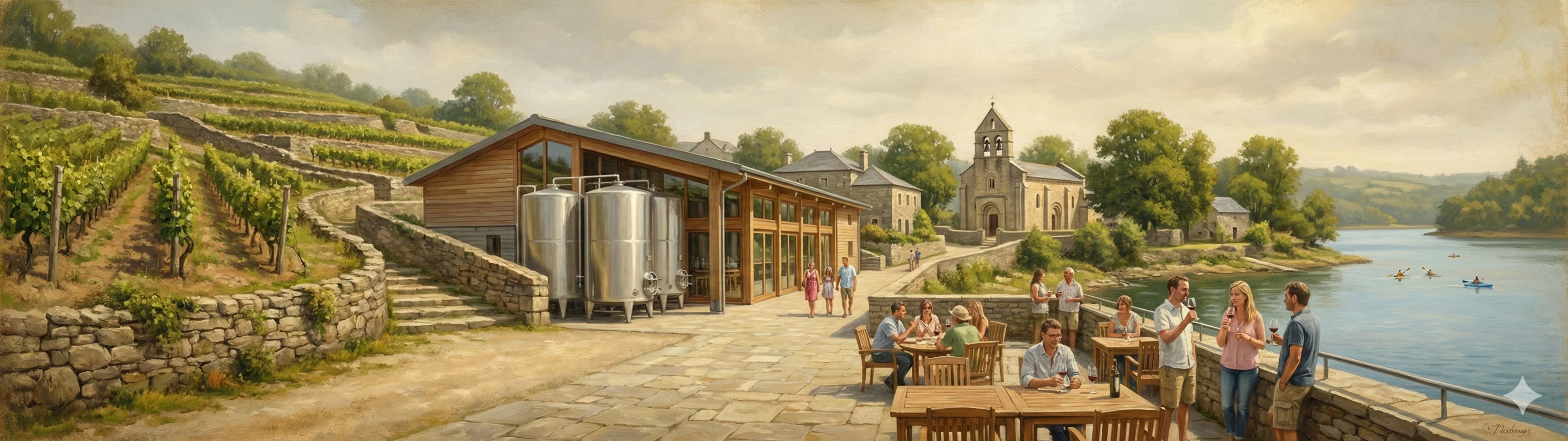
Despite a population that has declined from over 5,000 in the 1970s to approximately 1,300 today — a reflection of rural Galicia's broader depopulation challenge — Castrelo de Miño remains a vibrant community anchored by wine, water, and deep cultural roots. The municipality has reinvented itself around the reservoir, which now hosts the Club Náutico Castrelo do Miño with its 2,000-metre competition rowing track, attracting athletes from across Europe. The Galician Open Water Championship and international rowing events regularly take place on its still waters.
The annual calendar pulses with tradition: the Festa da Anguía (Eel Festival) in August, now in its 30th year; the Ribeiro Blues Wine Festival at the Nautical Park; the Festa da Codorniz (Quail Festival); Espírito Ribeiro, a joint wine festival with neighbouring municipalities. A school of bagpipes and tambourines keeps traditional Galician music alive. The municipality has declared itself an "entrepreneurial council," offering young entrepreneurs up to 90% tax exemptions. In 2014, Castrelo joined the WHO Global Network for Age-Friendly Cities — a recognition that this small community, shaped by Celtic castros, Roman wine presses, medieval kings, and modern reservoirs, continues to look forward while honouring its extraordinary past.
- Population: approximately 1,300 inhabitants across 43 villages in 7 parishes
- Club Náutico: 2,000m competition rowing track, one of Spain's best rowing courses
- Festa da Anguía (Eel Festival): 30 years of tradition, nearly 1,000 kg of eels served
- Ribeiro Blues Wine Festival: free concerts and wine tastings at the Nautical Park
- Member of the WHO Global Network for Age-Friendly Cities since 2014
- Designated "entrepreneurial council" with up to 90% tax exemptions for young businesses
Heritage Sites
From Neolithic tombs to Romanesque churches, the monuments of Castrelo de Miño span six millennia of continuous habitation.
Key Dates
“A terra de Castrelo garda nas súas pedras a memoria dos reis, e nas súas augas o lume que nunca se apaga.”— The land of Castrelo keeps in its stones the memory of kings, and in its waters the fire that never goes out.