Casa de Castro
Lemos · Sarria · Galicia
Casa de Castro
Lords of Lemos & Sarria · Adelantados Mayores of Galicia
“Here lies all the loyalty of Spain.”— Epitaph of Fernando Ruiz de Castro, Bayonne, 1377
The Arms
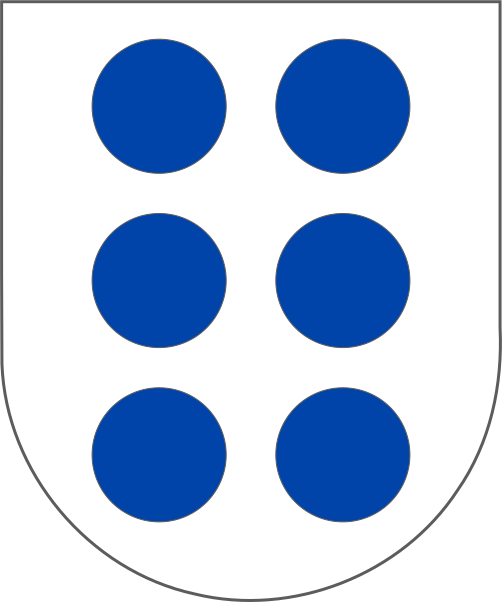
Six blue roundels on a silver field — the heraldic device of the Galician branch of the Casa de Castro, among the oldest armorial bearings in Iberia.
From Castrogeriz to the Lords of Galicia
The Castro name derives from the Latin *castrum* — a fortified place — and the family traced its origins to Castrogeriz, the ancient hilltop town on the Camino de Santiago in the province of Burgos. They belonged, alongside the Lara, the Haro, and the Guzmán, to the five great houses linked by blood to the first kings of Castile. The Castro-Lara rivalry — a bitter contest for influence over the Castilian crown during the reign of Alfonso VIII — defined twelfth-century court politics before the family's centre of gravity shifted permanently westward.
By the thirteenth century, the Galician branch of the house had eclipsed the Castilian line. Through a series of strategic marriages — most critically to the royal house of León — the Castros established themselves as Lords of Lemos and Sarria, controlling the great fortified towns of interior Galicia from Monforte de Lemos to Castro Caldelas. The historian Murguía called them a "semi-royal dynasty"; Crespo Pozo observed that no other Galician house could claim so many blood ties to the medieval kings of Spain. It was not an exaggeration. The Castros descended from Alfonso IX of León, married into the line of Sancho IV of Castile, and produced children who would sit on — or shake — the thrones of both Castile and Portugal.
- *Castrum* (Latin): a fortified place — the family name, like the hillforts that dot the Galician landscape, signals the deep link between lordship and defence
- Castrogeriz (Province of Burgos): the family's Castilian heartland, on the Camino de Santiago
- Castro-Lara rivalry: the two great Castilian houses fought for control of the regency during Alfonso VIII's minority
- The Galician branch descends from Alfonso IX of León through Aldonza Rodríguez de León, wife of Esteban Fernández de Castro
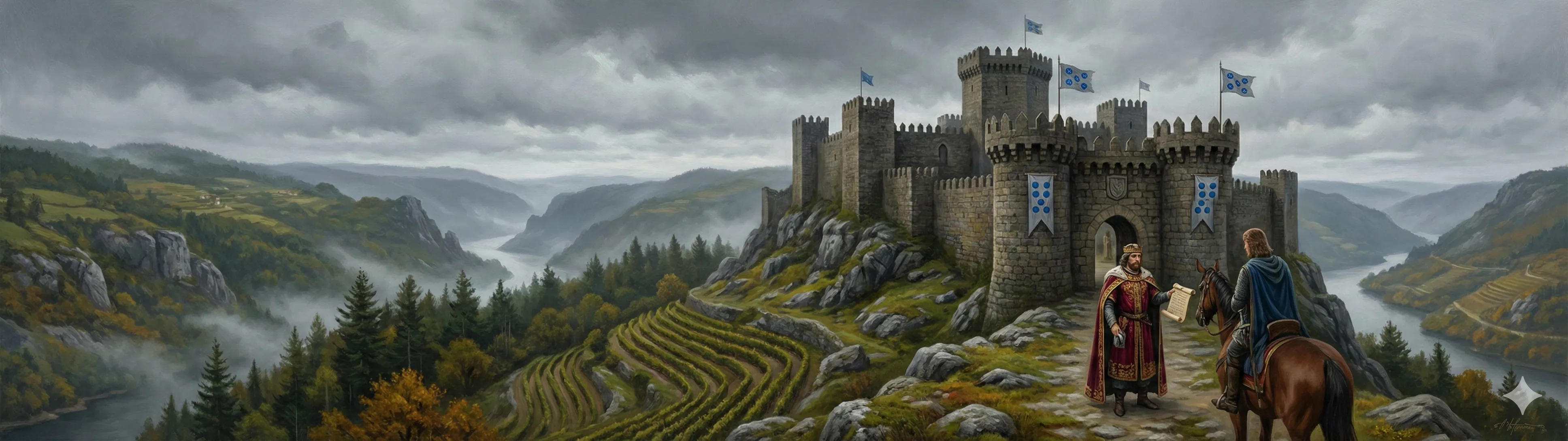
Adelantados, Pertigueros, and the Sultan's Gold Spurs
Esteban Fernández de Castro held the Adelantamiento Mayor de Galicia — the same office the Sarmientos would later inherit — and the Pertiguería Mayor de Santiago, the powerful military governorship of the lands belonging to the cathedral of Compostela. His domains stretched from Lemos and Sarria in the interior to Valladares and Castro Caldelas in the province of Ourense, with holdings extending into the Tierra de Toroño — the territory that encompassed the Ribeiro wine country and the Miño valley from Ribadavia south to the Portuguese border.
But the most extraordinary Castro of the thirteenth century was Pedro Fernández de Castro, known as *el de la Guerra* — "of the War." Grandson of Sancho IV of Castile, orphaned when his father was killed fighting royal forces at Monforte de Lemos in 1304, Pedro was sent as a child to the Portuguese court. Returning to Galicia around 1319, he recovered the family lordships and became Alfonso XI's most trusted commander — serving simultaneously as Lord Steward of the realm, Adelantado of Galicia, Andalusia, and Murcia, and Pertiguero Mayor of Santiago. At the Battle of Salado in 1340, Pedro Fernández de Castro fought against the Marinid sultan of Morocco and, according to tradition, seized the sultan's golden spurs from the battlefield. He died of plague during the Siege of Algeciras in 1342. His body was carried back to Galicia and buried in the choir of the Cathedral of Santiago de Compostela, where his tomb was opened in the nineteenth century and the gold spurs found still beside his bones.
- Esteban Fernández de Castro: Adelantado Mayor de Galicia and Pertiguero Mayor de Santiago under Alfonso X
- Tierra de Toroño: the southern Galician region encompassing the Ribeiro de Avia and the Miño valley — Castro territory before it became Sarmiento territory
- Pedro Fernández de Castro "el de la Guerra" (c. 1290–1342): Lord Steward of Castile, the most powerful nobleman in Galicia in the first half of the fourteenth century
- Battle of Salado (1340): the decisive Christian victory over the Marinid invasion; Pedro Fernández de Castro seized the Moroccan sultan's gold spurs
- Buried: Cathedral of Santiago de Compostela, with the gold spurs still in his tomb
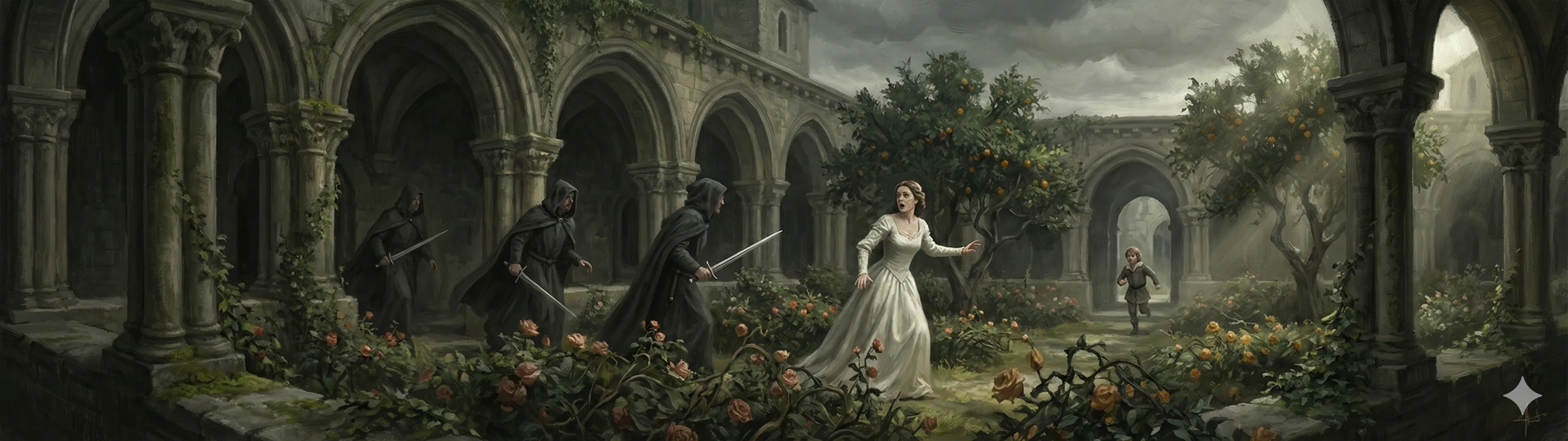
Inês de Castro and the Crowned Corpse
Pedro Fernández de Castro "el de la Guerra" fathered four children who would shape the history of two kingdoms. By his wife Isabel Ponce de León, he had Fernando — who would become the last great Castro lord of Galicia — and Juana, who married Pedro I of Castile. By his mistress, a Portuguese noblewoman named Aldonça Lourenço de Valladares, he had Álvaro — who would become Constable of Portugal — and Inês.
Inês de Castro arrived at the Portuguese court around 1340 as a lady-in-waiting to Constance of Castile, the bride of Prince Pedro, heir to the Portuguese throne. Pedro fell in love with the Galician noblewoman. The affair endured beyond the death of Constance in 1345, producing four children, and drew the Castro family — through Inês's brothers Fernando and Álvaro — dangerously deep into Portuguese court politics. King Afonso IV, fearing the Castro clan would drag Portugal into the Castilian succession crisis, ordered Inês killed. On 7 January 1355, three courtiers murdered her at the monastery of Santa Clara in Coimbra.
When Pedro became king in 1357, he hunted down two of the killers and had their hearts torn from their bodies. He then announced that he had secretly married Inês before her death, legitimizing their children. According to the legend that has never left the Portuguese imagination, he ordered her body exhumed, dressed in royal robes, seated on the throne, crowned, and the entire court compelled to kiss the dead queen's hand. The twin tombs at the Monastery of Alcobaça are real. Pedro and Inês lie face to face across the nave, placed so that, according to legend, they will see each other first when they rise on the Day of Judgment. The daughter of a Galician lord of Lemos and Sarria became the most famous queen in Portuguese history. The phrase *Agora é tarde; Inês é morta* — "It's too late; Inês is dead" — remains a common Portuguese expression to this day.
- Inês de Castro (c. 1325–1355): natural daughter of Pedro Fernández de Castro "el de la Guerra" and Aldonça Lourenço de Valladares
- Murdered on the orders of Afonso IV of Portugal at the monastery of Santa Clara, Coimbra, 7 January 1355
- Posthumous coronation: legend holds that Pedro I exhumed and crowned her corpse — the story that inspired Montherlant's *La Reine Morte* and Camões' *Lusíadas*
- Monastery of Alcobaça: the twin tombs of Pedro and Inês, face to face across the nave
- *Agora é tarde; Inês é morta*: the Portuguese proverb born from her story
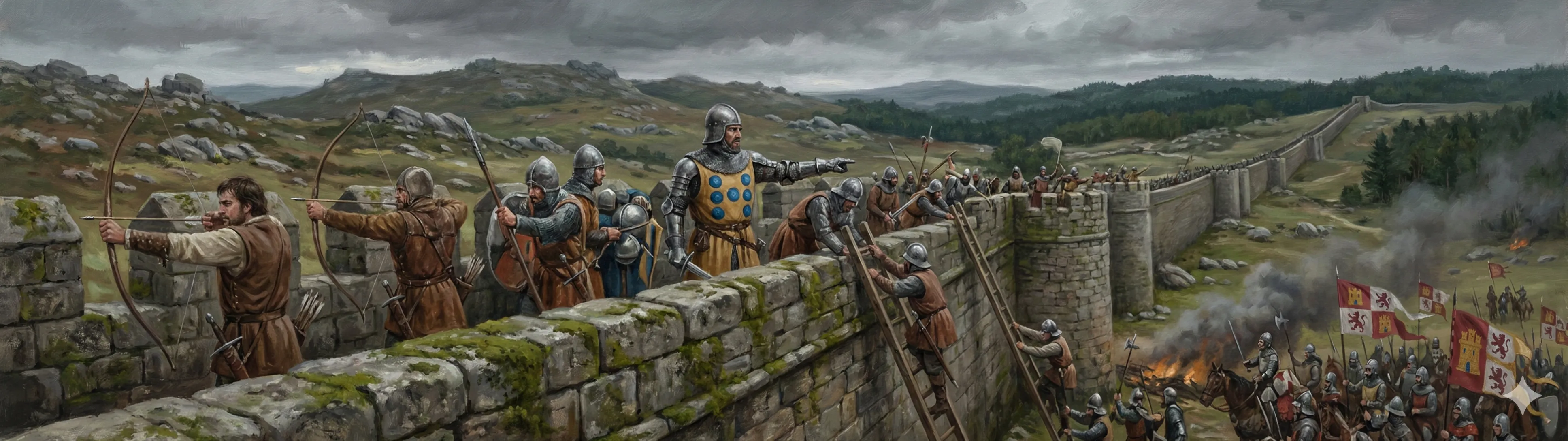
Fernando de Castro: All the Loyalty of Spain
Fernando Ruiz de Castro inherited his father's lordships, his titles, and his instinct for the losing side. When the Castilian civil war erupted between Pedro I and his half-brother Enrique de Trastámara, Fernando became the king's right hand — Pertiguero Mayor de Santiago, Mayordomo Mayor del Rey, Alférez Mayor, Count of Lemos, Trastámara, and Sarria. He was Pedro I's most powerful and loyal supporter.
The loyalty was tested. In 1354, Fernando briefly defected to Enrique's camp after Pedro I repudiated Fernando's sister Juana — abandoning her the day after their wedding. A question of family honour drove the break, and the suspicion that Enrique's faction may have been involved in the murder of his half-sister Inês in Portugal deepened his eventual hatred of the Trastámara cause. He returned to Pedro I and never wavered again.
When the war turned against the king, Fernando de Castro became the de facto regent of Galicia. He held the fortresses of the archbishopric of Santiago, controlled most of the kingdom, and fought Fernán Pérez de Andrade — the great Trastámara partisan — to a standstill in a two-month siege of Lugo. Then, in the spring of 1369, with Fernando de Castro still undefeated in the field, Enrique murdered Pedro I with his own hands at Montiel, and the war changed from a dynastic contest into a cause without a king.
Fernando refused to surrender. He allied with Fernando I of Portugal, who claimed the Castilian throne, and together they seized nearly all of Galicia. For three years after Montiel, the kingdom did not recognise the fratricide. The Galician towns held out. Fernando de Castro held out. The last Petrist in Spain would not bend the knee.
- Fernando Ruiz de Castro (c. 1338–1377): Count of Lemos, Trastámara, and Sarria; the last great Castro lord
- *Toda la lealtad de España* ("All the loyalty of Spain"): the inscription on his tomb in Bayonne — though some historians argue the epitaph is a later addition
- The Juana de Castro incident: Pedro I married Fernando's sister, then abandoned her — the insult that briefly drove Fernando to the Trastámara side
- Siege of Lugo: Fernando held the city for two months against Fernán Pérez de Andrade
- Montiel (23 March 1369): Enrique murders Pedro I in the royal tent — "I neither remove nor place kings, but I help my lord" (attributed to Du Guesclin)
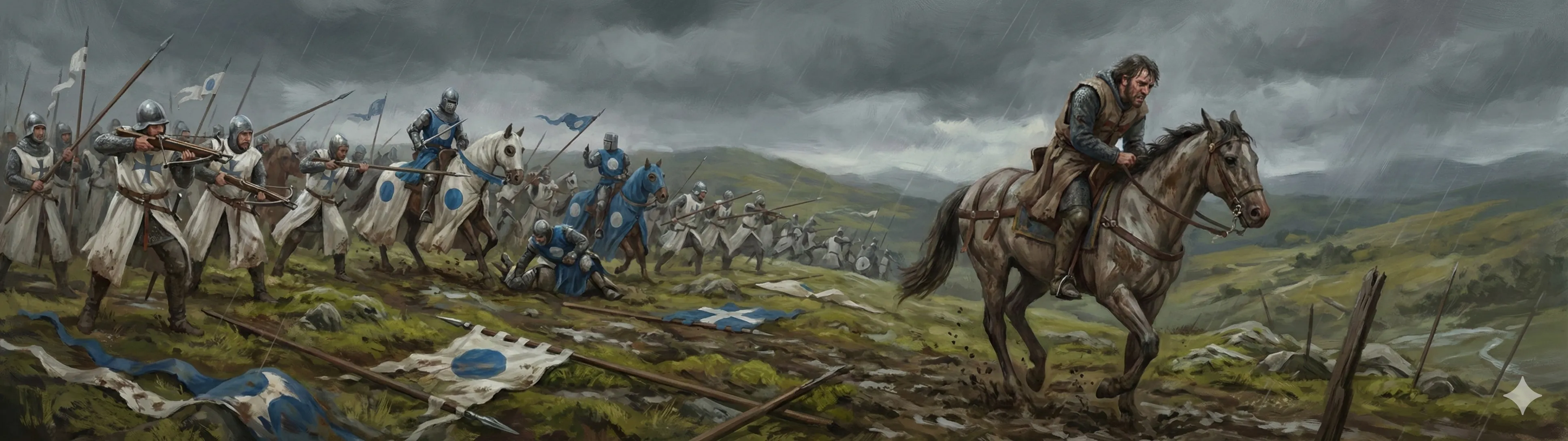
Porto de Bois and the End of the Castro Kingdom
In 1370, Enrique II sent his enforcer west. Pedro Ruiz Sarmiento — a Castilian nobleman with no Galician roots, carrying the title Adelantado Mayor de Castilla — arrived in Galicia at the head of the feared *Compañías Blancas*, the French mercenary companies that had helped Enrique seize the throne. His mission was simple: destroy Fernando de Castro and break the last Petrist resistance in the kingdom.
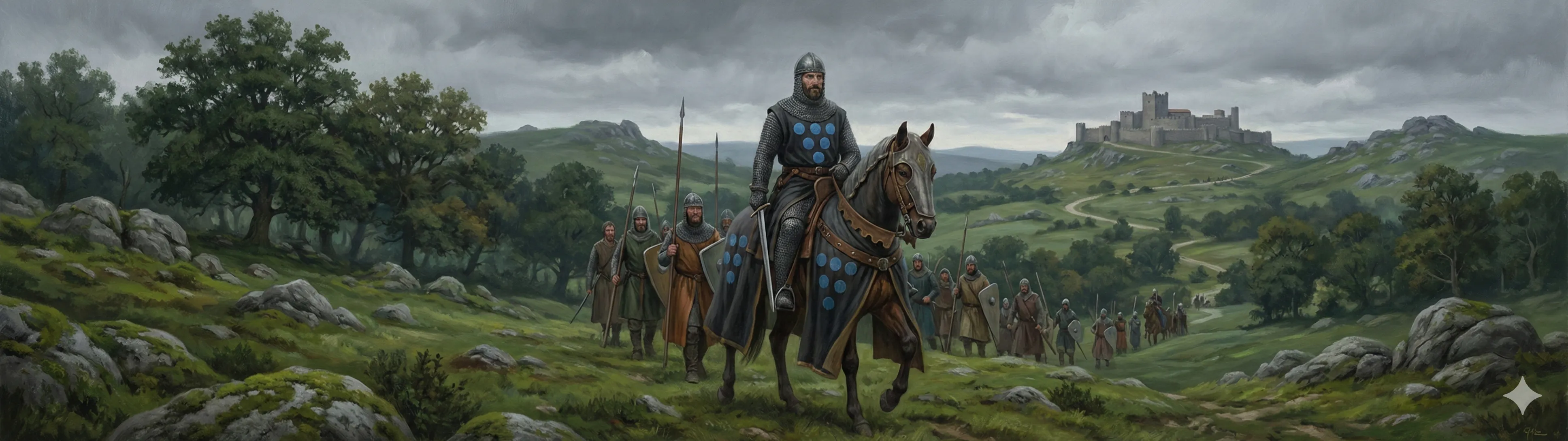
Fernando gathered an army of Galician loyalists and Portuguese allies and rode to meet him. The two forces clashed at Porto de Bois, near Palas de Rei in the province of Lugo, in early 1371. The site held a grim family resonance — Fernando's grandfather had been killed in battle at the same place in 1304. History repeated itself. The Castros were routed. Fernando fled south across the Miño into Portugal, wounded and broken.
The Treaty of Santarém in 1371 forced the Portuguese to expel the Petrist exiles. Fernando retreated to the castle of Ourém, then to English-held Bayonne in Gascony, where he died in 1377 — the last lord of the greatest Galician noble house, buried in exile in a foreign city. His tomb bore the inscription: *Aquí iace Don Fernando Ruiz de Castro, toda la lealtad de España.* The man who replaced him — Pedro Ruiz Sarmiento — received the Adelantamiento Mayor de Galicia from Enrique II and, in 1375, the lordship of Ribadavia. The lands the Castros had controlled or influenced for two centuries passed to newcomers. Porto de Bois was not just a battle. It was the end of a world.
- Porto de Bois (1371): the battle near Lugo that destroyed Petrist resistance in Galicia — fought on the same ground where Fernando's grandfather died in 1304
- *Compañías Blancas*: the French mercenary companies that accompanied Sarmiento into Galicia
- Treaty of Santarém (1371): forced the expulsion of Petrist exiles from Portugal
- Fernando de Castro died in Bayonne, 1377: buried in exile, the last lord of the Castro house in Galicia
- The Sarmiento succession: Pedro Ruiz Sarmiento received exactly the offices and territories the Castros had lost — Adelantado Mayor, control of the Ribeiro, lordship of the southern valleys
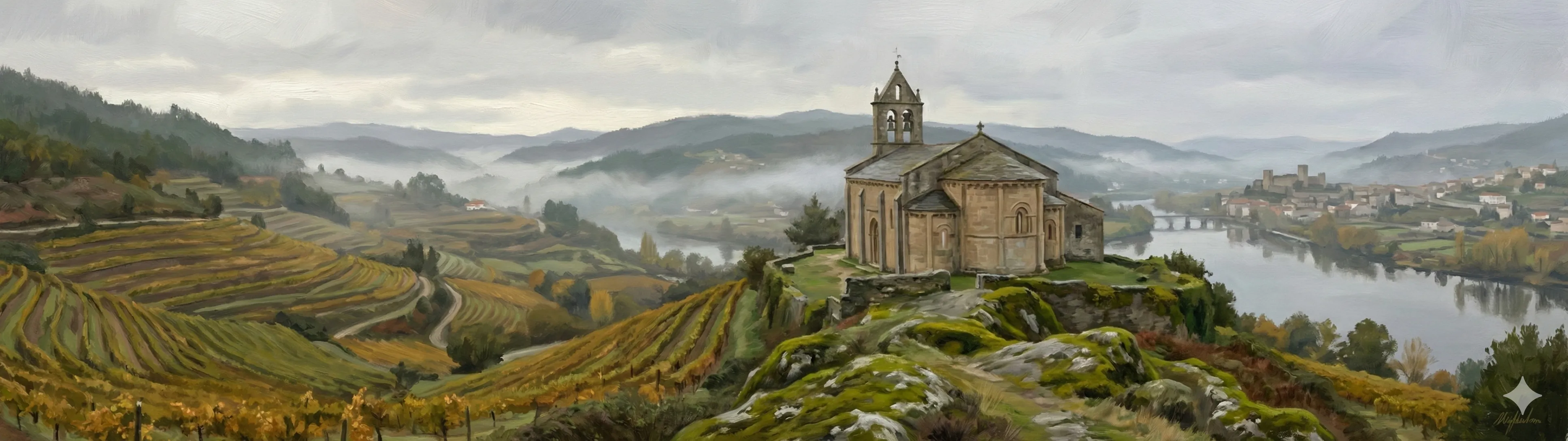
Castrelo de Miño: Where Kings Were Buried and Kingdoms Ended
Across the Miño from Ribadavia — visible from the Sarmiento castle walls — lies the parish of Castrelo de Miño. The name means what it sounds like: *castrelo*, the diminutive of *castro*, a little fort on the river. The place is older than the noble house, older than the medieval kingdom, older than the name itself. On the hilltop above the modern village, where the church of Santa María now stands, there was once a castro — an Iron Age hillfort — and after it a fortress, and after the fortress a monastery.
It was in this monastery that Sancho Ordóñez, the last independent King of Galicia, was buried in 929 after a reign of just three years. His widow, the Galician noblewoman Goto Muñoz, took the veil at the same house and served as its abbess until at least 947. Forty years later, Sancho I of León — known as *el Craso*, "the Fat" — came to Castrelo de Miño to suppress a Galician rebellion and was poisoned there in 969 by Count Gonzalo Menéndez, who offered him an apple laced with venom. Two kings, one monastery, both dead.
Castrelo de Miño is not a Castro lordship in the dynastic sense — the Galician branch of the house was centred on Lemos and Sarria, not the Ribeiro. But the name itself maps the connection. The *castros* — the fortified hilltops that dot every ridge in the Miño valley — predate all the noble houses, all the military orders, all the kingdoms. The triangle holds. Ribadavia (Sarmiento castle, Jewish quarter, wine market), Cartelle (Templar commandery), Castrelo de Miño (royal monastery, ancient fortress, Miño crossing) — three points of a single system. The Castros left their name on the landscape. The Sarmientos built their walls on top of it.
- Castrelo de Miño: *castrelo* = diminutive of *castro* (fortified hilltop settlement)
- Sancho Ordóñez (c. 895–929): King of Galicia, crowned in Santiago de Compostela 926, buried at the monastery of Castrelo de Miño
- Queen Goto Muñoz: widow of Sancho Ordóñez, became abbess of the Castrelo de Miño monastery, attested in 947
- Sancho I "el Craso" of León: poisoned at Castrelo de Miño in 969
- Diego Xelmírez: Archbishop of Compostela, imprisoned at the Castrelo de Miño fortress twice in the twelfth century
- The Ribadavia–Cartelle–Castrelo triangle: castle, commandery, and crossing — the three nodes of power in the Ribeiro valley (see The Military Orders, Casa de Sarmiento)
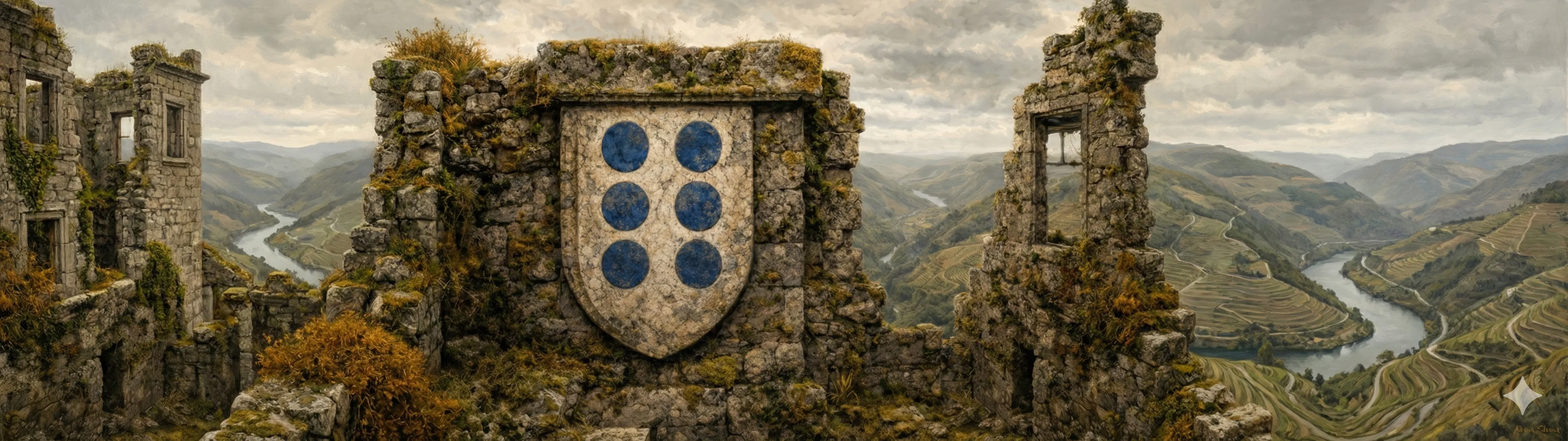
Six Roundels on a Field of Silver
The arms of the Galician branch of the Casa de Castro bear six blue roundels (*roeles de azur*) on a silver field (*argent*), arranged 2-2-2. The Portuguese branch used thirteen roundels on gold. The roundel — called a *torteau* in French blazon and a *roel* in Castilian — is among the oldest charges in Iberian heraldry, and the Castro arms are considered one of the most ancient armorial devices on the peninsula. Over time, as the house merged with the Osorios to form the Castro-Osorio line that held the County of Lemos in the sixteenth and seventeenth centuries, the arms were quartered with the Osorio wolves passant — but the six blue roundels remained the identifying mark of the original house.
Murguía called the Castros a "semi-royal dynasty." Hermida Balado went further: "the only lineage that could have forged a dynasty of kings in Galicia." The arms survive on churches and pazos across the interior of Galicia — from Monforte de Lemos to Castro Caldelas to the ruins of lordly houses in the Ribeira Sacra. When the senior Castro line failed for lack of heirs, the County of Lemos passed through the Osorios and eventually to the House of Alba, where the title rests today. But the six blue roundels on silver — the oldest heraldic mark of Galician lordship — endure on stone lintels and church walls throughout the kingdom the Castros once ruled.
- Arms: six blue roundels (*roeles de azur*) on a silver field (*argent*), arranged 2-2-2
- Portuguese branch: thirteen roundels on gold
- Castro-Osorio quartering: the later combination with the Osorio wolves (*lobos pasantes*) after the families merged through the County of Lemos
- The County of Lemos: the Castros' primary title, passed to the Osorios, then to the House of Alba
Key Figures
Lords, queens, and exiles of the Casa de Castro
The first great Castro lord of the Galician branch. Served as Adelantado Mayor under Alfonso X and Pertiguero Mayor de Santiago. Married Aldonza Rodríguez de León, granddaughter of Alfonso IX.
Grandson of Sancho IV of Castile. Seized the Moroccan sultan's gold spurs at the Battle of Salado (1340). Died of plague at the Siege of Algeciras. Buried in the Cathedral of Santiago de Compostela.
Natural daughter of Pedro Fernández de Castro. Lover and posthumous wife of Pedro I of Portugal. Murdered at Coimbra. The subject of Camões, Montherlant, and five centuries of Portuguese literature.
The last great Castro lord of Galicia. Backed Pedro I in the civil war, held Galicia for three years after Montiel, defeated at Porto de Bois in 1371. Died in exile in Bayonne.
Daughter of Pedro Fernández de Castro. Married Pedro I of Castile in 1354, abandoned the following day. Buried in the Cathedral of Santiago de Compostela.
Half-brother of Fernando and Inês, born of the same Portuguese mother as the Dead Queen. Became one of the most powerful noblemen in Portugal. Founded the Portuguese branch of the house.
Not a Castro, but buried at Castrelo de Miño — the monastery across the river from Ribadavia whose name carries the *castro* root into the landscape of the Ribeiro.