Feijóo · Noboa · Araújo · Villamarín
Arenteiro · Castrelo de Miño · Ribadavia · Ourense
Feijóo · Noboa · Araújo · Villamarín
Wine Nobles & Quartered Arms of the Ribeiro
“Their arms were quartered on the same stones, their surnames compounded in the same parish records, their blood mingled in the same children. They were not four families — they were one system.”— The inner circle of the Ribeiro hidalgo network
The Arms
Four shields, one valley
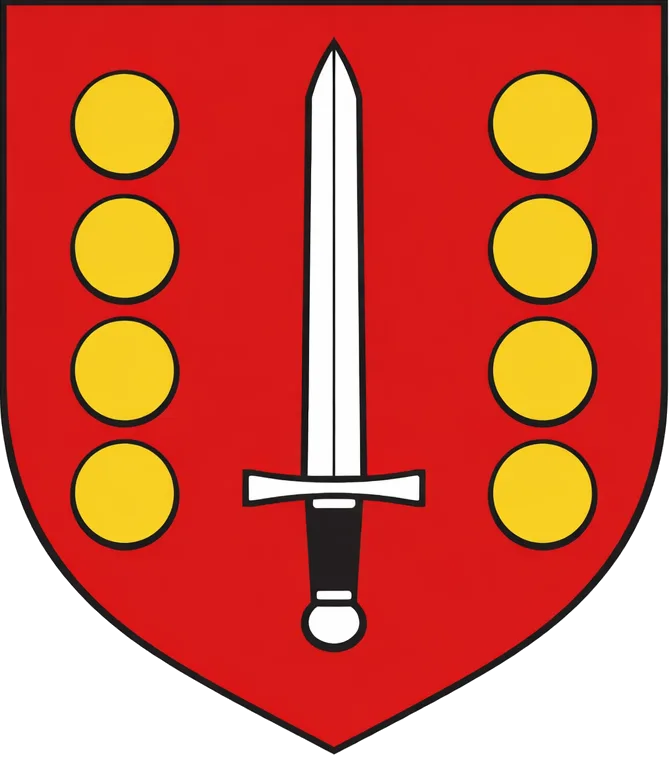
Feijóo: Gules, a sword argent garnished or, flanked by six bezants or — three on each side. The sword points upward, declaring martial status.
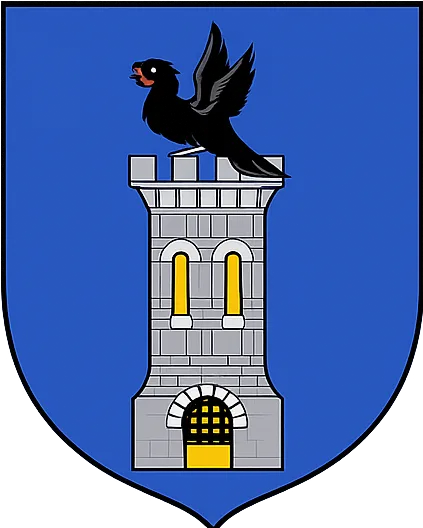
Noboa: Cut — 1st, or, a stone tower; 2nd, argent, an eagle sable sinistered by a lion rampant gules. Variant: azure, a gold tower with half-eagle crowned or.
Araújo: Azure, a cross or; half-party argent, two fesses vair; cut or, a tower over waves. Bordure gules with seven veneras argent.
Villamarín: Azure field — arms quartered with Puga and Novoa at the Pazo de Olivar. Visible on the fortress exterior at Vilamarín.
The Second Ring of the Ribeiro Hidalgo Network
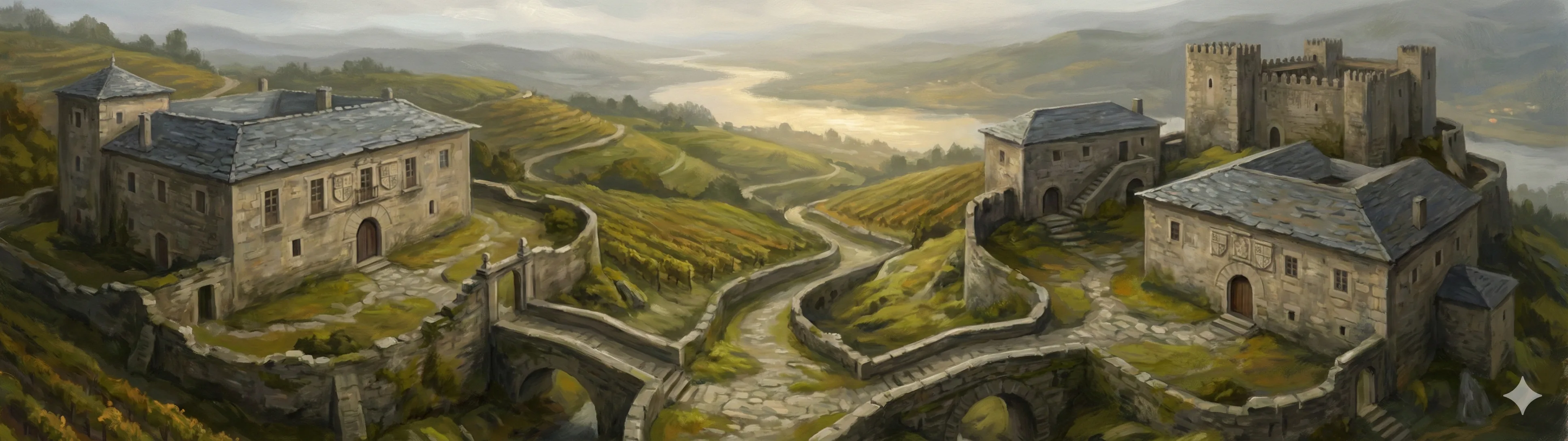
The Armada, Puga, and Mosquera — tower lords and knights of Santiago — formed the military core of the Ribeiro's lesser nobility. But no hidalgo network runs on swords alone. Around that core there existed a wider ring of families whose power was expressed not through fortified towers but through pazos, wine commanderies, marriage alliances, and the quartered arms carved above their doors. These were the "Feijóo", the "Noboa", the "Araújo", and the "Villamarín" — four houses whose interlocking genealogies bound the entire system together.
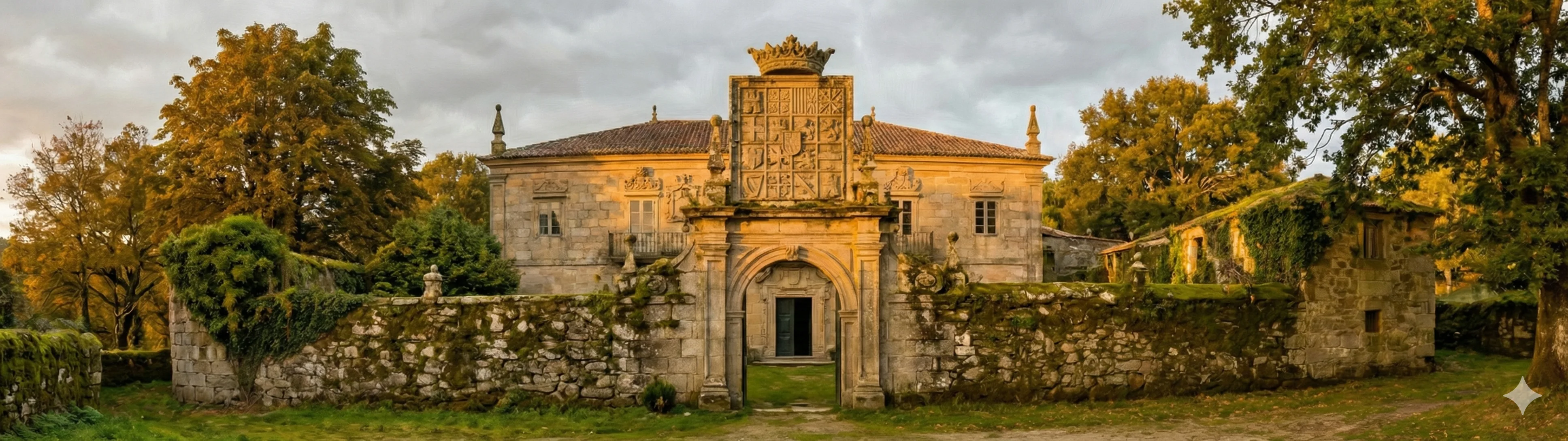
The connections are everywhere. Diego Feijóo "el Bravo" married Berenguela de Noboa Villamarín — one marriage uniting three of the four families. Their son Suero Feijóo married Susana de Puga, daughter of Gonzalo de Puga and Teresa de Noboa — linking the Feijóo directly to the Puga tower lords. Antonio de Puga Feijóo married Antonia de Araújo. The compound surname "Feijóo y Araújo" appears across the Ribeiro's parish records throughout the seventeenth and eighteenth centuries. At the Pazo de Olivar in Puga, the shield displays the combined arms of Puga, Villamarín, and Novoa. At the Casa Grande de Merens in Cortegada, the largest heraldic shield in Galicia — eighteen quarters under a count's crown — bears the names Araújo, Feijóo, Mosquera, Novoa, and Sarmiento side by side.
If the Armada-Puga-Mosquera triangle was the skeleton of the network, the Feijóo-Noboa-Araújo-Villamarín ring was the connective tissue — the web of marriages, shared jurisdictions, and wine wealth that kept the valley's nobility functioning as a single system for three hundred years.
- Four families, one system: Feijóo (Lords of Arenteiro), Noboa (Lords of Pena Novoa), Araújo (Lords of Castrelo de Miño), Villamarín (Lords of the Fortress)
- The compound surname "Feijóo y Araújo" appears in parish records from Gomariz (1680), Vide (1705), and San Cristóbal de Rejo (1730) — proof of repeated intermarriage
- The Casa Grande de Merens shield (1789): eighteen quarters displaying Araújo, Feijóo, Ortigueira, Mosquera, Cisneros, Figueiroa, Novoa, and Sarmiento — the heraldic summary of the entire network
- Cross-references to the core network: Armada · Puga · Mosquera — the tower lords and military order knights of the Ribeiro valley
Lords of Arenteiro, Knights of Malta, and the Wine Parish
The Feijóo were among the oldest lineages in Galicia. The surname derives from the Galician *feixón* ("broad bean," from Latin *faseolus*), rooting the family in the agricultural landscape of southern Galicia. Genealogical tradition traces the line to "Giraldo Feijóo", a knight of Gothic lineage who lived in the tenth century and is said to have founded the villa of Freixo de Espada à Cinta in Trás-os-Montes, Portugal. His ancestry connects to Duke Hermenegildo, whose son Gutier received the county of Celanova; Gutier's son "San Rosendo" founded the great Monastery of Celanova in 936. Numerous Feijóo knights are buried in its cloister.
The documented trunk begins with "Juan Feijóo de Prado "el Bueno"", esquire, buried at Celanova. His descendant "Gonzalo Méndez Feijóo Sotelo" held the lordships of Vilardecas, Fruíme, and Podentes. From this line descended "Diego Feijóo "el Bravo"" — lord of Sorga, Freixo, and Sotopenedo — whose marriage to "Berenguela de Noboa" (of the house of Villamarín) wove the Feijóo into the wider Ribeiro network. Their son "Suero Feijóo" became alcalde and merino of Sarria, lord of Bóveda de Limia and the cotos of Sorga and Sotopenedo. He married "Susana de Puga", daughter of Gonzalo de Puga and Teresa de Noboa — linking the Feijóo line directly to the tower lords of the Ribeiro.
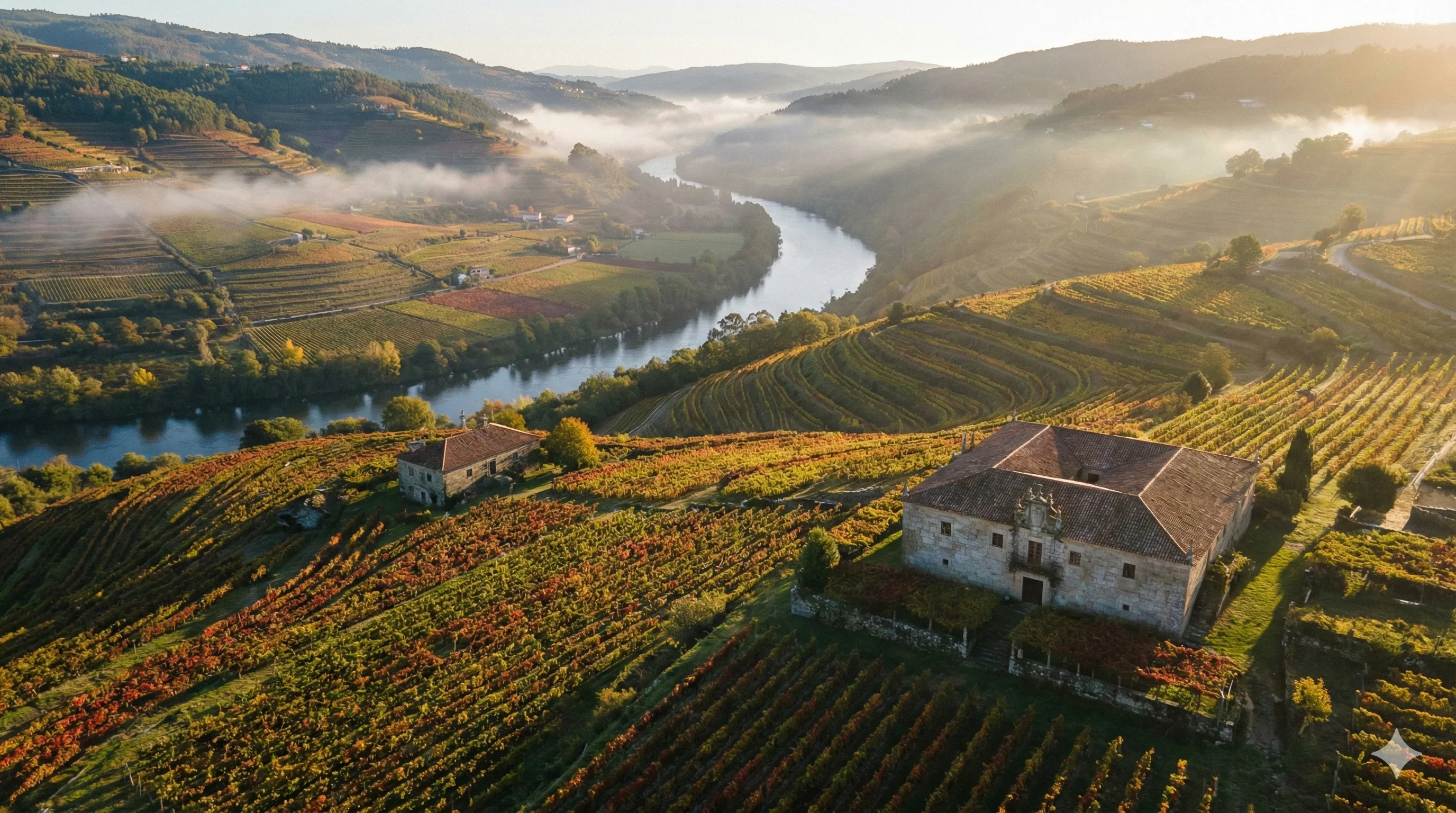
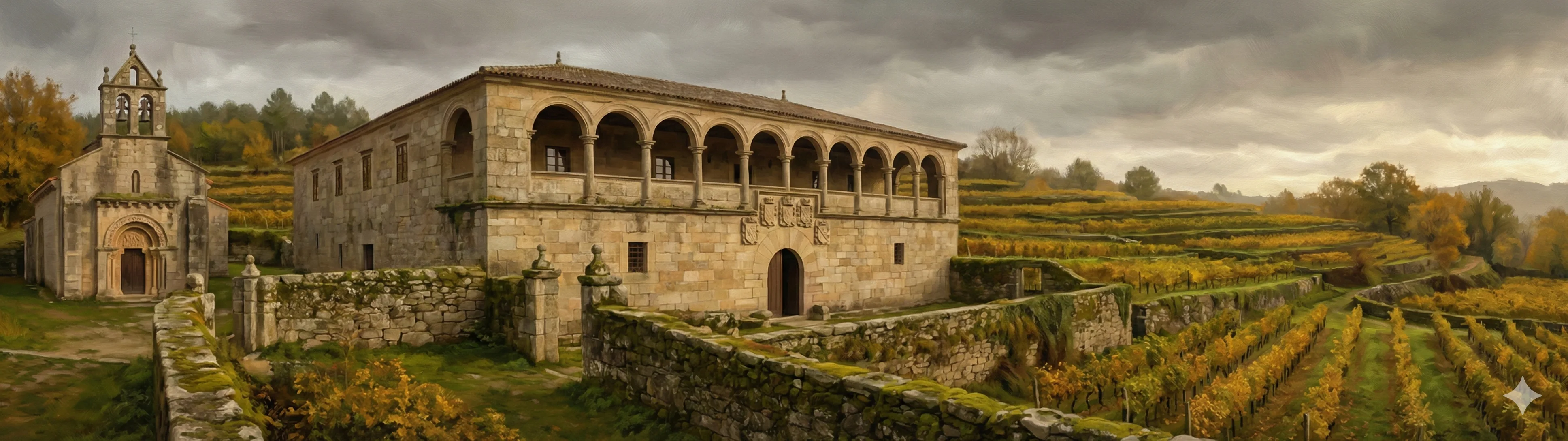
The family's spiritual and economic capital was "Pazos de Arenteiro" — a parish in the municipality of Boborás that holds the distinction of being the "only rural settlement in Galicia" declared a Historic-Artistic Ensemble (17 August 1973). The ensemble includes seven noble houses — among them the "Pazo dos Feixóo" (1553), with its *solaina* of semicircular arches on pillars and three heraldic shields above the entrance — the thirteenth-century Romanesque Church of San Salvador, two medieval bridges, and the "Pazo de la Encomienda", whose walls are studded with Malta crosses. The Order of the Holy Sepulchre first established a commandery at Arenteiro in the twelfth century; in "1542" the Order of Malta took over — one of only four Maltese commanderies in Galicia — controlling tax collection and wine commerce toward Santiago de Compostela.
The Feijóo's most famous son came from this world of wine and learning. "Benito Jerónimo Feijóo y Montenegro" (1676–1764) was born at the family pazo of Casdemiro in the parish of Santa María de Melías, near the Miño. His mother — Doña María de Puga Sandoval Novoa y Feijóo — carried both the Puga and Novoa surnames, placing the great Benedictine scholar at the intersection of the Ribeiro hidalgo network. He renounced his rights as firstborn to the family's *mayorazgo* upon entering the monastery and went on to become the most influential Spanish intellectual of the eighteenth century, a one-man Enlightenment whose *Teatro Crítico Universal* dismantled superstition in favour of empirical reason.
- Pazo dos Feixóo (1553): the ancestral Feijóo seat in Pazos de Arenteiro — *solaina* with semicircular arches, three heraldic shields on the facade
- Pazos de Arenteiro: the only rural settlement in Galicia declared a Historic-Artistic Ensemble (1973) — seven pazos, a Romanesque church, two medieval bridges, and the Malta commandery
- Pazo de la Encomienda: the Order of Malta's commandery at Arenteiro — one of only four in Galicia, with Renaissance staircase and Malta crosses embedded in the walls; now a guesthouse
- Diego Feijóo "el Bravo": lord of Sorga, Freixo, and Sotopenedo — married Berenguela de Noboa (of the house of Villamarín), uniting three families in one marriage
- Captain Suero Feijóo de Alberos: described as "of the house of Villamarín" — a descendant of Diego Feijóo el Bravo who received a legacy from Antonio Feijóo, who died in the Indies (will of 1587)
- Benito Jerónimo Feijóo (1676–1764): born at the pazo of Casdemiro — his mother carried the Puga and Novoa surnames; author of the *Teatro Crítico Universal*, the most influential Spanish intellectual of the eighteenth century
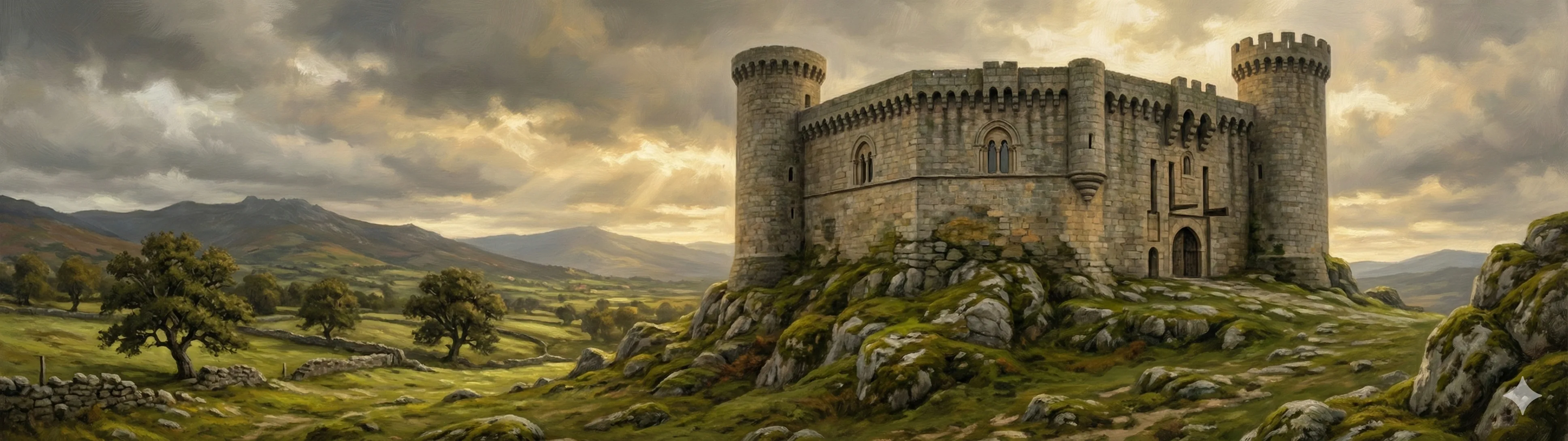
Lords of Pena Novoa, Keepers of Maceda, and the Plateresque Tombs
The Noboa — also rendered Novoa — were one of the most ancient noble houses in Galicia. Their primitive solar was at "Pena Novoa", in the parish of Novoa, within the district of Ribadavia, province of Ourense. From this castle the family took their name. They were lords of the land of Novoa and its castle, and married several times into descendants of the Royal House of Castile and León.
A critical branch took root at the "Castle of Maceda" — an eleventh-century fortress in the Allariz region of Ourense, notable for its massive granite walls. In the twelfth century, the castle was given as a dowry to "Doña María Fernández", daughter of "Teresa of Portugal" (daughter of Alfonso VI) and — according to tradition — Count Pedro Froilaz de Traba, though some genealogists attribute the parentage to his son Fernando Pérez de Traba. Her marriage to "Juan Ares de Novoa" established the Noboa lineage at Maceda, where it continued until the seventeenth century. The castle hosted the young "Alfonso X the Wise" (age eleven), who studied the Galician language within its walls — a detail that connects the Noboa to the very origins of Galician literary culture. Declared a Historic-Artistic Monument in 1949 and a Cultural Heritage Asset in 1994, the castle now operates as a hotel-monument.
The most vivid record of the Noboa is carved in stone. In the "Church of San Francisco de Ourense", four plateresque tombs from the early sixteenth century preserve the memory of the Noboa-Puga alliance. "Teresa de Noboa", wife of Gonzalo de Puga, lies beneath an ornamental arch — her effigy with hands clasped in prayer, two small dogs playing at her feet. Gonzalo's adjacent tomb shows him in full armour, helmet, hands on chest, head on two cushions, a greyhound at his feet, an angel bearing a prayer book at his side. His epitaph — the most extensive and laudatory of the entire funerary ensemble — declares him a vassal of Ferdinand and Isabella and a regidor of Ourense. The heraldry on the tombs connects both families to the house of Villamarín.
Two further tombs complete the ensemble: "Juan de Noboa", in battle attire with hands joined in prayer, and his granddaughter "Elvira de Noboa" — described as the eighteenth lady of the house of Maceda. Elvira's arcosolium features a carved *vultus trifrons* (three-faced head sharing only four eyes) — an extremely rare iconographic element that speaks to the theological sophistication of the patrons who commissioned it. She wears platform shoes, holds a rosary, and rests her head on rich pillows, while a small dog pauses from gnawing a bone at her feet.
- Pena Novoa: the primitive Noboa solar in the district of Ribadavia — lords of the land of Novoa and its castle
- Castle of Maceda: 11th-century fortress in the Allariz region — hosted Alfonso X the Wise; declared BIC (1994); now a hotel-monument
- Teresa de Noboa: wife of Gonzalo de Puga, daughter of Juan de Noboa — buried in the plateresque tombs at San Francisco de Ourense (dated 1512)
- Elvira de Noboa: 18th lady of the house of Maceda — her tomb features a carved *vultus trifrons* (three-faced head), an extremely rare iconographic element
- The Noboa proved their noble status before the Sala de los Hijosdalgo in Valladolid and Granada between 1506 and 1795 — multiple branches from Ourense and Lugo provinces
- Noboa × Villamarín: Suero de Villamarín ceded the lordship of Maceda to his half-brother Juan Pérez de Novoa — binding the two families through shared jurisdiction
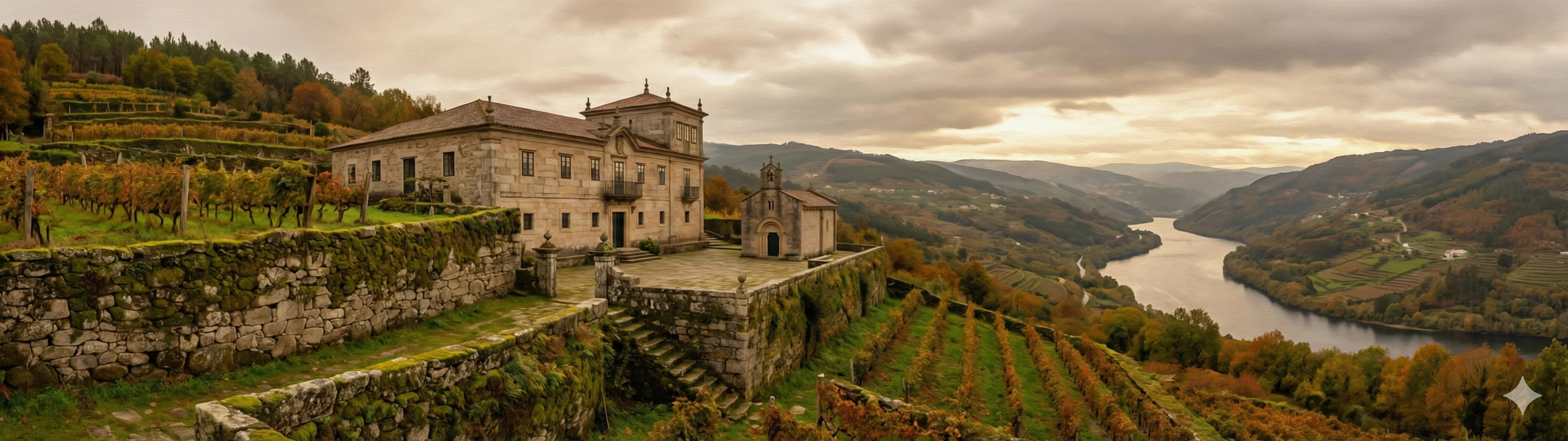
From the Castle of Sande to the Count of Troncoso
The Araújo arrived in Galicia from Portugal, founding houses near Lovios and Bande in the Ourense borderlands. One of the first documented lords was "Payo Rodríguez de Araújo", lord of Lovios and the Castle of Sande — the same fortress that anchors the oldest hidalgo page in this project. The family's trajectory through the Ribeiro followed the classic pattern: marriage into the existing network, consolidation of property through *foros* and *vínculos*, and the gradual accumulation of the compound surnames that mark hidalgo genealogy.
The Araújo's physical seat in the Ribeiro was the "Pazo da Cavadina" — a Baroque manor house in the parish of Santa María de Astariz, place of Troncoso, municipality of Castrelo de Miño. The two-story building, with its central section projecting forward and a chapel in the courtyard, sits on a steep slope overlooking the Miño valley. It was here, in the village of Troncoso, that the family's greatest figure was born.
"Pedro Martínez Feijóo" was born on 8 July 1694 in Troncoso, Astariz, Castrelo de Miño — the heart of Feijóo-Araújo country. His mother, "María Feijóo" of Do Barral, bore the same surname that pervades the Ribeiro's records. Pedro studied Canon Law at the University of Santiago de Compostela, entering the Fonseca College in 1718 and earning his doctorate in 1719. He became a Knight of Santiago, then a Councillor of the Royal Council of Castile (1760). On "2 September 1762", Carlos III created him "Conde de Troncoso" — naming the title after his birthplace in Castrelo de Miño. In 1748 he donated altarpieces by the sculptor Salvador Carmona to the Church of Santa María de Astariz. He died on 7 March 1768.
The Araújo name permeates the Ribeiro's records through the compound surname. "Miguel Araújo Feijóo" of Olivar de Puga — a man bearing the combined Araújo-Feijóo name and living at the Puga family's own seat — filed a *pleito de hidalguía* in 1701. "Diego Feijóo y Araújo" and "Francisco Feijóo y Araújo" of San Cristóbal de Rejo filed their own in 1730. "Pedro Feijóo de Novoa" of Gomariz filed in 1752 — showing the Feijóo-Novoa variant in the same wine country. Captain Juan de Armada married Francisca Fernández de Araújo; Mariana Suárez de Puga married Melchor de Araújo y Colmenero. The Araújo were not a separate house — they were the network itself.
- Payo Rodríguez de Araújo: lord of Lovios and the Castle of Sande — one of the earliest documented Araújo lords in Galicia
- Pazo da Cavadina: Baroque manor in Astariz, Castrelo de Miño — two-story building with chapel, on a steep slope above the Miño valley
- Pedro Martínez Feijóo (1694–1768): born in Troncoso, Castrelo de Miño — Doctor of Canon Law, Knight of Santiago, Councillor of the Royal Council of Castile, "1st Conde de Troncoso" (1762)
- His mother María Feijóo of Do Barral — born in the heart of Feijóo-Araújo country in Castrelo de Miño
- His son Pedro Manuel Martínez Gayoso: scholar at Santa Cruz college, criminal judge at the Chancillería of Valladolid — married María de Zúñiga y Losada, daughter of the Marquises of Bosqueflorido
- Miguel Araújo Feijóo of Olivar de Puga: *pleito de hidalguía* (1701) — an Araújo-Feijóo living at the Puga family seat
- Captain Juan de Armada married Francisca Fernández de Araújo (d. 1629) — the Armada-Araújo connection
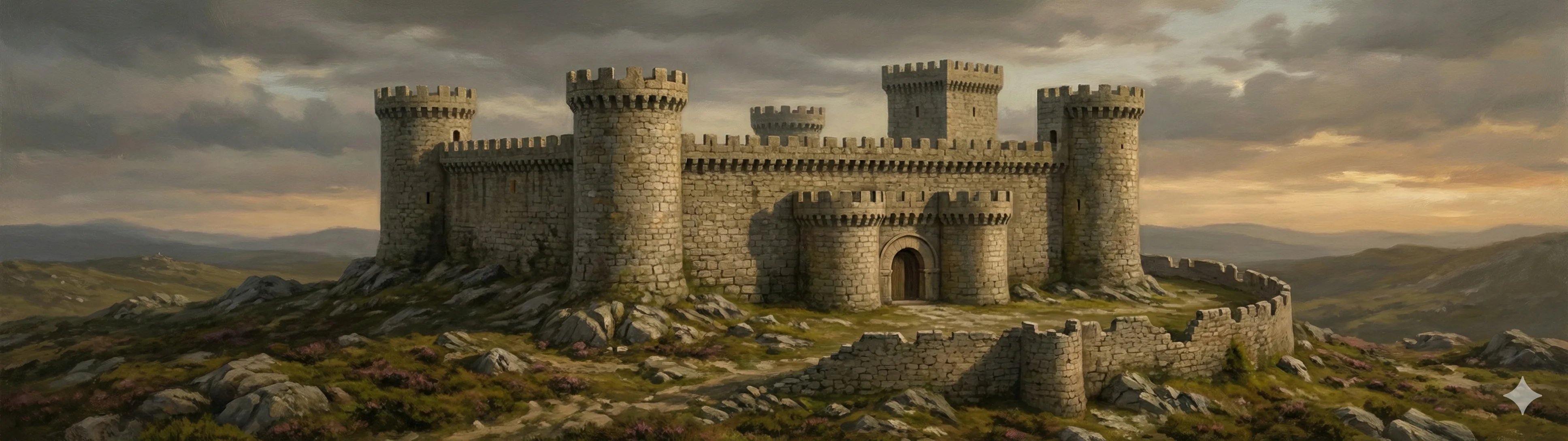
From Oseira Tenants to Fortress Lords: The Pazo-Fortaleza de Vilamarín
The Villamarín story is the most dramatic social ascent in the Ribeiro network — from monastery tenants to fortress lords in three generations. The property that became their seat was originally called the "Casal de Bouzoa", under the domain of the Monastery of Oseira — the great Cistercian house of Ourense. In "1321", the monastic administrator leased it for eight years to "Gil Fernández de Vilamarín" — the man whose name would become the family's surname and the name of the fortress itself.
The transformation from tenant to lord came in "1372", when King Enrique II granted the district and jurisdiction of Vilamarín to "Alfonso Ougea de Vilamarín" and his descendants. This royal grant converted what had been a lease into a lordship. The Vilamarín lords built their fortress on the leased land while nominally continuing to pay tribute to Oseira, but over time payments became negligent and the family claimed outright possession. Litigation with the monastery arose at the beginning of the sixteenth century and was presumably settled in the family's favour — by then, the fortress they had built was the most imposing private residence in the province.
The "Pazo-Fortaleza de Vilamarín" stands at nearly 450 metres elevation on a rocky formation. Its plan is an irregular polygon with seven corners — a kind of elongated hexagonal shape — built of granite masonry. "Five crenellated towers" rise from the walls — three circular and two square according to the Galician Wikipedia, though other sources such as Galicia Máxica describe four circular and one square — all supported by corbels. The central entrance, a round-arch doorway flanked by semicircular towers, leads into a complex that includes a barbican on the less protected sides, four chimneys (the kitchen chimney alone measuring over two metres per side), and multiple construction phases spanning the fourteenth to eighteenth centuries. Reportedly damaged during the "Irmandiño revolt of 1467" — though no documentary evidence confirms outright destruction — it was rebuilt with Baroque additions and declared a *Monumento Histórico-Artístico* in 1977. Owned since 1976 by the Diputación Provincial de Ourense, it now serves as a museum.
The Villamarín name appears throughout the network's heraldry. "Leonor López de Noboa Villamarín" married into the Neira family; their son Suero de Neira Villamarín married "Constanza Feijóo" — linking Noboa, Villamarín, and Feijóo in a single alliance. "Catalina Feijóo "of the house of Villamarín"" married Cristóbal Rodríguez de Noboa — again uniting all three surnames. At the Pazo de Olivar in Puga, the Villamarín arms sit beside those of Puga and Novoa on the combined shield. And "Suero de Villamarín" ceded the lordship of Maceda to his half-brother Juan Pérez de Novoa — binding the Villamarín and Noboa houses through shared jurisdiction over one of the greatest fortresses in Ourense.
- Casal de Bouzoa: the original leased property under the Monastery of Oseira — transformed from monastery tenancy to fortress lordship in three generations
- Gil Fernández de Vilamarín (1321): the founding tenant whose name became the family's surname and the fortress's name
- Alfonso Ougea de Vilamarín (1372): received the royal grant of jurisdiction from Enrique II — the moment the family became lords
- Pazo-Fortaleza de Vilamarín: irregular polygon, five crenellated towers (sources differ on the circular-to-square ratio), granite masonry — reportedly damaged during the Irmandiño revolt (1467), rebuilt with Baroque additions; declared Monumento Histórico-Artístico (1977)
- Marcos Barreiros Villamarín of Santa María de Villarino: *pleito de hidalguía* (1701) — proving the family's continued noble status in the early eighteenth century
- Now a museum owned by the Diputación Provincial de Ourense — housing works by Galician and Portuguese artists, including painter Xaime Quessada
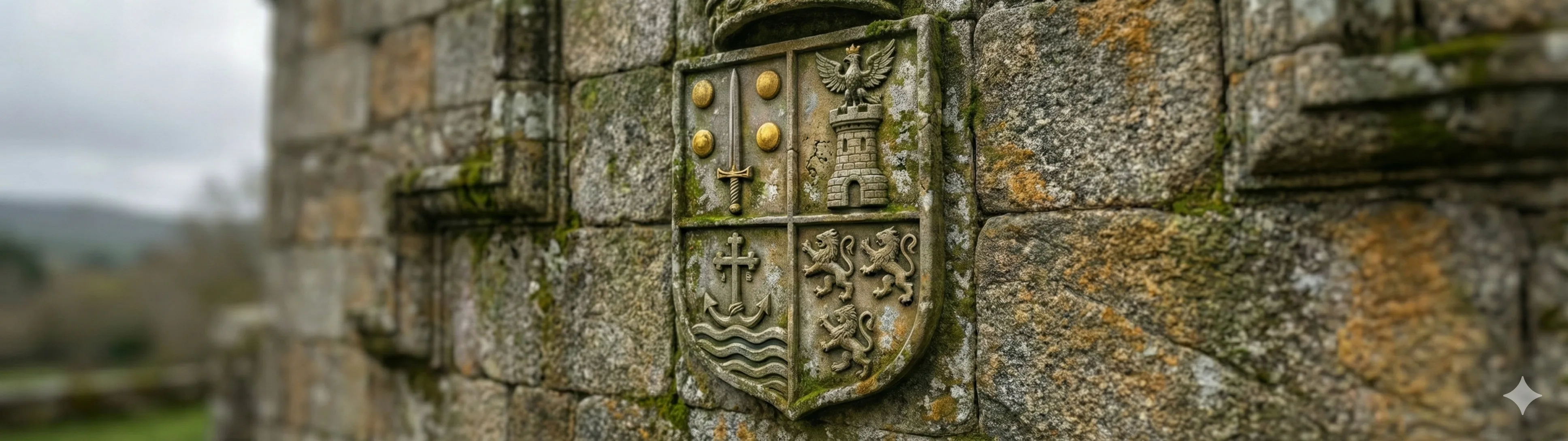
The Marriage Web That Bound the Four Houses
The genealogical record of the Feijóo, Noboa, Araújo, and Villamarín reads like a closed loop. Every marriage connected at least two of the four families, and most connected three. "Diego Feijóo "el Bravo"" married "Berenguela de Noboa Villamarín" — uniting Feijóo, Noboa, and Villamarín in a single alliance. Their son Suero married Susana de Puga — but Susana's mother was Teresa de Noboa, so the Noboa blood entered the Feijóo line twice, from both the paternal and maternal sides. "Leonor López de Noboa Villamarín" married into the Neira line; their son Suero de Neira Villamarín married "Constanza Feijóo" — Noboa, Villamarín, and Feijóo again. "Catalina Feijóo "of the house of Villamarín"" married "Cristóbal Rodríguez de Noboa" — all three surnames, one more time.
The Araújo entered the web through both the Feijóo and the Puga. "Antonio de Puga Feijóo" married "Antonia de Araújo" — linking Puga, Feijóo, and Araújo in the early seventeenth century. "Mariana Suárez de Puga" married "Melchor de Araújo y Colmenero" around 1655. Captain Juan de Armada married "Francisca Fernández de Araújo" before 1629. The compound surname ""Feijóo y Araújo"" became so common that it appears as a single entity in parish records: Pedro Feijóo y Araújo of Gomariz (1680), Vicente Feijóo y Araújo of Vide (1705), Francisco Feijóo y Araújo of San Cristóbal de Rejo (1730). The mother of the first Count of Troncoso — María Feijóo of Do Barral, per the Real Academia de la Historia — bore the Feijóo surname from the heart of Araújo country.
The stone record confirms the paper record. At the "Pazo de Olivar" in Puga, a shield displays the combined arms of Puga, Villamarín, and Novoa — three families on one stone. At the "Pazo de Guimarei" in A Estrada, the Mosquera wolves share a quartered shield with the Villar bands, the Sarmiento roundels, and an Aranda lion. At the "Casa da Señora in Lapela", the Armada arms are quartered with Sarmiento, Castro, Feijóo, and Araújo. And at the "Casa Grande de Merens" in Cortegada — built in 1789 — the largest heraldic shield in Galicia displays eighteen quarters bearing the names Araújo, Feijóo, Ortigueira, Mosquera, Cisneros, Figueiroa, Novoa, and Sarmiento under a count's crown. Each carved stone is a marriage contract made permanent.
- Diego Feijóo "el Bravo" × Berenguela de Noboa Villamarín: the triple alliance — Feijóo + Noboa + Villamarín
- Suero Feijóo × Susana de Puga (daughter of Gonzalo de Puga and Teresa de Noboa): Feijóo + Puga + Noboa
- Leonor López de Noboa Villamarín → son Suero de Neira Villamarín × Constanza Feijóo: Noboa + Villamarín + Feijóo
- Catalina Feijóo "of the house of Villamarín" × Cristóbal Rodríguez de Noboa: Feijóo + Villamarín + Noboa
- Antonio de Puga Feijóo × Antonia de Araújo: Puga + Feijóo + Araújo
A Count, an Enlightenment Scholar, and the Largest Shield in Galicia
The four families produced figures that transcended the boundaries of the Ribeiro valley. The most remarkable was "Pedro Martínez Feijóo", born in the village of Troncoso in Castrelo de Miño in 1694 — a man from the heart of Feijóo-Araújo country whose career spanned province to court. He rose from provincial hidalgo to Doctor of Canon Law, Knight of Santiago, and Councillor of the Royal Council of Castile. On 2 September 1762, Carlos III created him "Conde de Troncoso" — naming the title after his birthplace. His son Pedro Manuel married María de Zúñiga y Losada, daughter of the Marquises of Bosqueflorido — connecting the Ribeiro network to the Zúñiga counts of Monterrey. The Count of Troncoso donated altarpieces by the sculptor Salvador Carmona to the church of Astariz — a gesture of patronage that echoed the traditions of his ancestors.
But the family's most enduring contribution to Spanish culture came through the Feijóo line. Benito Jerónimo Feijóo y Montenegro (1676–1764), whose mother carried the Puga and Novoa surnames, became a Benedictine monk at Celanova and went on to write the *Teatro Crítico Universal* (1726–1740) and the *Cartas Eruditas y Curiosas* (1742–1760) — works that challenged superstition, championed empirical science, and made their author the most widely read Spanish intellectual of the eighteenth century. His advocacy for reason and observation predated the French Encyclopaedists and earned him the protection of Fernando VI, who decreed in 1750 that criticising Feijóo's works was forbidden. The hidalgo from the Ribeiro wine country became Spain's one-man Enlightenment.
The physical legacy survives in stone. The "Casa Grande de Merens" (1789) in Cortegada — owned by "Agustina de Puga y Araújo" and her husband "Pedro de Cisneros de Castro y Ulloa", II Conde de Gimonde — displays the largest heraldic shield in Galicia: eighteen quarters bearing the surnames of the entire hidalgo network under a comital crown. The Count of Gimonde himself was a member of Spain's Supreme Central Junta during the Napoleonic War, a patron of the arts who created a free Drawing School in Santiago in 1805 and protected an entire generation of Galician artists. Pazos de Arenteiro, declared a Historic-Artistic Ensemble in 1973, preserves the Feijóo world intact: the *solaina* of the Pazo dos Feixóo, the Malta crosses of the Encomienda, the Romanesque church, the medieval bridges.
- Pedro Martínez Feijóo (1694–1768): born in Troncoso, Castrelo de Miño — 1st Conde de Troncoso (1762), Knight of Santiago, Councillor of the Royal Council of Castile
- Benito Jerónimo Feijóo (1676–1764): Benedictine monk, author of the *Teatro Crítico Universal* — the most widely read Spanish intellectual of the 18th century; mother carried the Puga and Novoa surnames
- Pedro de Cisneros de Castro y Ulloa, II Conde de Gimonde (1770–1824): husband of Agustina de Puga y Araújo — member of the Supreme Central Junta, patron of the arts, creator of a free Drawing School in Santiago (1805)
- Pazos de Arenteiro: Historic-Artistic Ensemble since 1973 — seven pazos, a Romanesque church, two bridges, the Malta commandery
- The Pazo-Fortaleza de Vilamarín: now a museum of Galician art, owned by the Diputación Provincial de Ourense — the fortress that began as a monastery lease in 1321 serves the public six centuries later
Four Shields, One System
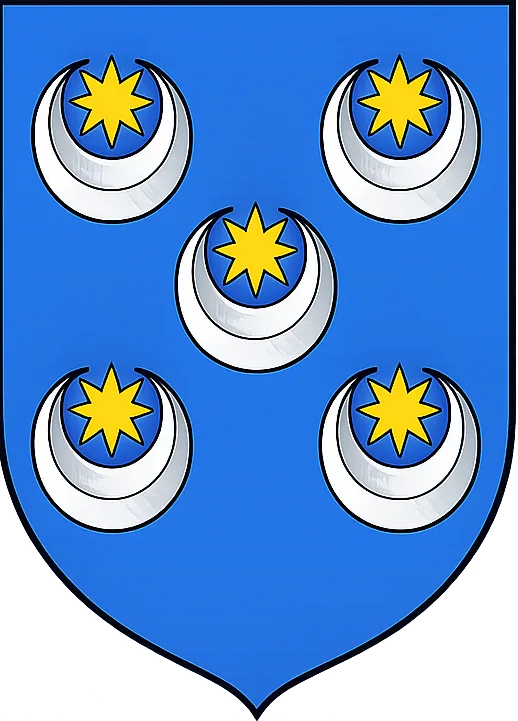
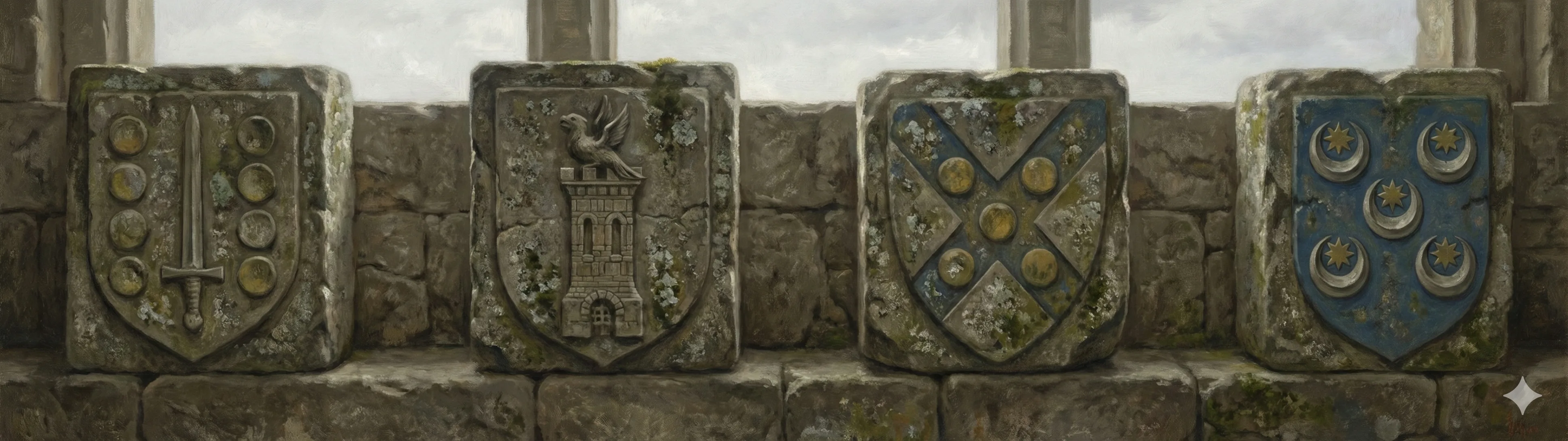
The "Feijóo" bore arms of "gules with a silver sword" (guarnished in gold) "flanked by six gold bezants", three on each side. The sword — military, vertical, pointing upward — declares martial status, while the bezants (a device shared with the Sarmiento and Castro) signal alliances with the greater houses. Some Ourense and Portuguese branches adopted a variant: roundels of sinople on a field of silver, omitting the sword. The arms appear on the facade of the Pazo dos Feixóo in Arenteiro and — in escutcheon — at the centre of the shield at the Pazo de Chaioso in Maceda, surrounded by the quarters of Novoa, Mosquera, Losada, and Salgado.
The "Noboa" (Novoa) bore multiple variants reflecting the family's widespread branches. The most recognised shows a "cut shield": upper half, a stone tower on a gold field; lower half, a sable eagle and a gules rampant lion on a silver field. A Galician variant shows an "azure field with a gold tower", from whose merlons rises a silver half-eagle crowned in gold. At the Church of San Francisco de Ourense, the arms on the plateresque tombs connect the Noboa to the house of Villamarín — the heraldry confirming what the genealogies record.
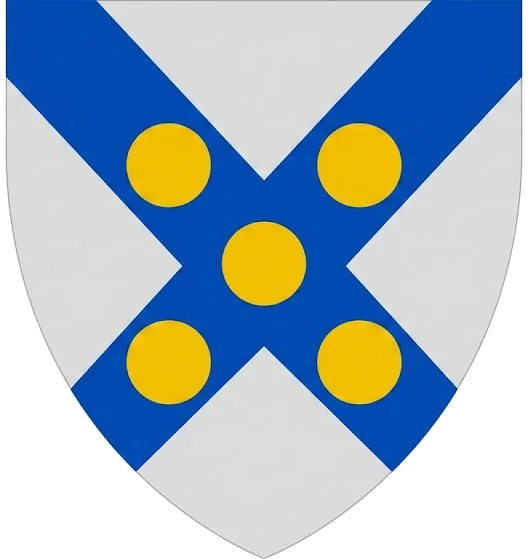
The "Araújo" bore an "azure field with a plain gold cross", half-party silver with two stripes of vair, cut gold with a stone tower over water waves, all within a border of gules bearing seven silver scallop shells (*veneras*). The scallop shells — the emblem of Santiago — mark the family's Compostelan orientation. A smaller Araújo shield at the entrance of the Casa Grande de Merens may show a variant: the cross of Calvary cantoned by four bezants that appears in local descriptions.
The "Villamarín" bore arms that survive, somewhat eroded, on the exterior of the Pazo-Fortaleza de Vilamarín. Heraldic references describe an "azure field" symbolising loyalty and truth. The arms appear quartered with those of the Puga and Novoa at the Pazo de Olivar in Toen — three families, one stone, one valley.
- Feijóo: Gules, a sword argent garnished or, flanked by six bezants or, three on each side — the sword points upward, declaring martial status
- Noboa (primitive): Cut shield — 1st, or, a stone tower; 2nd, argent, a sable eagle sinistered by a gules rampant lion
- Noboa (Galician variant): Azure, a gold tower with a silver half-eagle crowned or rising from the merlons
- Araújo: Azure, a plain cross or; half-party argent with two fesses of vair; cut or with a stone tower over waves — bordure gules with seven veneras argent
- Villamarín: Azure field — arms visible on the fortress exterior, quartered with Puga and Novoa at the Pazo de Olivar
- The Pazo de Chaioso shield (c. 1850): Feijóo in the escutcheon, surrounded by Novoa, Mosquera, Losada, and Salgado — a heraldic summary of the network
Key Figures
Lords, scholars, fortress builders, and the keepers of the Ribeiro's quartered arms
Legendary founder of the Feijóo lineage, traced to the counts of Celanova and the family of San Rosendo, founder of the great Monastery of Celanova (936). His descendants established the Feijóo as one of the oldest houses in southern Galicia.
Received an eight-year lease on the Casal de Bouzoa from the Monastery of Oseira. His name became the family surname and the name of the fortress. Within two generations, his descendants were lords, not tenants.
Married Berenguela de Noboa Villamarín — the single marriage that united three of the four families. Their son Suero Feijóo married Susana de Puga, daughter of Gonzalo de Puga and Teresa de Noboa, weaving the Feijóo into the core of the hidalgo network.
Buried in a plateresque tomb in the Church of San Francisco de Ourense, her effigy shows her with hands clasped in prayer and two small dogs playing at her feet. Her husband Gonzalo, vassal of the Catholic Monarchs, lies in full armour beside her.
Granddaughter of Juan de Noboa, also buried at San Francisco de Ourense. Her tomb features a carved *vultus trifrons* — a three-faced head sharing only four eyes — one of the rarest iconographic elements in Galician funerary sculpture.
Born in Troncoso, Castrelo de Miño. Doctor of Canon Law (Santiago, 1719). Knight of Santiago. Created Conde de Troncoso by Carlos III (1762). Donated Salvador Carmona altarpieces to the church of Astariz. His mother María Feijóo, a native of Do Barral, bore the Feijóo surname.
Born at the pazo of Casdemiro; mother carried the Puga and Novoa surnames. His Teatro Crítico Universal (1726–1740) championed empirical reason over superstition. Fernando VI decreed in 1750 that criticising his works was forbidden. Spain's one-man Enlightenment.
Husband of Agustina de Puga y Araújo, lady of Merens. Member of Spain's Supreme Central Junta during the Napoleonic War. Patron of the arts, protector of Galician artists, creator of a free Drawing School in Santiago (1805). The shield at his Casa Grande de Merens bears eighteen quarters.
Brought the Merens estate and its Puga-Araújo lineage into the marriage with the Count of Gimonde. The Casa Grande de Merens (1789) displays the largest heraldic shield in Galicia — eighteen quarters under a comital crown.