Armada · Puga · Mosquera
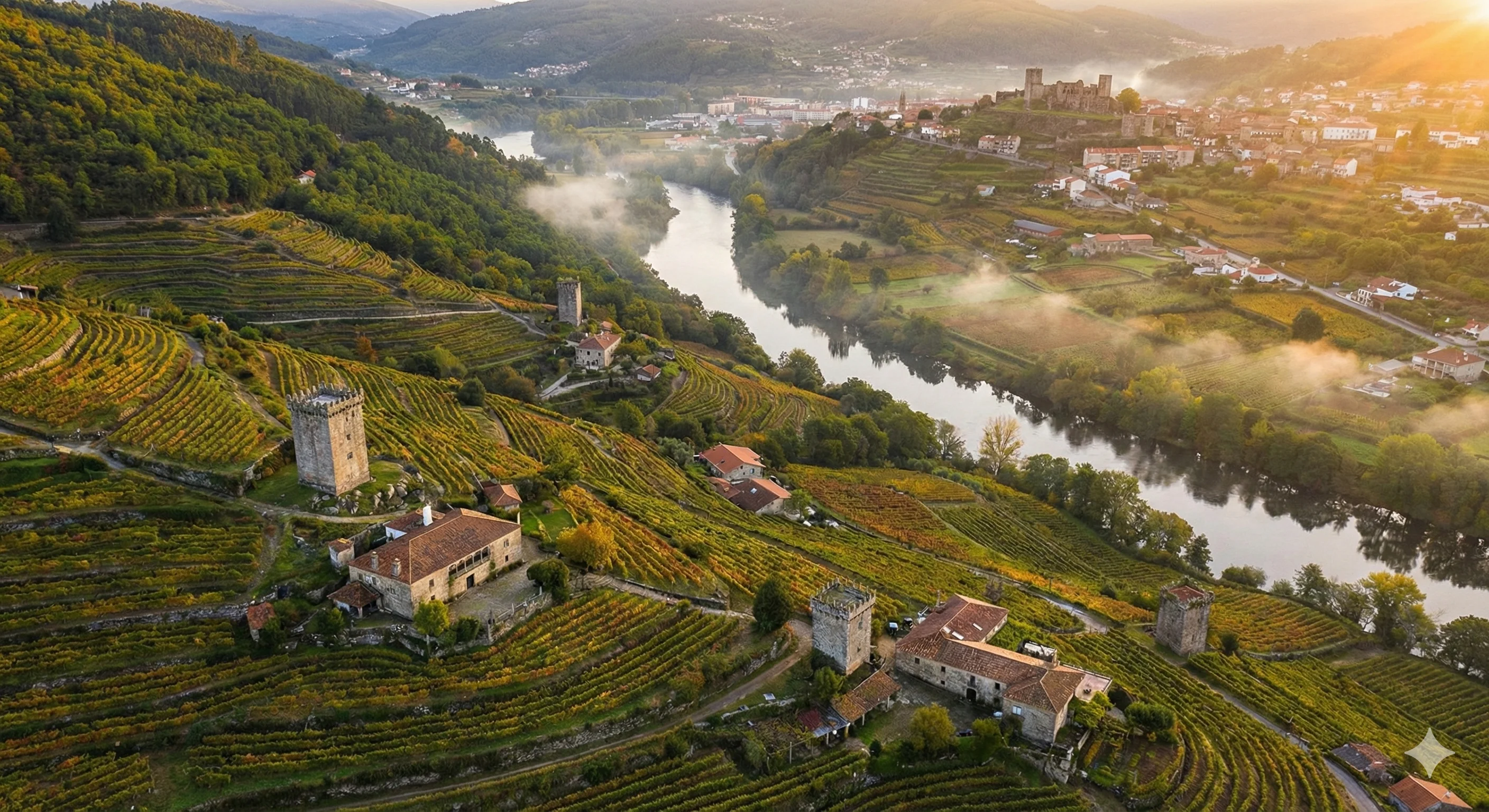
Castrelo de Miño · Ribadavia · Ourense
Armada · Puga · Mosquera
Tower Lords & Knights of the Ribeiro
“They proved their noble status before the Real Chancillería de Valladolid, entered the military orders, and — most importantly — married each other.”— The hidalgo network of the Ribeiro valley
The Arms
Three shields, one valley
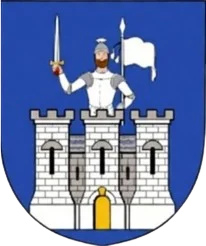
Armada: Warriors with swords and banners; castles and towers defended by armed figures. Tinctures: sable, azure, gules, and argent.
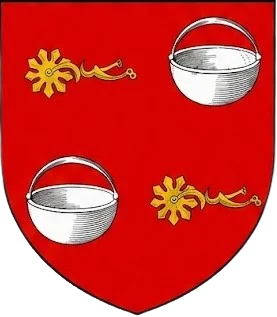
Puga: Azure, two cauldrons argent in pale, two spurs or in fess. Alternative: Gules, a lion rampant or with four fleur-de-lis or.
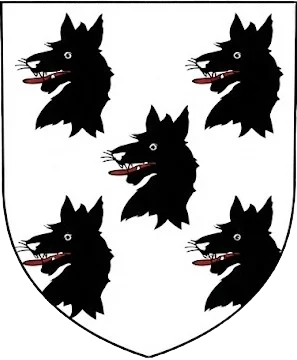
Mosquera: Argent, five wolf heads sable, langued and couped gules. Canting variant: Azure, five flies or in saltire.
The Hidalgo Web of the Ribeiro Valley
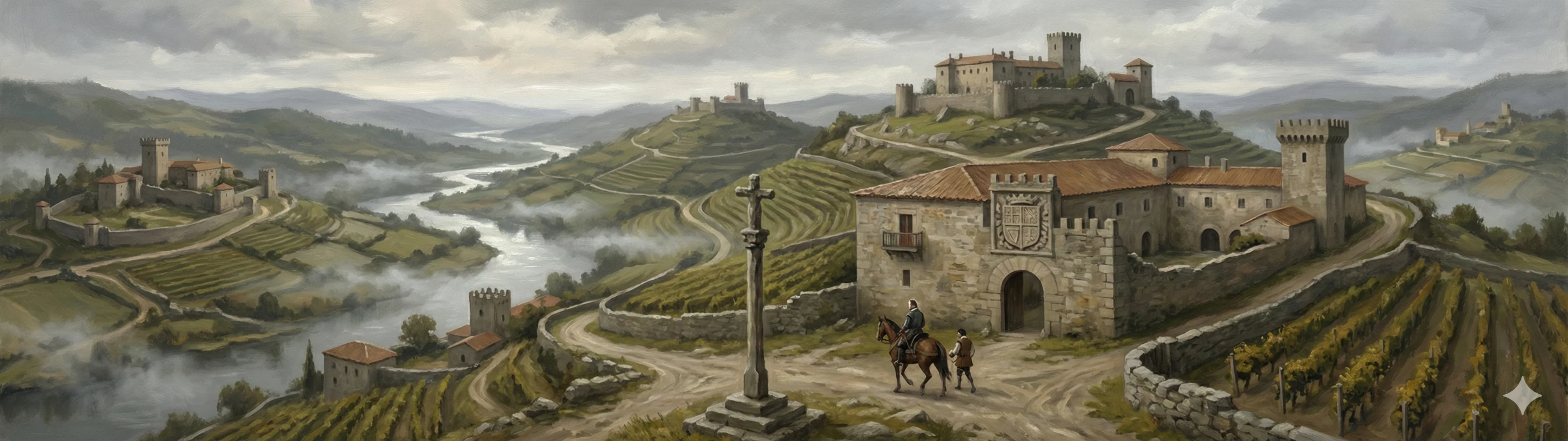
Below the great lords — the Sarmiento counts of Ribadavia, the Castro lords of Lemos, the Zúñiga-Biedma counts of Monterrey — there existed a denser, more permanent layer of local power. These were the *hidalgos*: the lesser nobility of proven blood who held the fortified towers, the casas solares, and the pazos that dot the landscape of the Ribeiro valley. They served as regidores of Ourense, captains of local militia, administrators of tithes and taxes. They proved their noble status before the Real Chancillería de Valladolid, entered the military orders, and — most importantly — married each other.
Three families dominated the hidalgo network of Castrelo de Miño and Ribadavia: the "Armada", whose casa solar stood in the parish of Vide do Miño; the "Puga", whose fortified tower commanded the heights above the Miño valley from Toen; and the "Mosquera", whose escuderos appear in Ribadavia's records from the late fifteenth century. Together with the Feijóo, the Araújo, the Noboa, and the Villamarín, they formed an interconnected web of marriage alliances, shared jurisdictions, and quartered arms that bound the region's lesser nobility into a single system. The Casa da Señora in Lapela — where the arms of the Armada appear quartered with the Sarmiento, Castro, Feijóo, and Araújo — is the physical proof of how tightly these families were woven together.
- *Hidalgo* (from *hijo de algo*, "son of something"): the lowest rank of the Castilian nobility — proven by blood, confirmed by the Real Chancillería de Valladolid
- Casa solar: the ancestral house or fortified tower that served as the physical seat of a noble lineage
- Real Chancillería de Valladolid: the principal tribunal for adjudicating noble status in northern Spain — families that proved their *hidalguía* here had their blood nobility confirmed by the crown
- The Ribeiro triangle: Ribadavia (Sarmiento castle), Cartelle (Torre de Sande), and Castrelo de Miño (royal monastery) — the hidalgo families operated within this system of overlapping jurisdictions
From Vide do Miño to the Marqueses de Santa Cruz de Ribadulla
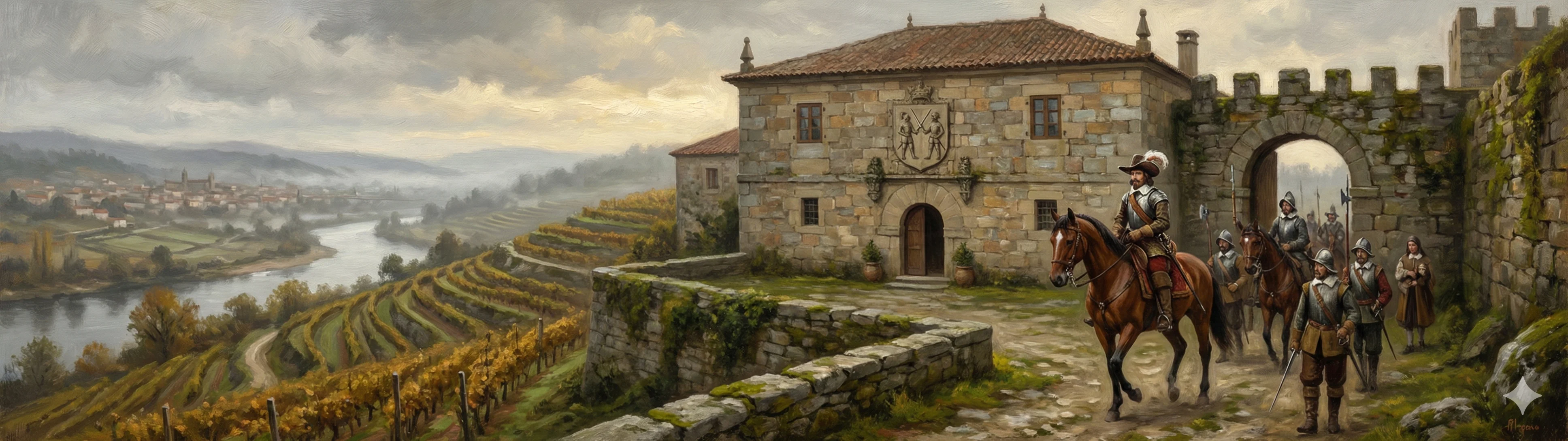
The Armada family's casa solar was the "Casa do Casar", in the parish of San Salvador de Vide do Miño, municipality of Castrelo de Miño — placing them at the geographic heart of the Ribeiro valley, within sight of Ribadavia across the river. The surname is toponymic, derived from the various places in Galicia called "A Armada," though genealogical tradition traces the family's deeper roots to Rivadulla, along the banks of the Ulla river in the shadow of Pico Sacro. The Casa do Casar still stands today, listed as a heritage property by the Xunta de Galicia.
The first documented head of the line was "Captain Juan de Armada", owner of the Casa do Casar, who died in October 1629. He married Francisca Fernández de Araújo — the Araújo connection, like the Feijóo and Mosquera alliances that followed, was typical of the local hidalgo marriage network. His son, also Captain Juan de Armada, served as regidor and *alguacil de millones* (tax administrator) of Ourense, marrying Isabel Salgado y Taboada, señora de la Casa de Gargalo from Monterrey. The family's trajectory was clear: local captains and property owners rising through municipal service and strategic marriage.
The critical leap came with "Pedro Manuel de Armada y Taboada", baptised in 1645, who became regidor of Ourense and — on 7 November 1668 — was admitted as a "Knight of the Order of Santiago". Admission to Santiago required rigorous proof of noble blood going back four generations, *limpieza de sangre*, and the absence of any manual trade. It was the gold standard of proven *hidalguía*, and Pedro Manuel's admission placed the Armada definitively among the military elite of the kingdom.
The family's transformation from local hidalgos to titled nobility came through "Ignacio Antonio de Armada y Salgado de Mondragón", baptised in Vide do Miño in 1690. He served as regidor mayor and alcaide de millones of Ourense and, through a complex inheritance from his mother's Mondragón line, became the "Marqués de Santa Cruz de Ribadulla" — a title originally created by Carlos II in 1683. The Armada name was now attached to one of the most celebrated estates in Galicia: the Pazo de Santa Cruz de Rivadulla, a thirty-hectare Renaissance garden considered the finest in the kingdom.
- Casa do Casar, Vide do Miño: the ancestral seat of the Armada, in the parish of San Salvador, municipality of Castrelo de Miño
- Captain Juan de Armada (d. 1629): founder of the documented line; married Francisca Fernández de Araújo
- Pedro Manuel de Armada y Taboada: Knight of Santiago (1668) — the admission that confirmed the family's hidalguía
- Marquesado de Santa Cruz de Ribadulla: created by Carlos II (1683); passed to the Armada line through Ignacio Antonio de Armada y Salgado de Mondragón
- Pazo de Santa Cruz de Rivadulla: the great Armada estate in Vedra, A Coruña — 30 hectares of Renaissance and Baroque gardens, designated a Garden of International Excellence by the International Camellia Society
- Pazo dos Armada, Ourense: the family's 16th-century townhouse in the Praza do Eirociño dos Cabaleiros, in the old quarter of Ourense, with heraldic shields above the entrance
The Tower on the Heights: Lords of Puga and Vassals of the Catholic Monarchs
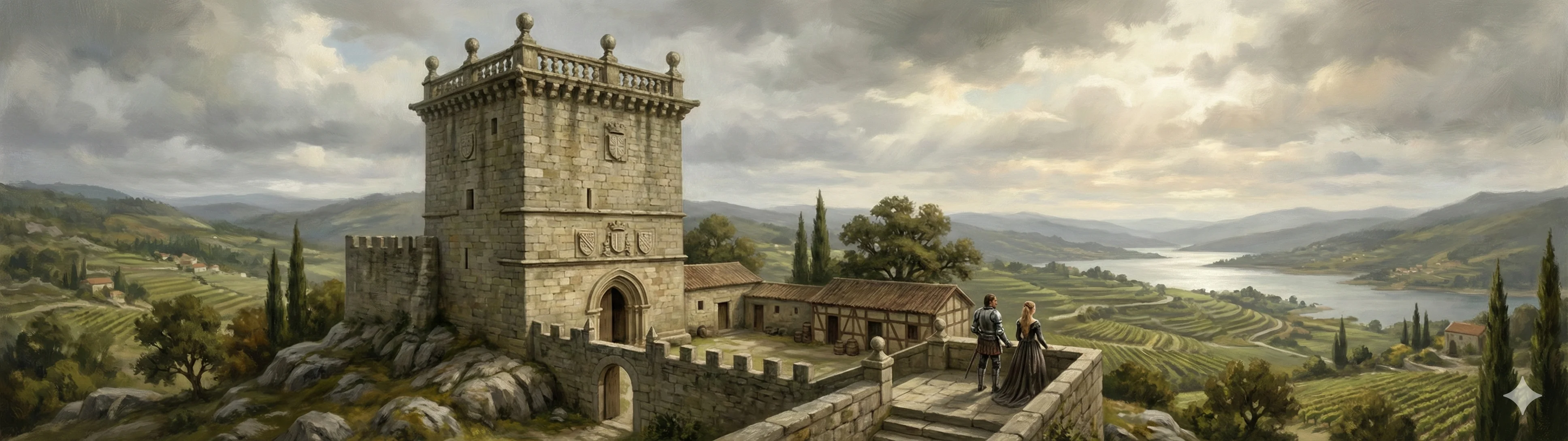
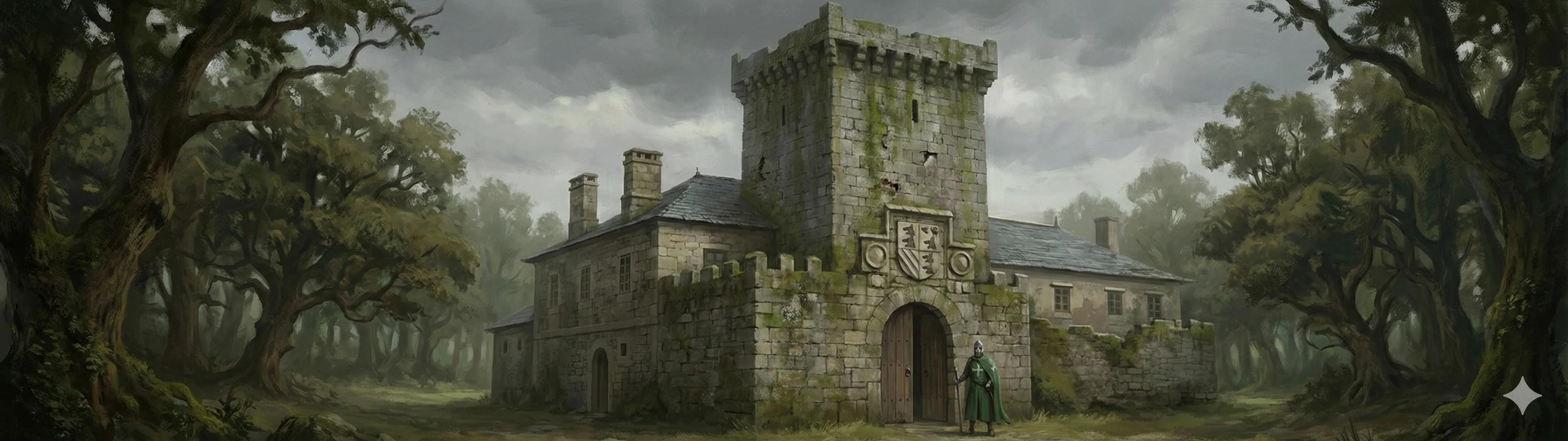
The Puga family took their name from their primitive solar — the "Torre de Puga", in the parish of San Mamede de Puga, municipality of Toen, in the heart of the O Ribeiro wine region. The tower stood at 180 metres elevation on a granite outcrop above the Miño valley, commanding views across the landscape that is now the Castrelo de Miño reservoir and the entrance to the Barbantino valley — two critical routes connecting Ourense with the coast and the northern province. Its proximity to Portugal made it an observation post of exceptional strategic importance. The Puga held a second ancestral seat — the "Torre de Louredo" in Cortegada, twelve kilometres south of Ribadavia — which controlled the Miño valley below the town. The tower was razed during the Irmandiño revolt of 1467, when peasant armies destroyed the feudal fortresses of the Galician nobility; the Catholic Monarchs' subsequent *doma y castración* policy prohibited full military reconstruction, and the tower was rebuilt only as a domestic residence. Its ruins still stand in the village of Louredo, beside the shell of the old Baroque church.
The first documented record of the surname dates to 1276, when *Migeel Eanes de Puga* appears in medieval Galician charters. Heraldic sources trace the lineage further back to the twelfth century, during the reign of Alfonso VII. The Torre de Puga itself — built in the fifteenth and sixteenth centuries — was a fortified house divided into several enclosures, with exterior defensive walls, a central tower, auxiliary dependencies including wine cellars (*bodegas*) and haylofts, and three noble shields displaying the Puga family arms on the entrance and tower facades. An ornamental cornice with baroque-style ball pinnacles crowned the tower at all four corners.
The most prominent figure of the house was "Gonzalo de Puga" (d. c. 1512), knight and lord of the Torre de Puga and Casa de Maceda, *vasallo de los Reyes Católicos* (vassal of Ferdinand and Isabella) and regidor of Ourense. His marriage to Teresa de Noboa linked the Puga to the ancient Noboa lineage; their tomb chapel in the Church of San Francisco de Ourense is a masterpiece of early-sixteenth-century plateresque sculpture. Gonzalo's recumbent effigy shows him in full armour and helmet, hands clasped on his chest, head resting on two cushions, feet on a greyhound, with an angel holding a book of prayers at his side. The heraldry on the tombs connects the Puga to the House of Villamarín.
Gonzalo's daughter Susana married Suero Feijóo — son of Diego Feijóo "el Bravo," lord of Soto de Penedo — forging another link in the valley's hidalgo network. The adjacent Pazo de Olivar, built in the seventeenth century when the family moved from the tower to a more comfortable manor house, displays a shield showing an eagle with extended wings (the Novoa connection) sheltering the arms of the Puga, Villamarín, and possibly Araújo or Deza families. In the mid-nineteenth century, the pazo belonged to *D. Fernando de Puga*, described as "owner and lord of many lands and houses in the region."
- Torre de Puga (also Torre do Olivar): 15th–16th century fortified tower in San Mamede de Puga, Toen — placed on Spain's Lista Roja in 2021 for abandonment, removed in 2024 after private restoration
- First documented reference: *Migeel Eanes de Puga* in a charter of 1276
- Gonzalo de Puga (d. c. 1512): knight, vassal of the Catholic Monarchs, regidor of Ourense — buried in the Church of San Francisco de Ourense with his wife Teresa de Noboa
- Pazo de Olivar: 17th-century manor house adjacent to the tower, now in ruins — displays the combined arms of the Puga, Villamarín, and Novoa families
- Torre de Louredo (Cortegada): the Puga's second solar — destroyed in the Irmandiño revolt of 1467, partially rebuilt; ruins still visible in the village of Louredo beside the old church
- *Probanza de hidalguía*: the Puga proved their noble status before the Real Chancillería de Valladolid — the definitive confirmation of blood nobility
From the Escuderos of Ribadavia to the Lords of Guimarei
The Mosquera were among the oldest families in Galicia. According to Padre Crespo's *Linajes y Blasones de Galicia*, their first ancestral house was the "Casa de Lodoira", in the lands of Mesía near Santiago de Compostela. The founding trunk was Don Pedro Vidal de Santiago, who married Doña Teresa Sánchez de Ulloa; their son, Lope Sánchez de Moscoso, inherited the house of Lodoira, from which both the Moscoso and the Mosquera lineages descended. The Mosquera surname, in other words, shared blood with the Moscoso — one of the four oldest *casas solares* in the kingdom of Galicia.
The Mosquera's military pedigree ran deep. In the early fifteenth century, "Pedro López Mosquera "el Viejo"" served as *alférez mayor* (chief standard-bearer) of Don Fadrique, Duke of Arjona and *tenente* of the Castle of Alba. On 29 November 1425, he appeared before the Cabildo of Ourense seeking absolution after his squire killed the bishop at Pozo Meimón — a dramatic incident recorded in the cathedral archives and studied by Eduardo Pardo de Guevara. His granddaughter "Violante López Mosquera" married Afonso Vázquez de Vilar and settled in "Prado de Miño, Castrelo de Miño", receiving a *foro* (land grant) from the Monastery of Oseira in 1474. Their daughter "Sancha Bello de Mosquera" married "Pedro Vázquez de Puga" of the Louredo branch — the marriage that fused the Puga and Mosquera lines in the heart of the Ribeiro valley. Meanwhile, in 1489, an escudero named "Ares Mosquera" appears in the records of Ribadavia, and in 1504, Pedro López Mosquera renewed the family's *foro* in the district of Castrelo. The academic Pablo S. Otero Piñeyro Maseda has studied them specifically as a lineage of *escuderos* (squires) — the lower ranks of the Galician lesser nobility — in a paper published in the 2010 conference volume *Nobleza y Monarquía: los linajes nobiliarios en el Reino de Granada (Siglos XV–XIX). El linaje Granada Venegas, Marqueses de Campotéjar*.
But the Mosquera were not destined to remain squires. The family's senior branch accumulated an extraordinary series of military order admissions: "Order of Santiago" (1541, 1619, 1631, 1647, 1667, 1751), "Order of Calatrava" (1532, 1717), and "Order of Alcántara" (1638). Each admission required formal proof of noble blood — the Mosquera's genealogical dossiers, submitted and accepted again and again over two centuries, constitute one of the most complete documentary records of provincial hidalguía in Galicia.
The physical seat of the Mosquera's power was the "Torre and Pazo de Guimarei" in A Estrada, Pontevedra — a fortified complex with a twelfth- to thirteenth-century tower and a late-seventeenth-century pazo. The tower, measuring 6.6 by 6.6 metres with thick ashlar walls rising to fifteen metres, was damaged during the Irmandiño revolts of the 1460s and subsequently rebuilt. "Antonio de Mosquera Novoa", born in 1589 and lord of Villar de Payo Muñiz, was a "Knight of Alcántara" (1638) and the first documented inhabitant of the pazo. His descendant "Melchor de Mosquera y Sarmiento", lord of the fortress of Guimarei, became a Knight of Santiago in 1667. The Marquesado de Guimarei was created by Felipe V on 30 September 1716 in favour of Fray Pedro Mosquera Pimentel de Sotomayor, a Knight of the Order of St. John and *Gran Prior de Castilla* of the Order of Malta.
- Casa de Lodoira (Mesía): the primitive Mosquera solar, near Santiago de Compostela — shared ancestry with the Moscoso, one of the four oldest solar houses in Galicia
- Pedro López Mosquera "el Viejo" (early 15th c.): alférez mayor of Don Fadrique, Duke of Arjona — documented in the Cabildo of Ourense (1425)
- Violante López Mosquera × Afonso Vázquez de Vilar: residents of Prado de Miño, Castrelo de Miño — received a *foro* from the Monastery of Oseira (1474)
- Sancha Bello de Mosquera × Pedro Vázquez de Puga: the marriage that united the Puga and Mosquera lines in the coto of Prado, Castrelo de Miño (foro renewed 1504)
- Ares Mosquera (1489): escudero in the Ribadavia region
- Torre de Guimarei (A Estrada, Pontevedra): 12th–13th century tower and 17th-century pazo — declared a *Bien de Interés Cultural*, currently in ruins, on the Lista Roja of Hispania Nostra since 2016
- Marquesado de Guimarei: created by Felipe V (1716) for Fray Pedro Mosquera Pimentel, Gran Prior de Castilla of the Order of Malta
- The Mosquera coat of arms at the Pazo de Guimarei includes the Villar three bands, the Sarmiento thirteen roundels, the five Mosquera wolf heads, and an Aranda lion — a heraldic summary of the family's alliances
Crosses of Santiago, Calatrava, and Alcántara: The Proof of Noble Blood
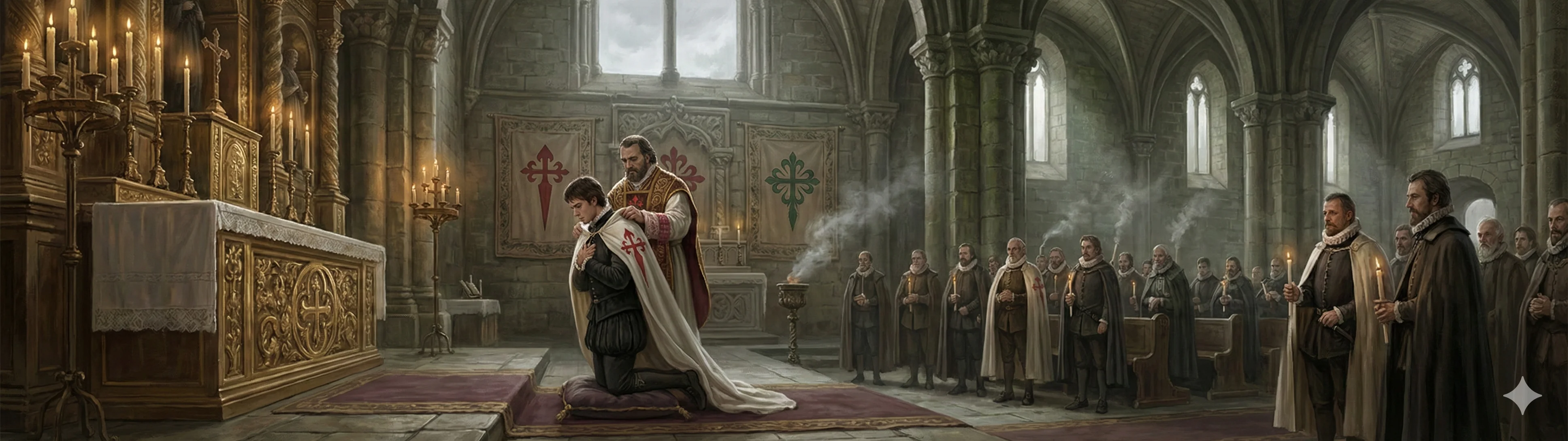
For a provincial hidalgo family in Galicia, admission to one of the great military orders was the ultimate confirmation of blood nobility. The process was gruelling: investigators appointed by the order's council — *informantes* — would travel to the candidate's homeland, interview witnesses, examine parish baptismal registers, inspect tombstones for heraldic devices, and compile a dossier proving four generations of noble blood on both the paternal and maternal lines. Any trace of Jewish, Moorish, or converso ancestry, any ancestor who had practised a manual trade, any hint of legal disability, and the application was rejected. The cross on a man's chest was proof that his blood had passed the most rigorous genealogical audit in the Spanish system.
The Armada's great moment was "Pedro Manuel de Armada y Taboada's" admission to the "Order of Santiago" in 1668. The Puga proved their nobility through the older route — the *probanza de hidalguía* before the Real Chancillería de Valladolid — but their marriages into the Feijóo and Noboa lines connected them to families with their own order memberships. It was the Mosquera, however, who amassed the most extraordinary record: at least six Knights of Santiago (1541–1751), two Knights of Calatrava (1532, 1717), and one Knight of Alcántara (1638). The Mosquera genealogical dossiers, submitted and accepted by three different orders over two centuries, constitute a documentary archive of provincial nobility unmatched by any other single family in the Ribeiro region.
The concentration of knights in one valley was no accident. The military orders required not just noble blood but the endorsement of neighbours — other hidalgos who could swear to the candidate's lineage. When a Mosquera applied for Santiago, an Armada or a Puga or a Feijóo testified. When an Armada sought admission, the Mosquera returned the favour. The system was self-reinforcing: each successful admission strengthened the entire network's claim to collective nobility.
- Order of Santiago: the most prestigious of the Castilian military orders — Armada (1668), Mosquera (1541, 1619, 1631, 1647, 1667, 1751)
- Order of Calatrava: Mosquera (1532, 1717) — including Bernardo Mosquera y Vera, commander of Piedrabuena
- Order of Alcántara: Mosquera (1638) — Antonio de Mosquera Novoa, lord of Villar de Payo Muñiz
- Real Chancillería de Valladolid: the tribunal before which the Puga filed their *probanza de hidalguía* — the older route to confirmed nobility for families that did not enter the military orders
- *Informantes*: the investigators who compiled genealogical dossiers for order admissions — their reports survive in the Archivo Histórico Nacional and are a primary source for provincial Galician genealogy
The Marriage Alliances That Bound the Valley
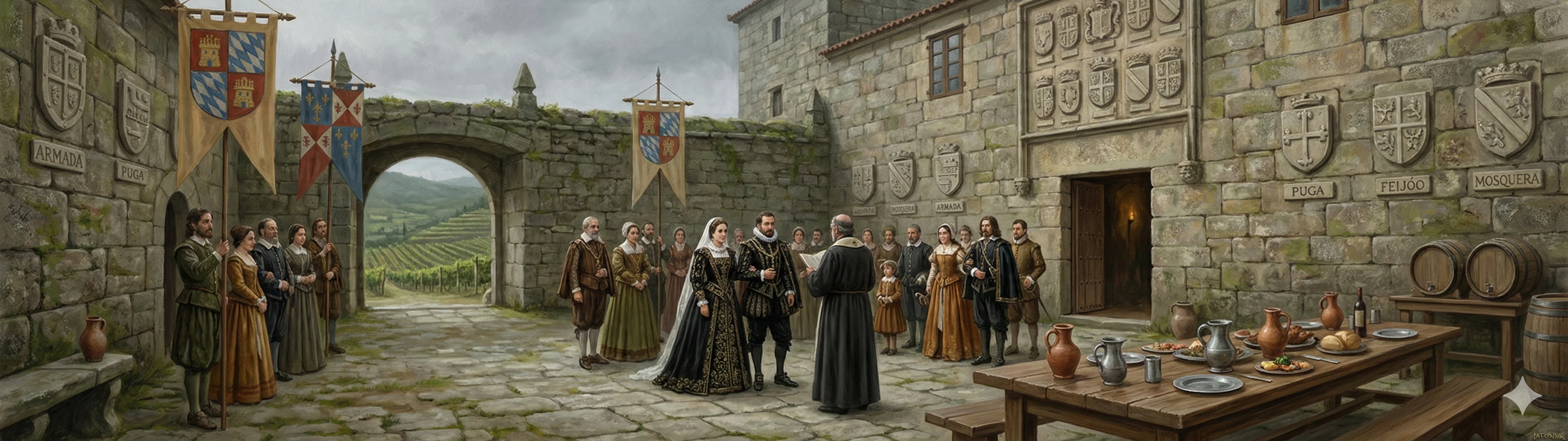
The hidalgo families of the Ribeiro did not marry at random. They married each other, generation after generation, in a pattern so consistent that the genealogical records read like a periodic table of local nobility. The most consequential alliance was the "Puga × Mosquera" marriage: "Pedro Vázquez de Puga", lord of the Torre de Louredo, regidor of Ribadavia, and alcaide of the Castle of Roucos, married "Sancha Bello de Mosquera" — whose mother Violante López Mosquera had brought the family to Prado de Miño, Castrelo de Miño, through a *foro* from the Monastery of Oseira. Pedro and Sancha were buried in the apsidal chapel of the Church of Santo Domingo in Ribadavia, their sarcophagi carved with the Puga cauldrons and the Mosquera wolves. Their daughter Violante married Lope García de Baamonde, lord of Regodeigón, and around 1533 the family consolidated their holdings through a *vínculo* (entail). The five heraldic shields on the façade of the "Casa de la Inquisición" in Ribadavia's Jewish quarter — Puga, García Camba, Bahamonde, an unidentified house, and Mosquera-Sandoval — are the stone record of this network.
The quartered arms on the pazos and church facades of the Ribeiro are the permanent record of these alliances. At the Pazo de Olivar in Puga, the shield shows the eagle of Novoa sheltering the arms of Puga and Villamarín. At the Pazo de Guimarei, the Mosquera wolf heads sit beside the Sarmiento roundels and the Villar bands. At the Casa da Señora in Lapela, the Armada arms are quartered with Sarmiento, Castro, Feijóo, and Araújo. Each stone shield is a marriage contract made permanent — a declaration that two families had merged their blood, their property, and their claims to noble status.
The logic was simple. In a society where *hidalguía* was transmitted by blood, and where the Real Chancillería required proof of noble lineage on both sides for four generations, marrying within the network guaranteed that your grandchildren would pass the test. Marrying outside it — into a family of uncertain or non-noble status — risked contaminating the blood and disqualifying future generations from the military orders, from municipal office, and from the legal privileges that made life as an hidalgo different from life as a commoner. The web was not sentimental. It was structural.
- Puga × Mosquera: Pedro Vázquez de Puga married Sancha Bello de Mosquera — lord of Louredo, regidor of Ribadavia, alcaide of Roucos; buried in Santo Domingo, Ribadavia
- Casa de la Inquisición, Ribadavia: five shields — Puga, García Camba, Bahamonde, unidentified, Mosquera-Sandoval — the stone record of the Puga-Mosquera alliance
- Armada × Araújo: Captain Juan de Armada married Francisca Fernández de Araújo (17th century)
- Puga × Noboa: Gonzalo de Puga married Teresa de Noboa (c. 1480–1512)
- Puga × Feijóo: Susana de Puga married Suero Feijóo, son of Diego Feijóo "el Bravo"
- Mosquera × Sarmiento: attested by the heraldry at the Pazo de Guimarei, which includes the Sarmiento thirteen roundels
- Armada × Salgado de Mondragón: the marriage that brought the Marquesado de Santa Cruz de Ribadulla into the Armada line
- Puga × Araújo: Mariana Suárez de Puga married Melchor de Araújo y Colmenero (1655)
- The Casa da Señora in Lapela: arms of Armada, Sarmiento, Castro, Feijóo, and Araújo quartered on a single facade — the physical proof of the network
Marquises, Painters, Viceroys, and a Galician Cookbook
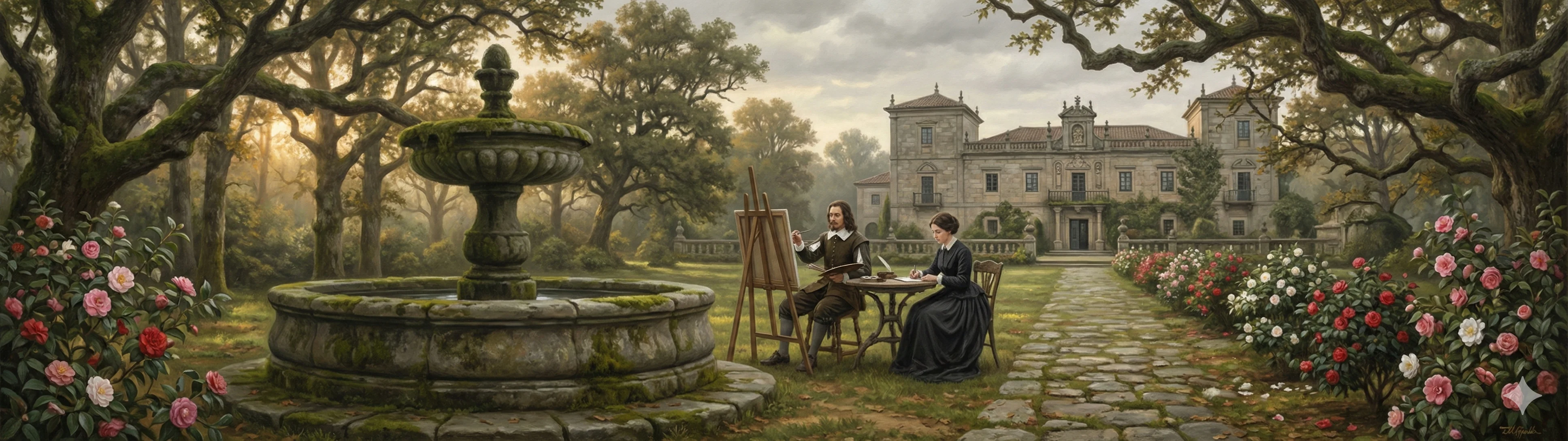
The three families followed different paths out of provincial obscurity, each producing figures that transcended the boundaries of the Ribeiro valley. The Armada line's trajectory was the most dramatic. Through the Salgado de Mondragón inheritance, the family acquired the Marquesado de Santa Cruz de Ribadulla and, with it, one of the great estates in Galicia. In the 1870s, "Iván Armada y Fernández de Córdoba", known as "el Tío Iván," dramatically expanded the botanical gardens at the Pazo de Santa Cruz de Rivadulla, planting the camellia collection — some dating to 1780–1820 — that earned the estate its designation as a Garden of International Excellence. But the ninth marqués cast a darker shadow: "Alfonso Armada y Comyn" (1920–2013), private secretary and tutor to the future King Juan Carlos, was implicated as one of the three principal conspirators in the 23-F coup attempt of 23 February 1981 — the most serious threat to Spanish democracy since the Civil War. Sentenced to thirty years, pardoned in 1988, he spent his final years at the family pazo.
The Puga-Mosquera-Baamonde marriage bore fruit across the Atlantic. "Vasco de Puga" (c. 1523–1576), grandson of Pedro Vázquez de Puga and Sancha Bello de Mosquera through their daughter Violante and her husband Lope García de Baamonde of Regodeigón, became an *oidor* (judge) of the Real Audiencia of Mexico, appointed in 1557. In 1563, he compiled the *Cedulario de Puga* — the first printed collection of royal decrees for New Spain, covering governance, justice, taxation, and the treatment of indigenous peoples from 1525 onwards — one of the most important legal documents of colonial Latin America. The name Puga also appears in the arts, though the connection to the Torre de Puga hidalgos is unproven. "Antonio de Puga" (1602–1648), born in Ourense to a tailor of the same name and his wife Ynés Rodríguez, trained in Madrid as a "disciple of Eugenio Cajés". The eighteenth-century art historian Ceán Bermúdez attributed him to the school of Velázquez — a tradition that persists but is disputed by modern scholars. In 1634, he collaborated with Cajés on two battle paintings for the Hall of Kingdoms of the Buen Retiro Palace — a commission left unfinished when Cajés died that December. His only securely attributed masterwork, *San Jerónimo* (1636), hangs in the Bowes Museum in Barnard Castle, England; the Museo de Pontevedra notes another attributed work (*Anciana sentada*), on deposit from the Prado. Three centuries later, "Manuel María Puga y Parga", known as *Picadillo* (1874–1918) — whose grandfather Manuel María Puga Feijóo, a colonel and heir of the Countess of Ximonde, united two of the valley's core hidalgo surnames in his own name — served as mayor of A Coruña and authored *La cocina práctica*, the definitive traditional Galician cookbook. He died at forty-four, a victim of the 1918 influenza pandemic. The prologue to his cookbook was written by none other than Emilia Pardo Bazán — a Mosquera descendant introducing a Puga descendant's masterwork, the hidalgo network still operating four centuries after its formation.
The Mosquera achieved the widest reach. The Marquesado de Guimarei, created in 1716, made them titled nobility; the lordship of Bentraces, inherited through the Aranda line, made them territorial magnates. But the family's most enduring connection to Spanish cultural history runs through a mother. "Joaquina Mosquera y Ribera" married Miguel Pardo Bazán in Santiago de Compostela in 1821. Their son "José Pardo Bazán y Mosquera" (1827–1890) became the first Conde de Pardo Bazán — a papal title granted by Pius IX in 1871 for José's defence of Catholic interests in the Cortes, later confirmed as a Spanish royal title for his daughter in 1908. Tragedy struck the family first: in 1848, Joaquina was murdered by her second husband, who then took his own life. José was just twenty-one. His daughter was "Emilia Pardo Bazán" (1851–1921) — the greatest Galician novelist of the nineteenth century, champion of literary naturalism, and one of the most important women of letters in the history of the Spanish language. The Mosquera blood, which first appeared in the Ribadavia records as a squire's name in 1489, runs in the veins of the woman who wrote *Los pazos de Ulloa*.
- Pazo de Santa Cruz de Rivadulla: the Armada marquises' estate — 30 hectares of gardens with camellias planted as early as 1780, now open to visitors
- Alfonso Armada (1920–2013): IX Marqués de Santa Cruz de Ribadulla — implicated in the 23-F coup attempt of 1981
- Vasco de Puga (c. 1523–1576): Oidor of the Real Audiencia of Mexico — compiler of the *Cedulario de Puga* (1563), the first printed collection of royal decrees for New Spain; grandson of Pedro Vázquez de Puga and Sancha Bello de Mosquera through the Baamonde line
- Antonio de Puga (1602–1648): Baroque painter, disciple of Eugenio Cajés (Velázquez attribution disputed), born in Ourense to a tailor — *San Jerónimo* (1636) in the Bowes Museum, Barnard Castle; no proven link to the Torre de Puga hidalgos
- Manuel María Puga y Parga "Picadillo" (1874–1918): mayor of A Coruña, author of *La cocina práctica* (prologue by Emilia Pardo Bazán) — grandson of Colonel Puga Feijóo; died of the 1918 influenza pandemic
- Emilia Pardo Bazán (1851–1921): daughter of José Pardo Bazán y Mosquera, son of Joaquina Mosquera y Ribera — the greatest Galician novelist, author of *Los pazos de Ulloa*
- Marquesado de Guimarei (1716): created by Felipe V for Fray Pedro Mosquera Pimentel — later merged with the Marquesado de Aranda, producing a Grandee of Spain
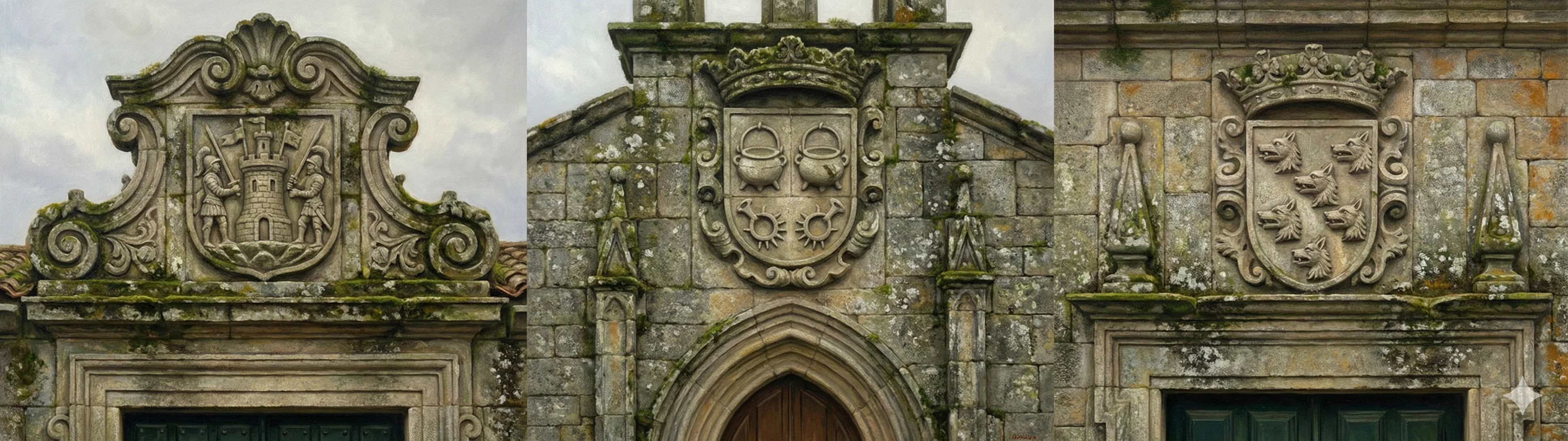
Three Shields, One Valley
The Armada bore arms showing "warriors wielding swords and banners", with castles and towers defended by armed figures — a martial vocabulary appropriate for a family named after a fleet. Seven distinct variants are documented, certified by the Cronista and Dean King of Arms Don Vicente de Cadenas y Vicent. The tinctures favoured sable, azure, gules, and argent — dark, military colours. The arms appear on the facade of the Pazo dos Armada in the old quarter of Ourense and on the Casa do Casar in Vide do Miño.
The Puga bore two principal devices. The older, from Padre Crespo's *Blasones y Linajes de Galicia*, shows a field of "azur with two silver cauldrons" (*calderas de plata*), one in the chief and one in the base, with two gold spurs in the centre of each flank. The alternative shows a field of "gules with a gold rampant lion" surrounded by four gold fleur-de-lis. Thirteen variants are documented in total. Three shields displaying the Puga arms survive on the Torre de Puga itself.
The Mosquera bore a field of "azur with five gold flies" (*moscas de oro*) arranged in saltire — a canting device derived from the family's Moscoso origins (mosca = fly). The alternative blazon — argent, five wolf heads of sable — appears on the stone escutcheon at the Pazo de Guimarei. The wolf heads, contoured with tongues and cut necks in gules, are the more common variant in the surviving stone carvings. At Guimarei, the Mosquera wolves share a quartered shield with the Villar bands, the Sarmiento roundels, and an Aranda lion — four families, one stone.
- Armada: warriors with swords, castles, and towers — seven variants certified by Don Vicente de Cadenas y Vicent
- Puga (primitive arms): Azure, two cauldrons argent in pale, two spurs or in fess — from Padre Crespo's *Blasones y Linajes de Galicia*
- Puga (alternative arms): Gules, a lion rampant or surrounded by four fleur-de-lis or — thirteen variants documented
- Mosquera (canting arms): Azure, five flies or in saltire — from the Moscoso connection (*mosca* = fly)
- Mosquera (Guimarei variant): Argent, five wolf heads sable, langued and couped gules — the variant carved on the Pazo de Guimarei
Key Figures
Knights, painters, novelists, and marquises of the Ribeiro hidalgo network
Chief standard-bearer of Don Fadrique, Duke of Arjona. Appeared before the Cabildo of Ourense in 1425 seeking absolution after his squire killed the bishop at Pozo Meimón. His granddaughter Violante settled in Prado de Miño, Castrelo de Miño — the origin of the Mosquera presence in the Ribeiro.
Lord of the Torre de Puga and Casa de Maceda. Married Teresa de Noboa. Buried in a magnificent plateresque tomb in the Church of San Francisco de Ourense, depicted in full armour with a greyhound at his feet.
First documented head of the Armada family in Vide do Miño, Castrelo de Miño. Married Francisca Fernández de Araújo, linking the Armada and Araújo lineages.
The first Armada admitted to a military order — Knight of Santiago (1668). His admission confirmed four generations of noble blood and placed the family among the military elite of the kingdom.
Born in Ourense, son of a tailor. Trained in Madrid under Eugenio Cajés (the Velázquez connection, from Ceán Bermúdez, is disputed). Collaborated with Cajés on battle paintings for Philip IV's Buen Retiro Palace (1634). Masterwork: *San Jerónimo* (1636), Bowes Museum, Barnard Castle. No proven link to the Torre de Puga hidalgos.
Lord of the Torre de Louredo, regidor of Ribadavia, alcaide of the Castle of Roucos, and familiar of the Holy Office. Married Sancha Bello de Mosquera — the alliance that fused the Puga and Mosquera lines. Buried in the Church of Santo Domingo, Ribadavia. Their daughter Violante married Lope García de Baamonde, lord of Regodeigón.
Grandson of Pedro Vázquez de Puga and Sancha Bello de Mosquera through the Baamonde line. Appointed oidor (judge) of the Real Audiencia of Mexico in 1557. Compiled the *Cedulario de Puga* (1563) — the first printed collection of royal decrees for New Spain and one of the most important legal documents of colonial Latin America.
First lord of the Pazo de Guimarei. His admission to the Order of Alcántara (1638) confirmed the Mosquera's noble blood across multiple lines.
Baptised in Vide do Miño. Inherited the Marquesado de Santa Cruz de Ribadulla through his mother's Mondragón line. The hidalgo family from Castrelo de Miño became titled nobility.
Daughter of José Pardo Bazán y Mosquera, son of Joaquina Mosquera y Ribera. Author of *Los pazos de Ulloa* and champion of literary naturalism — the greatest Galician novelist of the nineteenth century. Wrote the prologue to Picadillo's *La cocina práctica*.
Author of *La cocina práctica* (1905) — the foundational Galician cookbook, with a prologue by Emilia Pardo Bazán. Grandson of Colonel Manuel María Puga Feijóo, heir of the Countess of Ximonde — uniting the Puga and Feijóo surnames. Mayor of A Coruña. Died at forty-four, victim of the 1918 influenza pandemic.
Private secretary and tutor to the future King Juan Carlos. Implicated in the 23-F coup attempt of 1981. Sentenced to thirty years, pardoned in 1988. The family name, born in a casa solar in Castrelo de Miño, ended in the dock of a military tribunal.