Phoenician Heritage
The ancient maritime traders who connected Galicia to the Mediterranean
Phoenician Heritage
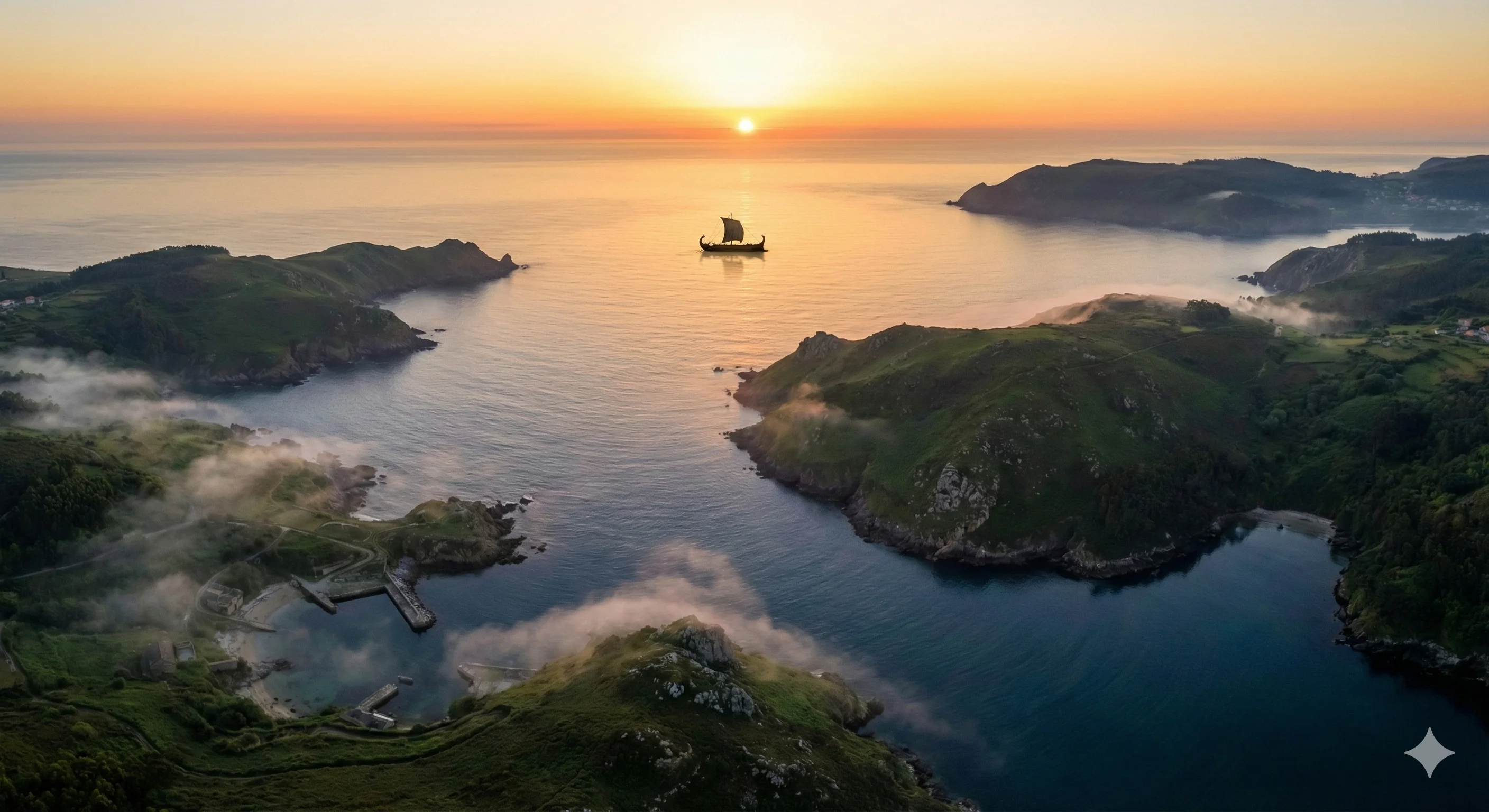
Nine centuries before Rome, Phoenician merchants from Tyre sailed beyond the Pillars of Hercules seeking the tin and gold of Galicia. Their trade routes connected the castros of the Miño valley to the workshops of the Levant — the first link between the Atlantic and the Mediterranean world.
“The Phoenicians, upon arriving beyond the Pillars of Hercules and sailing along the coast of Iberia, reached the region of Tartessos.”— Herodotus, Histories, Book IV (c. 440 BC)
Phoenicia: Traders at the Edge of the Known World
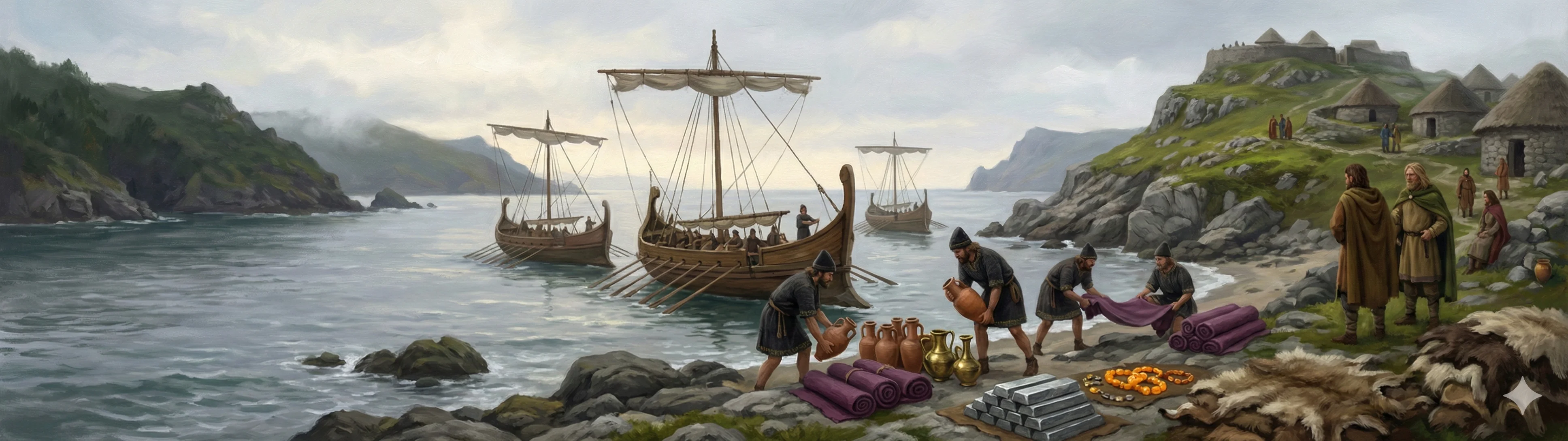
The Phoenicians were the master navigators and merchants of the ancient Mediterranean. From their city-states of Tyre, Sidon, and Byblos on the Levantine coast — in what is now Lebanon — they built a maritime trading empire that stretched from the eastern Mediterranean to the Atlantic. By around 800 BC, they had established Gadir (modern Cadiz) at the mouth of the Guadalquivir, the westernmost permanent colony in the ancient world. From Gadir, they ventured beyond the Pillars of Hercules into the open Atlantic, driven by one thing above all: the quest for tin.
Tin was the strategic metal of the Bronze Age. Without it, copper alone was too soft for weapons or tools. The Phoenicians discovered that the richest tin deposits in Europe lay along the Atlantic fringe — in Galicia, northern Portugal, Cornwall, and Brittany. The Greek historian Herodotus called these distant tin sources the Cassiterides, the "Tin Islands." For the Phoenicians, the Atlantic coast of Galicia was not the edge of the world — it was one of the most valuable places in it.
- Phoenicians originated from city-states of Tyre, Sidon, and Byblos in modern-day Lebanon
- Gadir (Cadiz) was founded c. 800–770 BC as their gateway to the Atlantic — one of the oldest continuously inhabited cities in Europe
- The Phoenicians invented the alphabet that became the basis for Greek, Latin, and all modern Western scripts
- Tin (cassiterite) was essential for making bronze — and Galicia held some of the richest deposits in Europe
- Herodotus and Strabo both described Phoenician voyages beyond the Pillars of Hercules for tin and other metals
- Phoenician ships were among the most advanced of their era — sturdy, keeled vessels capable of open-ocean voyaging
Gadir: The Westernmost City of the Ancient World
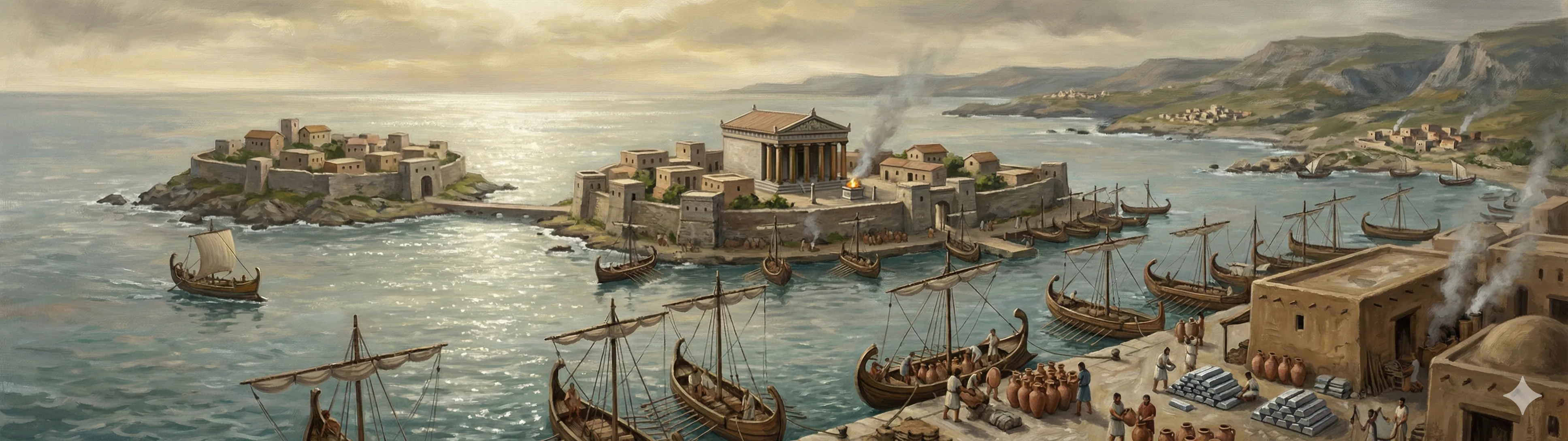
Around 800 BC, Phoenician colonists from Tyre founded Gadir — modern Cadiz — on a pair of small islands near the mouth of the Guadalquivir. It was the westernmost permanent settlement in the ancient world, and it became the nerve center of all Phoenician activity in the Atlantic. Within its walls rose a great temple to Melqart, the patron god of Tyre, whose bronze pillars — each eight cubits high — were widely proclaimed to be the true Pillars of Hercules. A perpetual flame burned on its altar, tended by priests who never let it die. Hannibal, Julius Caesar, and countless other figures of antiquity came to worship here.
From Gadir, the Phoenicians built a chain of colonies along the southern and southeastern coasts of Iberia. Malaka (modern Malaga) — named from the Phoenician word for "salt" — became a major hub for the fish-salting industry. Sexi (Almuñécar) and Abdera (Adra) anchored the southeastern coast. At Castillo de Doña Blanca, near El Puerto de Santa María, archaeologists found the most extensive surviving Phoenician river port in the Mediterranean — a walled city continuously occupied from the 8th to the 3rd century BC. And at Cerro del Villar near Malaga, because no later town was built on top, archaeologists have been able to study a rare intact Phoenician urban grid: streets lined with multi-room residences, metalworking shops, and pottery kilns.
- Gadir (Cadiz) was founded c. 800–770 BC — one of the oldest continuously inhabited cities in Western Europe
- The Temple of Melqart at Gadir featured bronze pillars, a perpetual flame, and a facade depicting the twelve labors of Hercules
- Malaka (modern Malaga), Sexi (Almuñécar), and Abdera (Adra) formed a chain of southern colonies
- Castillo de Doña Blanca is the most extensive preserved Phoenician river port in the Mediterranean — occupied 8th–3rd c. BC
- The Phoenicians also established Ebusus (Ibiza) c. 625 BC, whose necropolis at Puig des Molins — over 5,000 graves — is a UNESCO World Heritage Site
- By 700 BC, silver from the Río Tinto mines exported through Gadir had become so abundant it depressed silver prices across the Assyrian world
Tartessos: Where Phoenicia Met Iberia
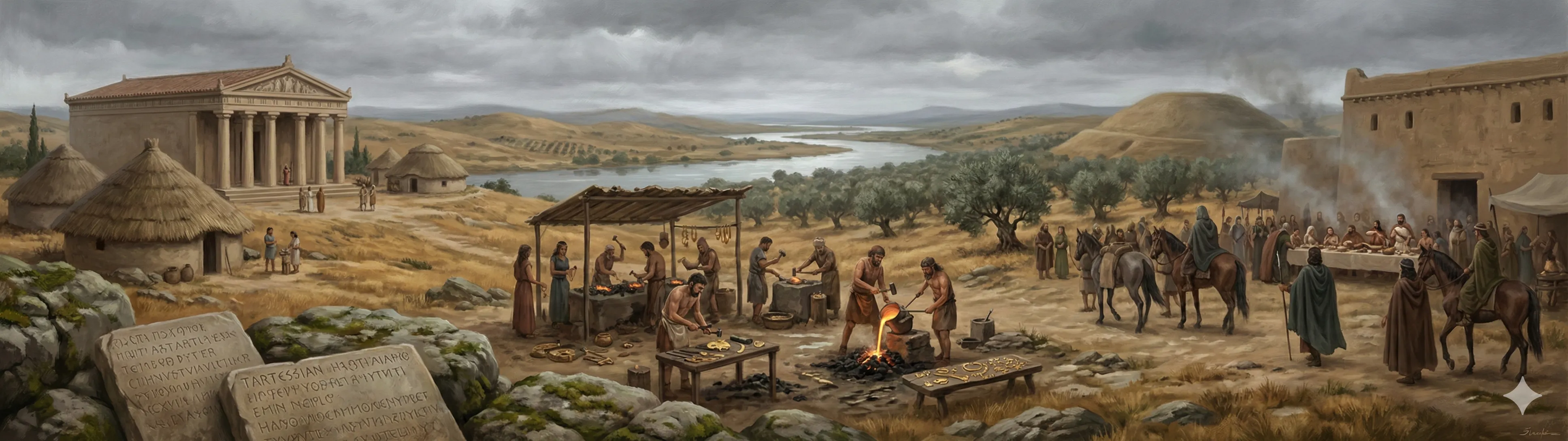
In the lower valley of the Guadalquivir, something extraordinary emerged from the meeting of Phoenician merchants and indigenous Iberians: Tartessos, a civilization born around the 9th century BC as a hybrid of both worlds. The Tartessians controlled vast reserves of silver, copper, and gold in southwestern Iberia, and the Phoenicians were their partners and buyers. Tartessian artisans trained in Phoenician goldsmithing techniques produced masterworks like the Treasure of El Carambolo — 21 pieces of gold discovered in 1958 near Seville, including ox-hide pectorals and a necklace with pendants, crafted with Phoenician methods from locally mined gold. At the same site, archaeologists found a temple dedicated to Astarte, the Phoenician goddess of fertility and war.
Tartessos vanished around the 5th century BC, and its disappearance remains one of Iberia's great mysteries. At Casas del Turuñuelo in Badajoz, archaeologists uncovered a dramatic ritual closure: the people held a final banquet, then sacrificed 52 animals — predominantly horses — in three sequential phases, before intentionally destroying and burying their great adobe building under a tumulus 90 meters in diameter. It was a world ending on its own terms. The Tartessians also developed the oldest known indigenous writing system of the Iberian Peninsula — a script derived directly from the Phoenician alphabet. Though Tartessos fell, its cultural DNA — the fusion of Phoenician and Iberian — lived on in the peoples and traditions of southern Spain.
- Tartessos flourished in the 8th–6th centuries BC in the lower Guadalquivir valley — a hybrid of Phoenician and indigenous Iberian culture
- The Treasure of El Carambolo (21 gold pieces, 8th c. BC) was crafted using Phoenician techniques from locally sourced gold near Seville
- At Casas del Turuñuelo, 52 animals (mostly horses) were ritually sacrificed in a dramatic ceremonial closure c. 5th century BC
- The Tartessian script, derived from the Phoenician alphabet, is the oldest known indigenous writing of the Iberian Peninsula (7th–6th c. BC)
- Greek sources describe the legendary king Arganthonios of Tartessos, who reportedly ruled for 80 years and welcomed Greek traders
- The word "Hispania" — from which "Spain" derives — may come from the Phoenician *I-Shpania*, meaning "land of rabbits" or "land where metals are forged"
From Gadir to the Rías: The Tin Route
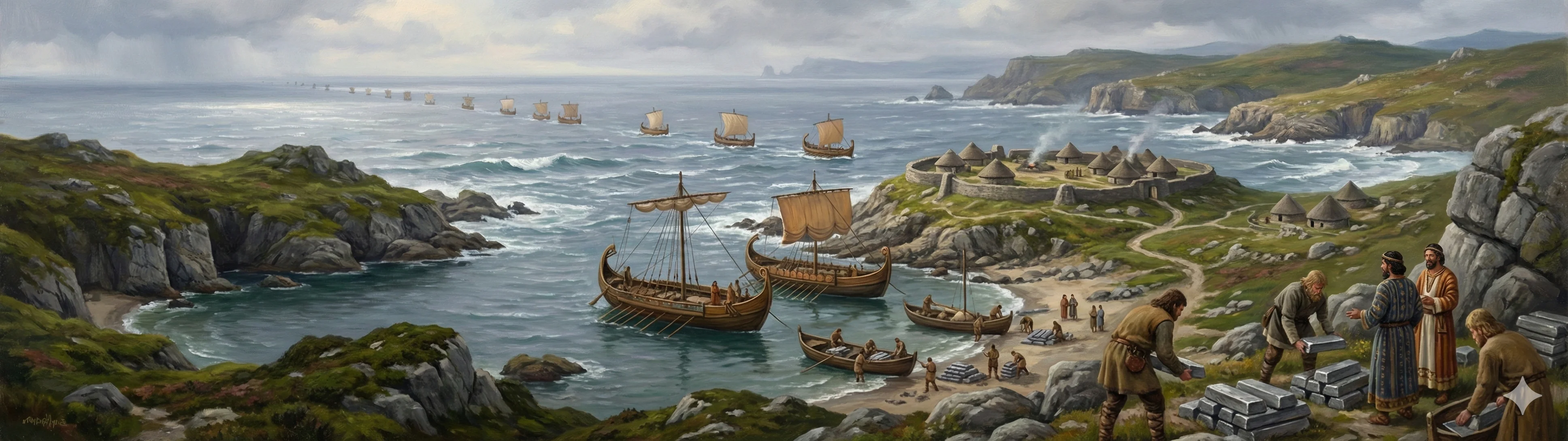
The Tin Route was not a single road but a web of maritime corridors connecting the Mediterranean world to the Atlantic's mineral wealth. Phoenician ships departed from Gadir, hugging the Portuguese coast northward — stopping at trading posts at the Sado estuary (Abul), the Tagus (Lisbon), and the Mondego (Santa Olaia, the northernmost confirmed Phoenician feitoria). Beyond Santa Olaia, the route entered the waters off the Galician coast, where the deep-cut Rías Baixas — the inlets of Vigo, Pontevedra, and Arousa — offered sheltered anchorage and access to the interior.
The Miño river was the great artery connecting the coast to the tin-rich interior. Its tributary, the Sil, drained the mountains of Ourense province — one of the most concentrated cassiterite zones in all of Europe. Tin and alluvial gold were carried downstream to the coast, where they entered the Phoenician trade network and ultimately reached the workshops of Tyre and the markets of the eastern Mediterranean. The Castro culture communities along the Miño and Sil valleys — including those in the territory around Castrelo de Miño and Cartelle — controlled access to these mineral resources and traded them for wine, glass, fine ceramics, and iron.
- Gadir (Cadiz) was the hub of the Atlantic trade — all routes funneled through this Phoenician city
- Santa Olaia (Figueira da Foz) was the northernmost confirmed Phoenician trading post, dated to the 7th–6th century BC
- The Rías Baixas of Galicia provided natural harbors accessible to Phoenician ships
- The Miño and Sil rivers formed a natural trade corridor from the Atlantic coast to the tin deposits of Ourense
- Tin from Ourense was traded for Mediterranean wine, olive oil, glass beads, ceramics, and iron goods
- Castro culture elites served as intermediaries, controlling mineral access and monopolizing the trade
The Temple at Vigo & the Port Sanctuaries
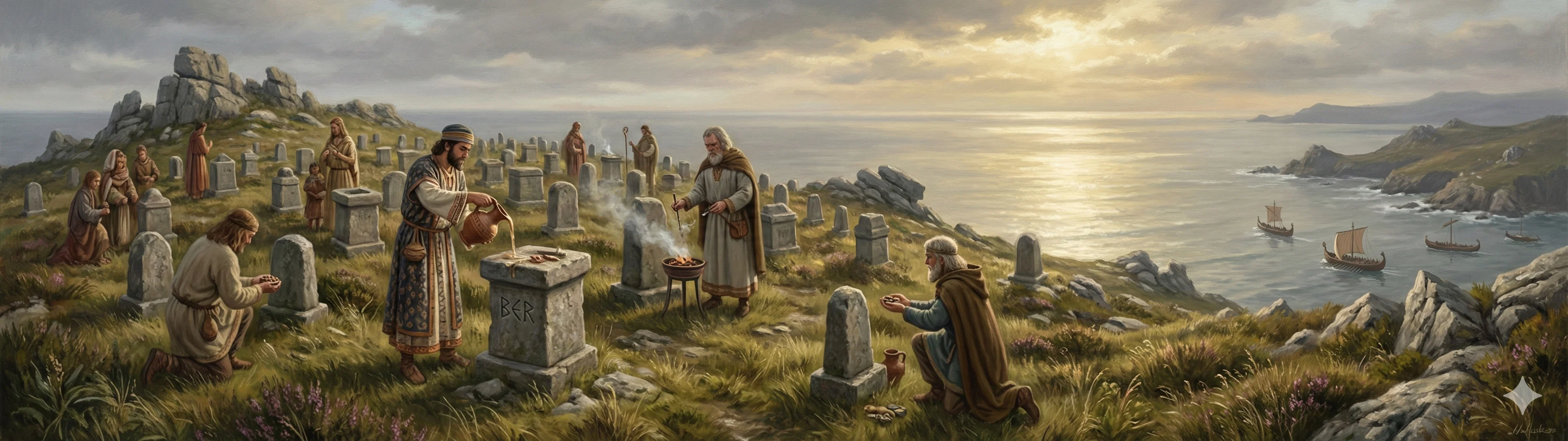
In 2001, construction work at the Museo do Mar de Galicia in Alcabre, Vigo, uncovered one of the most remarkable Phoenician discoveries in Atlantic Europe: an Ibero-Punic altar dedicated to the god Baal, dating to the 4th century BC. The altar — three vertical sacred stones (betilos) within a rectangular enclosure — sat within the Castro da Punta do Muiño do Vento, a coastal settlement inhabited since the 8th century BC. Over 20,000 archaeological pieces were recovered, including the largest concentration of Punic ceramics and amphoras in all of northwestern Iberia. The site was a port sanctuary — a sacred commercial space, visible from the sea, where Phoenician-Punic merchants from the colonies of southern Spain conducted trade with local Castro communities.
The Rías Baixas held a network of these sacred trading spaces. At Castro de Toralla, on Isla de Toralla in the Ría de Vigo, archaeologists found a 1.5-meter granite betilo — a sacred pillar of Phoenician-Punic type — now preserved in the Museo Quiñones de León. On the Monte do Facho, a peak overlooking both the Pontevedra and Vigo estuaries at the tip of the Morrazo peninsula, a hilltop sanctuary with painted ceramics and buildings full of wine amphoras served as another anchor point in the network. At A Lanzada in Sanxenxo, a Phoenician-Punic factory operated the earliest known salting operations in Galicia — fish-preserving techniques that arrived centuries before the Romans. And at Auga dos Cebros in Oia, a rock petroglyph depicting a Phoenician vessel, carved around the 10th century BC, provides some of the oldest evidence of contact between the Mediterranean and the Galician coast.
- Punta do Muiño do Vento (Vigo): Ibero-Punic altar to Baal (4th c. BC) with 20,000+ pieces — the largest Punic ceramic concentration in northwest Iberia
- Castro de Toralla (Isla de Toralla, Vigo): A 1.5-meter granite betilo (sacred pillar) of Phoenician-Punic type, now in the Museo Quiñones de León
- Monte do Facho (Cangas do Morrazo): Hilltop sanctuary with painted ceramics and amphora storehouses — later associated with the local deity Berobreo
- A Lanzada (Sanxenxo): Oldest known salting factory in Galicia (3rd–1st c. BC) — Mediterranean fish-preservation predating Roman garum
- Petroglyph of Auga dos Cebros (Oia): Rock carving of a Phoenician vessel (~10th c. BC) — among the earliest evidence of Mediterranean contact
- In 2014, the Rías Baixas officially joined the Ruta de los Fenicios, a Council of Europe Cultural Route encompassing 14 countries and 80+ cities
The Mazarrón Wrecks & the Ships That Sailed West
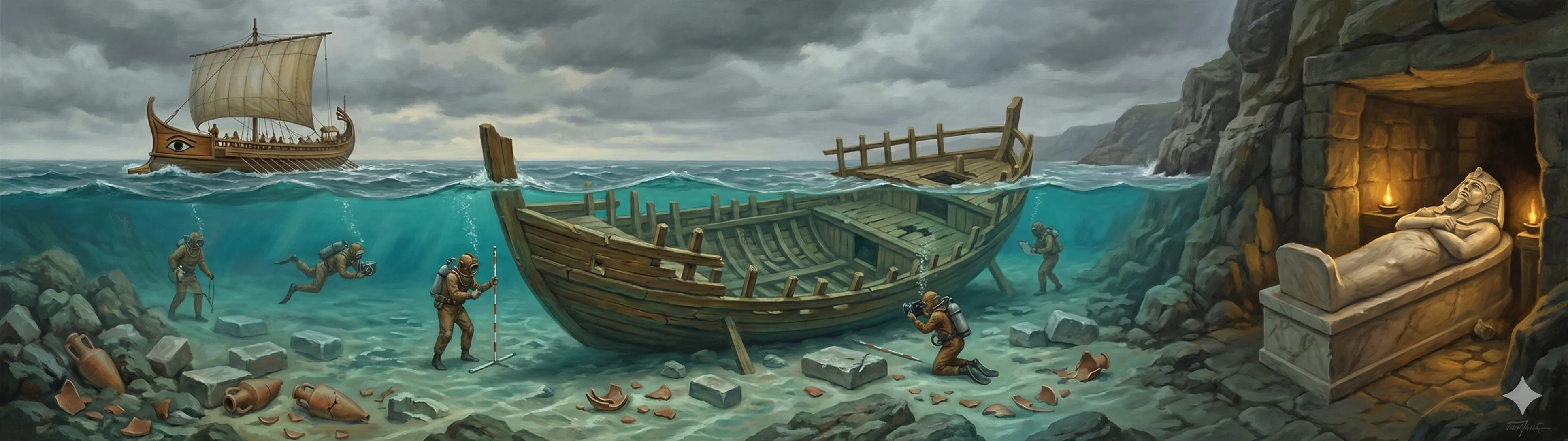
The Phoenicians were the greatest shipbuilders of the ancient world, and the coast of Spain has yielded their most spectacular remains. In 1994, divers off Mazarrón in Murcia discovered the Mazarrón II — the most complete ancient shipwreck ever found in the Mediterranean, with nearly the entire vessel preserved from bow to stern. The ship measures 8.1 meters long by 2.5 meters wide, dated to the late 7th or early 6th century BC. Its cargo was 2,820 kilograms of litharge blocks for silver production, plus over 7,300 Phoenician ceramic fragments. In 2024, a team of 14 specialists successfully extracted the entire vessel from the seabed — an operation that revealed even more about Phoenician construction techniques: mortise-and-tenon joints, a keeled hull for stability in open seas, and a design built for the long Atlantic haul.
At Cadiz itself, the archaeological treasures are equally dramatic. In 1887, workers at Punta de la Vaca uncovered a male anthropoid sarcophagus in white marble — a reclining man with an Egyptian-style headdress and curly beard, uniquely Phoenician. In 1980, a female sarcophagus, the Lady of Cádiz, was found on Ruiz de Alda street, dated c. 470 BC and even older than the male. Inside were bronze eyelashes, amulets, a scarab, and bronze nails. These are the only Phoenician anthropoid sarcophagi found in Spain, and both are now displayed in the Museum of Cadiz. Together with the Mazarrón wrecks, they offer an intimate portrait of the people who sailed from the Levant to the ends of the earth — and the ships that carried them.
- The Mazarrón II is the most complete ancient shipwreck in the Mediterranean — 8.1m long, extracted from the seabed in 2024
- Its cargo of 2,820 kg of litharge and 7,300+ ceramic fragments reveals the scale of Phoenician silver-processing trade
- Phoenician ships used mortise-and-tenon joints, keeled hulls, and central masts with square sails — innovations that enabled Atlantic voyaging
- The Phoenicians navigated by the North Star, which the Greeks called the "Phoenician Star" in their honor
- The male sarcophagus from Punta de la Vaca and the Lady of Cádiz (5th c. BC) are the only Phoenician anthropoid sarcophagi found in Spain — now in the Museum of Cadiz
- At Huelva, 90,000 ceramic fragments from a pre-colonial emporium (c. 900–770 BC) confirm the earliest Phoenician commercial activity in Iberia
What the Phoenicians Left Behind
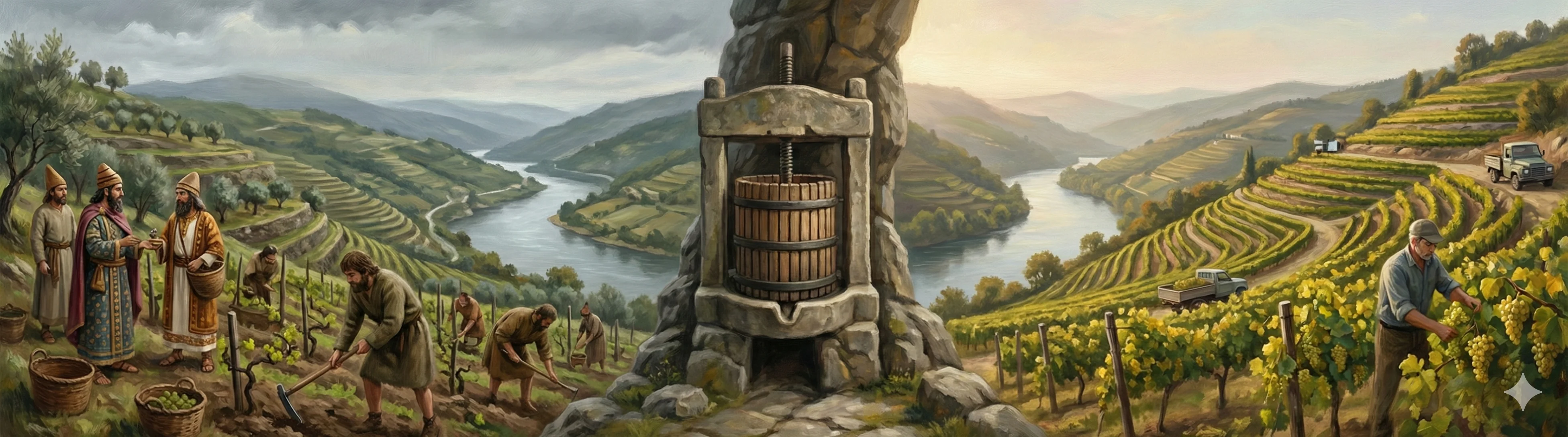
The Phoenicians transformed Galicia's world without ever settling it permanently. Through their trade networks, iron technology reached the northwest — gradually replacing bronze for tools and weapons and marking the transition from the Bronze Age to the Iron Age in the Castro culture. The potter's wheel arrived, supplementing the hand-built ceramic tradition. Wine and olive oil — luxuries unknown in Atlantic Europe — appeared for the first time at elite Castro feasts, beginning a wine culture that the Romans would later expand into the celebrated vineyards of the Ribeiro.
The Phoenician salting tradition took even deeper root. The fish-preserving techniques introduced by Punic merchants at sites like A Lanzada evolved into a major industry under the Romans — the massive SALINAE complex at O Areal in Vigo operated for centuries as one of the largest salt-production facilities in the entire Empire, built on foundations that Phoenician-era traders had laid. Perhaps most profoundly, the Phoenician trade connected Galicia to the wider Mediterranean world for the first time. A castro dweller in the Miño valley who wore a glass bead from a Phoenician workshop was linked, through chains of trade, to the great cities of the Levant. The same tin that was mined in the hills above Castrelo de Miño may have ended up as bronze armor in Tyre. This was the first globalization — and Galicia was part of it from the very beginning.
- Iron technology arrived in Galicia partly through Phoenician trade — transforming Castro culture warfare and daily life
- The potter's wheel, introduced via Mediterranean contact, gradually supplemented Galician hand-built ceramics
- Wine arrived in the northwest through Phoenician amphoras — the earliest wine culture that Romans later expanded into Ribeiro vineyards
- The Phoenician salting tradition became Roman industry — the SALINAE complex at O Areal (Vigo) operated for centuries on foundations laid by Punic merchants
- Phoenician trade routes became Roman trade routes — the same coastal and river corridors continued under the Empire
- The Phoenician alphabet influenced the Iberian scripts of southern Spain, though Galicia remained largely pre-literate until Roman contact
Sanctuaries, Sites & Artifacts
Port sanctuaries, trade posts, and archaeological discoveries tracing the Phoenician presence from Vigo to Cadiz.
Key Dates
“O estaño das montañas galegas viaxou ata os confíns do Mediterráneo.”— The tin from the Galician mountains traveled to the ends of the Mediterranean.