Celtic Heritage
The ancient Celtic peoples of Galicia
Celtic Heritage
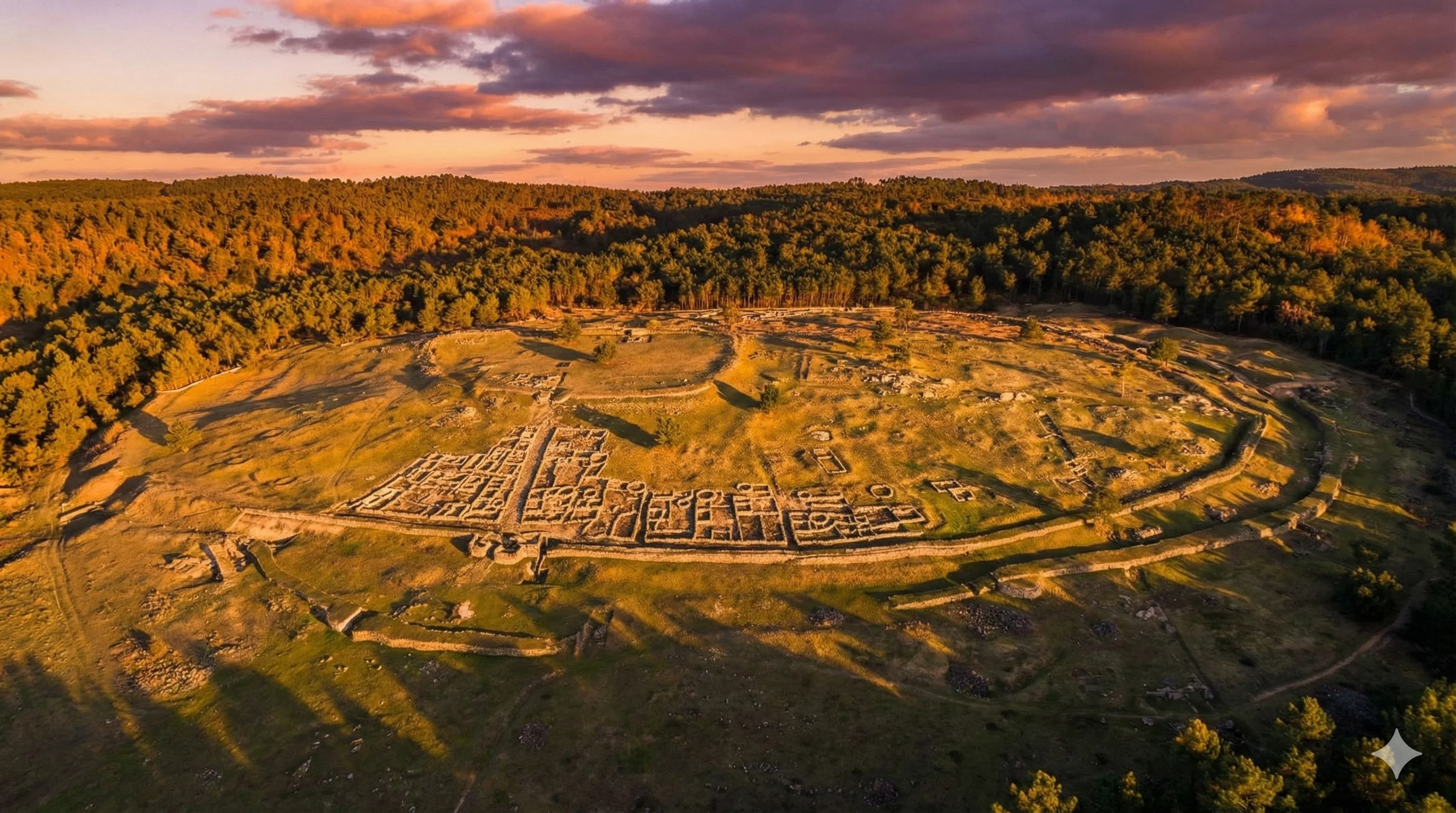
Three thousand years ago, Celtic peoples called the Gallaeci built fortified hilltop settlements across the territory that would become Ourense. Their castros, their art, and their spirit live on in the land, the language, and the culture of Galicia.
“The Gallaeci are the most warlike of all the peoples of Lusitania.”— Strabo, Geographica, Book III (early 1st century AD)
The Gallaeci: Celtic People of Northwestern Iberia
The Gallaeci were the Celtic tribal confederation that inhabited the territory stretching from the Douro river to the Cantabrian coast — the land the Romans would name Gallaecia, and that we know today as Galicia. Greek geographer Strabo described them as "the most warlike of all the Lusitanian peoples," a confederation of dozens of smaller groups (populi) united by a common language, material culture, and the distinctive settlement pattern of the castros — fortified hilltop villages that defined the landscape of northwestern Iberia for nearly a millennium.
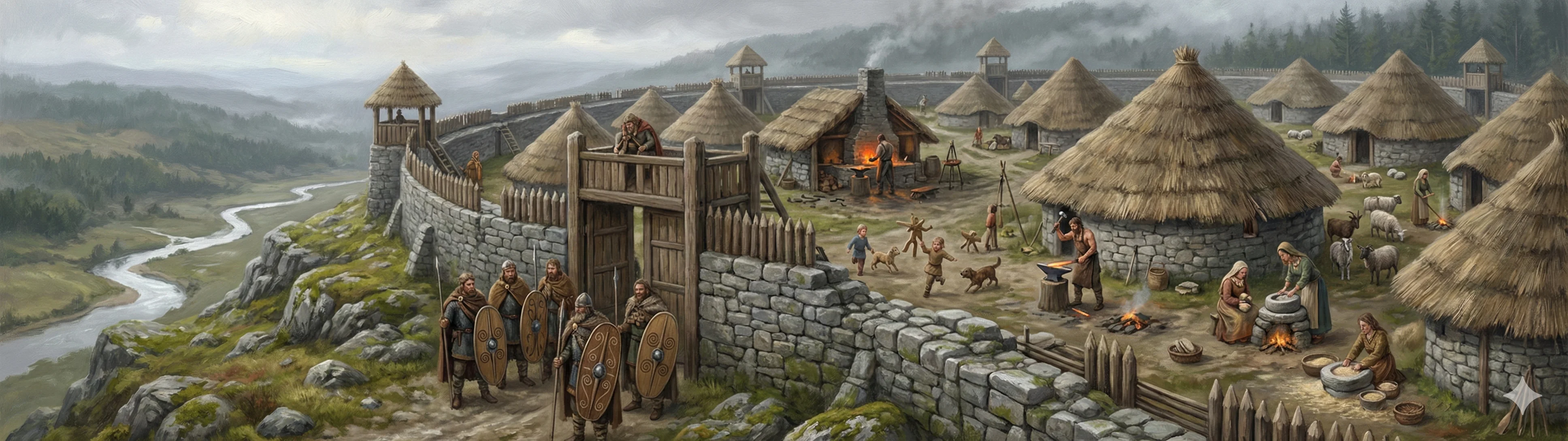
Among these populi, the Querquerni and Coelerni inhabited the middle Miño valley and the territory around the Arnoia river in what is now Ourense province — precisely the ancestral homeland of the Álvarez and Rodríguez families in Castrelo de Miño and Cartelle. These tribes lived in circular stone dwellings within fortified hilltop enclosures, practiced metalworking in gold and bronze, raised cattle, and cultivated the sheltered river valleys. The Gallaeci fiercely resisted Roman expansion; it took Rome over a century of campaigns to subdue them, from Decimus Junius Brutus Callaicus in 137 BC to Augustus during the Cantabrian Wars (29–19 BC).
- The Gallaeci gave their name to Gallaecia (modern Galicia), one of the oldest territorial identities in Western Europe
- Greek and Roman authors (Strabo, Pliny, Ptolemy) documented over 40 distinct Celtic populi in Gallaecia
- The Querquerni occupied the middle Miño valley; the Coelerni held the Arnoia valley — both are ancestral Álvarez territory
- Castromao near Celanova has been identified as Coeliobriga, the capital of the Coelerni tribe
- Decimus Junius Brutus earned the cognomen "Callaicus" after his 137 BC campaign against the Gallaeci
- Castro culture settlements in the Ribeiro region date primarily from 900 BC to the 2nd century AD
Warriors of Oak and Iron
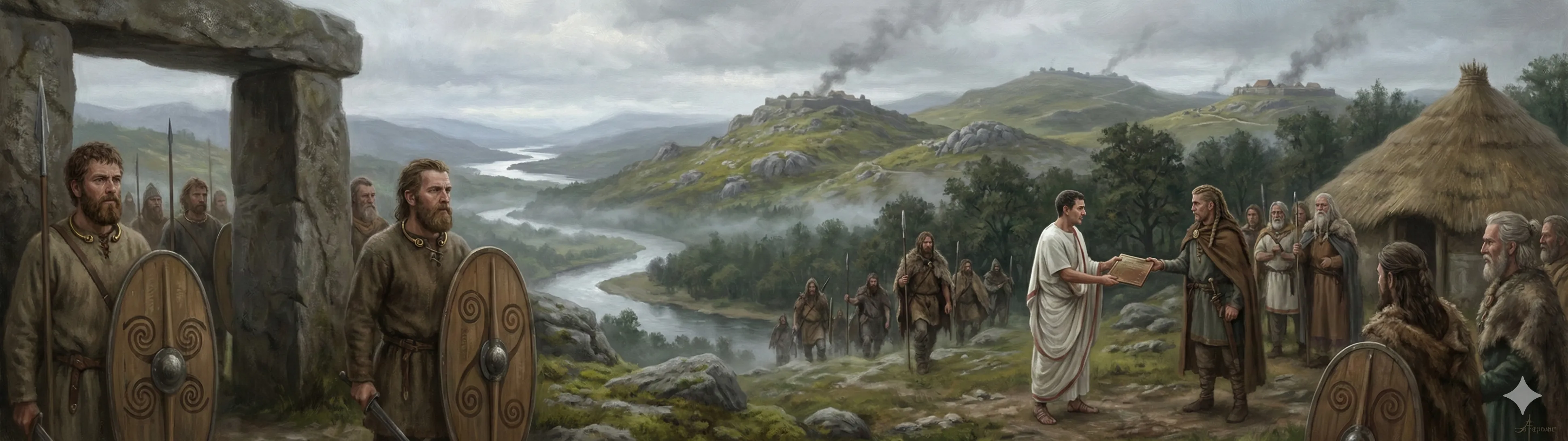
Within the vast Gallaeci confederation, the tribes of southern Ourense formed a distinct cluster of Celtic peoples belonging to the Conventus Bracarensis, the Roman administrative district centred on Bracara Augusta (modern Braga). Pliny the Elder recorded 24 civitates and 285,000 people within this conventus. Among them, the Coelerni occupied the territory that is now the Terra de Celanova and the Arnoia valley — the heartland of Cartelle and the ancestral land of the Rodríguez family. Their capital was Coeliobriga, identified with the castro of Castromao near Celanova, where archaeologists found the famous openwork triskelion — a quintessential symbol of Celtic art — and the bronze Tabula Hospitalitatis of 132 AD, recording a formal pact between the Coelerni and a Roman prefect under Emperor Hadrian.
To the south, the Querquerni — literally "the Oak People," from the same Indo-European root as Latin quercus — occupied the Baixa Limia region of southwestern Ourense. The Roman military fort of Aquis Querquennis in Bande, built c. 69–79 AD to house soldiers constructing the Via Nova, was named for the tribe's thermal springs and garrisoned some 500 legionnaires of the Legio VII Gemina. The Limici, who inhabited the lands around the River Lima on the Galician-Portuguese border, and the Bibali further east completed the mosaic of Celtic peoples whose territories converged in the Ourense river valleys — precisely where the Álvarez and Rodríguez families would later settle.
- The Coelerni held the Arnoia valley and Terra de Celanova — the ancestral territory of Cartelle
- Coeliobriga derives from Celtic *koyl- (bare hilltop) + *briga (fortified hill) — "fortress of the bare hill"
- The Querquerni name means "the Oak People" — from the same root as Latin quercus (oak)
- Aquis Querquennis in Bande is the most extensively excavated Roman fort in the Iberian Peninsula
- The Limici inhabited the River Lima basin; the Bibali occupied territory further east in Ourense
- Pliny the Elder documented the Coelerni, Querquerni, Limici, and Bibali among the 24 civitates of the Conventus Bracarensis
Names Written in Stone
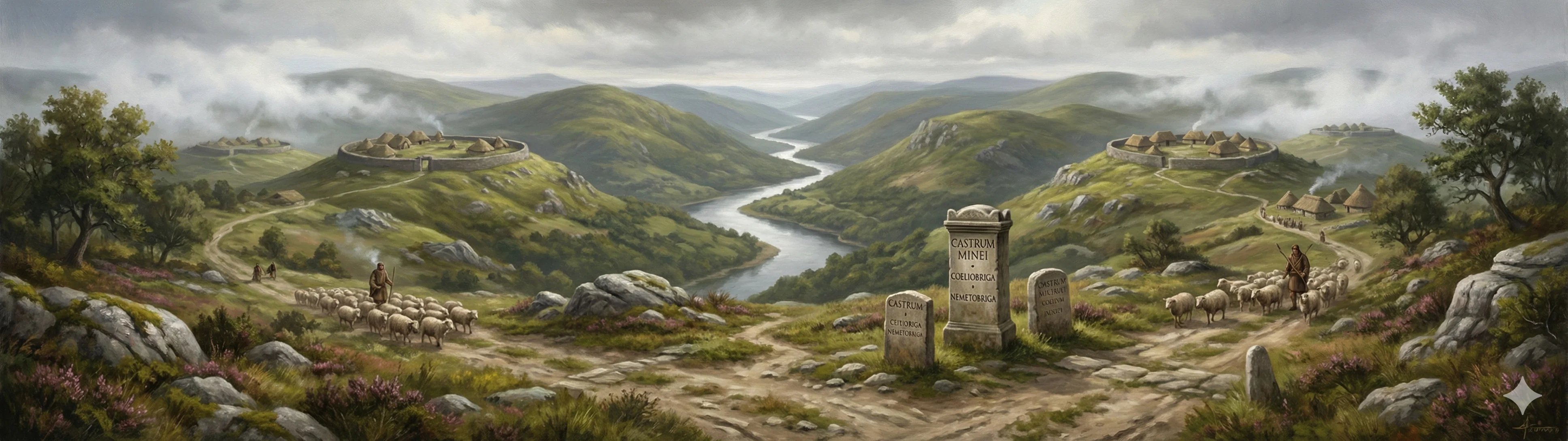
The word "Castrelo" itself is a direct inheritance from the Celtic past. It derives from the Latin "castrum" (fortress), which Romans used to designate the native hilltop settlements they encountered. The municipality of Castrelo de Miño was named for the ancient Castrum Minei — the castro that commanded the strategic river crossing of the Miño. This is no isolated case: across Ourense province, hundreds of place names encode Celtic and Castro-period origins. Every toponym beginning with "Castro-" or "Castrelo-" marks the site of a former hillfort. The suffixes "-briga" (fortified height) and "-dunum" (fortress) appear throughout Galicia — Nemetobriga, the sacred grove-fortress near Trives, and Brigantium (modern A Coruña) are among the most prominent.
In the family's ancestral parishes, the Celtic imprint runs deep. The Arnoia river, flowing through Cartelle, bears a pre-Roman hydronym of probable Celtic origin. The density of "castro" place names in the Ourense river valleys — Castro de Macendo, Castro de Outeiro, Castro das Cavadas — is among the highest in all of Iberia, reflecting the intense settlement of the Gallaeci in this region. Parish names containing elements like "-riz" (from later Germanic overlay) and "-edo/-ido" (Latin suffixes applied to Celtic root words) create a layered etymological record that traces continuous habitation from the Iron Age through the present day.
- "Castrelo" derives from Latin "castrum" (fortress), itself designating Celtic hilltop settlements
- Castrum Minei — the original castro on the Miño — gave Castrelo de Miño its name
- Ourense province contains more "Castro-" place names than any comparable region in Iberia
- Celtic suffix "-briga" (fortified hill) appears across Galicia: Nemetobriga, Brigantium (A Coruña)
- The Arnoia river (flowing through Cartelle) bears a pre-Roman hydronym of probable Celtic origin
- Place names encode a continuous record of habitation from the Iron Age to the present
Hilltop Fortresses of the River Valleys
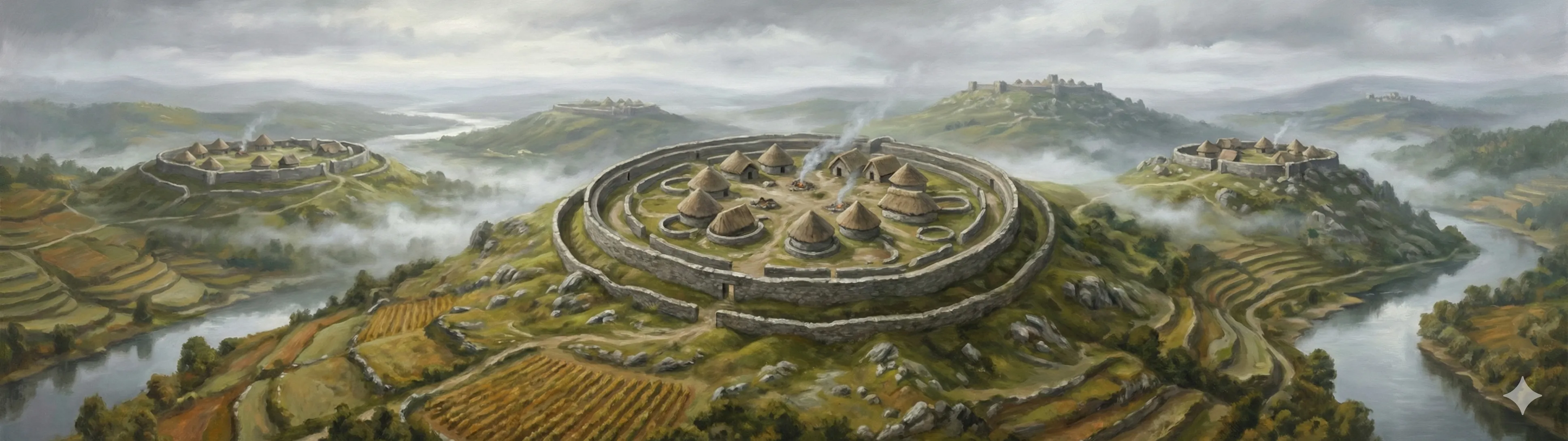
Over 5,000 castros have been catalogued across Galicia, with at least 383 documented in Ourense province alone — and the ancestral parishes of the family sit at the centre of one of the densest concentrations. In Castrelo de Miño, five castros have been identified: Castro de Santa Lucía in Astariz (2.75 hectares, excavated 2016–2017 by the University of Vigo), Castro de Las Cavadas (the legendary Castrum Minei commanding the Miño crossing), Castro de Macendo, Castro de Outeiro, and the Castrum Minei fortress itself. Together they formed a defensive network along the Miño between Ourense and Ribadavia — a chain of hilltop sentinels connected by line-of-sight across the valley.
In Cartelle, the Castro de Trelle — straddling the boundaries of Toén, Barbadás, and Cartelle — is one of the five largest castros in the entire province at 3.5 hectares. Aerial photographs from 1981 revealed its radial street pattern, reminiscent of the great oppidum of San Cibrán de Lás. Archaeological campaigns in 2024 and 2025 — the first scientific excavations of this site — uncovered circular stone dwellings, defensive walls approximately 10 metres high, a bronze fibula, carbonised wheat grains, and ceramics showing contact between the castro inhabitants and the Romans. The municipality's Monte de O Castro viewpoint marks another hillfort site. Across the Avia valley, the pre-Roman settlement of Abobriga — a Celtic place name meaning "settlement on the banks of the Avia" — was the direct predecessor of modern Ribadavia, its medieval Latin name Rippa Avie a translation of the original Celtic toponym.
- Over 5,000 castros catalogued across Galicia; at least 383 in Ourense province alone
- Five documented castros in Castrelo de Miño: Santa Lucía, Las Cavadas, Macendo, Outeiro, and Castrum Minei
- Castro de Trelle (Toén/Barbadás/Cartelle): 3.5 hectares — one of the five largest in Ourense, with excavations in 2024–2025 revealing 10m walls and circular dwellings
- Abobriga — the Celtic predecessor of Ribadavia — means "settlement on the banks of the Avia"
- Monte de O Castro in Cartelle: the toponym universally marks the site of a former hillfort
- Typical castro architecture: circular stone houses, defensive walls and ditches, granaries, and a croa (acropolis) at the summit
Stones That Remember
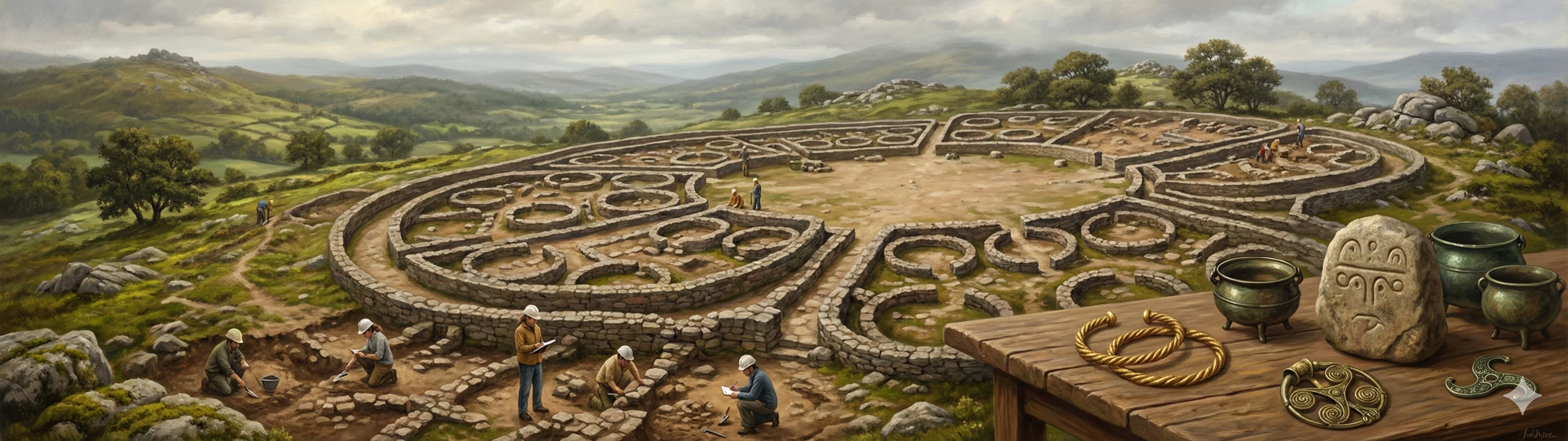
The physical evidence of Celtic life surrounds the family's ancestral parishes. Castro de Santa Lucía in Astariz, a parish of Castrelo de Miño, is a 2.75-hectare fortified settlement first excavated by the University of Vigo in 2016. Archaeologists uncovered circular stone dwellings characteristic of the Castro culture alongside later rectangular Roman-era structures — a visible record of the transition from Celtic to Roman life. A rock-cut wine press discovered at the site, dated to approximately 235 AD, provides the earliest evidence of winemaking in the Ribeiro region. Castro de Las Cavadas, the legendary Castrum Minei, once commanded the Miño river crossing, while Castro de Macendo and Castro de Outeiro formed a defensive network stretching along the Miño between Ourense and Ribadavia.
The crown jewel of the region's archaeological heritage is the Cidade de San Cibrán de Lás (Lansbrica), located between San Amaro and Punxín — just 18 km from Ourense. At approximately 10 hectares, it is the largest castro in all of Galicia, with two concentric oval walls, organized streets and drainage, over 50 excavated dwellings, and a ritual sauna (pedra formosa). At its peak around the 1st century BC, some 3,000 people lived within its walls. Nearby Castromao, identified as the ancient Coeliobriga and capital of the Coelerni tribe, yielded the famous Tabula Hospitalitatis — a bronze pact dated to 132 AD between the Coelerni and a Roman prefect, one of the most important epigraphic documents of Roman Gallaecia. The Ourense gold torcs, a pair of magnificent Iron Age neck rings found near the city and now in the British Museum, exemplify the metallurgical mastery of the Gallaeci.
- Cidade de San Cibrán de Lás (Lansbrica): ~10 hectares, the largest castro in Galicia, with an Archaeological Park since 2014
- Castromao (Coeliobriga): capital of the Coelerni, yielded the Tabula Hospitalitatis (132 AD) and an openwork trisquel
- Castro de Santa Lucía (Astariz, Castrelo de Miño): 2.75 hectares, excavated 2016, with a Roman-era wine press (c. 235 AD)
- Castro de Santomé (Ourense): discovered 1969, revealed blacksmith workshops, weapons, and bronze cauldrons
- The Ourense gold torcs — Iron Age neck rings now in the British Museum — exemplify Gallaeci metallurgical mastery
- Petroglyphs at Reigoso in Castrelo (1800–700 BC) predate but connect to the Castro culture
Gods of Oak and Thermal Springs
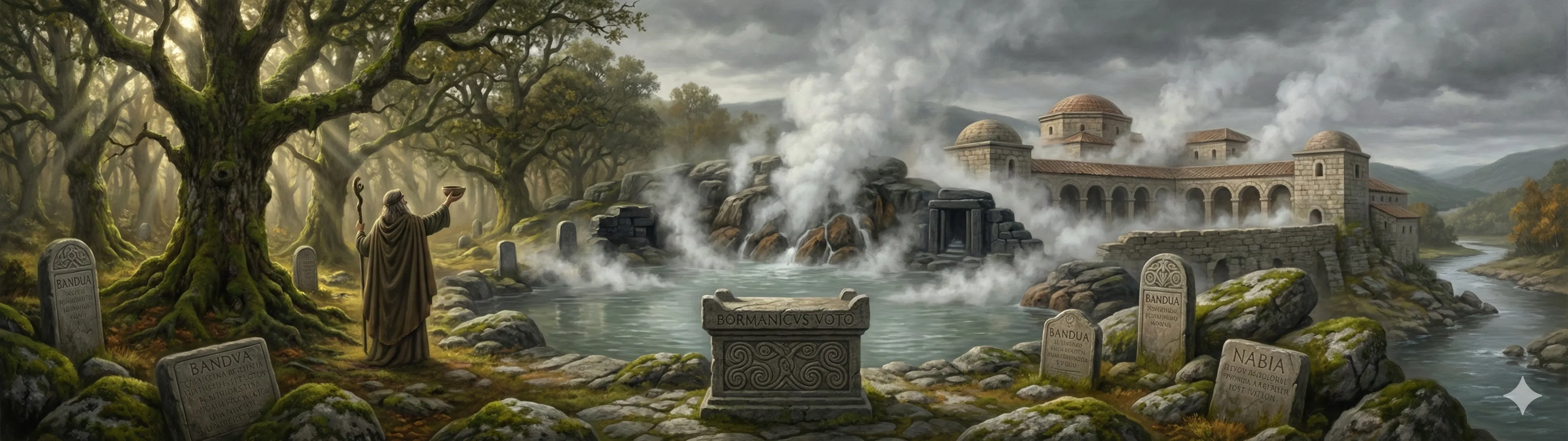
The province of Ourense holds the largest concentration of indigenous deity inscriptions in the entire Iberian Peninsula — a remarkable window into the religious world of the Gallaeci. Chief among the local gods was Bandua, a martial deity equated with Roman Mars, attested in six votive inscriptions from Ourense alone. At San Cibrán de Lás, a dedication to "Bandua Lansbricae" — Bandua of Lansbrica — reveals how each castro invoked the god under its own local epithet. Nabia, goddess of rivers, valleys, and fertility, appears in at least 28 inscriptions across Gallaecia and Lusitania; her sacred character may survive in the veneration of the Virgin of the Barca. The carballeira — sacred oak grove — served as a communal gathering place, echoing the Celtic reverence for trees documented by Caesar and Pliny among the Gauls and Britons.
The thermal springs that define Ourense — As Burgas in the city centre erupt at over 60°C — were sacred to the Castro-period inhabitants long before Rome. The deity Bormanicus, linked to hot springs, spas, and the subterranean world, was venerated at the Burgas alongside the god Reve. At Aquis Querquennis in Bande, the Romans built their military fort precisely at the thermal springs already sacred to the Querquerni — the fort's very name means "the waters of the Querquerni." In Castrelo de Miño, the thermal baths of O Diestro rest on Castro-Roman foundations, their curative waters drawing visitors for at least two millennia. This intertwining of sacred water and settlement is a defining feature of Celtic Gallaecia.
- Bandua: martial deity with 6 inscriptions in Ourense; "Bandua Lansbricae" found at San Cibrán de Lás
- Nabia: goddess of rivers and fertility, attested in 28+ inscriptions across Gallaecia and Lusitania
- Bormanicus: deity of hot springs and the subterranean world, venerated at As Burgas in Ourense (60°C+)
- Aquis Querquennis — "the waters of the Querquerni" — was built at springs sacred to the tribe
- Thermal baths at O Diestro in Castrelo de Miño rest on Castro-Roman foundations
- Ourense holds the highest concentration of indigenous Celtic deity inscriptions in all of Iberia
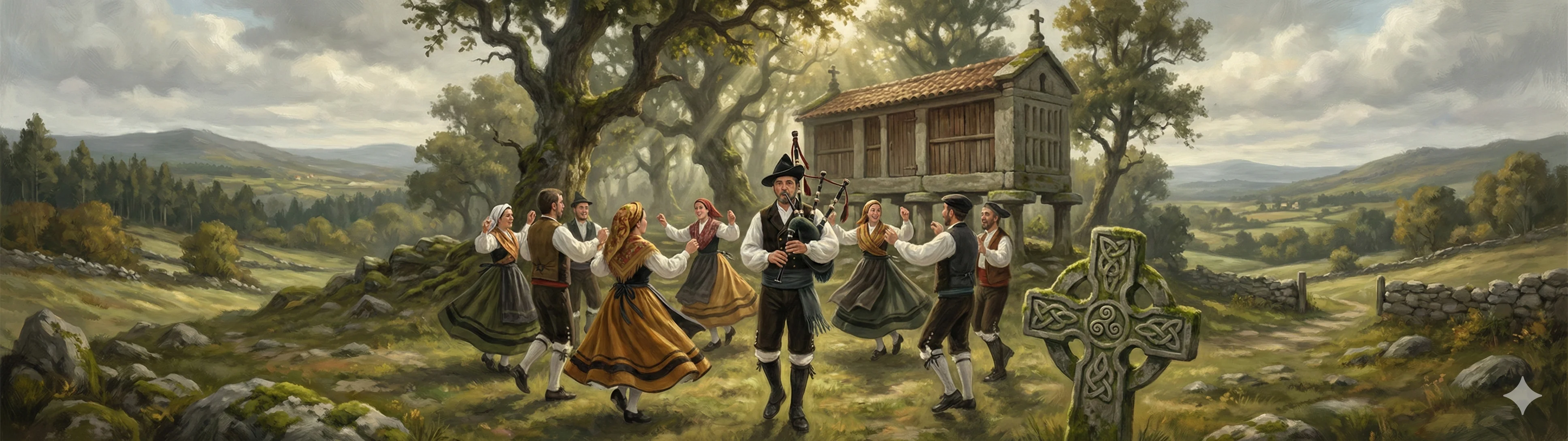
The Celtic Spirit Alive in Galicia
The gaita gallega — the Galician bagpipe — is the most visible thread connecting Galicia to the broader Celtic world. Directly related to the bagpipe traditions of Scotland, Ireland, Brittany, and Asturias, the gaita has been the voice of Galician identity for centuries. Galicia is recognised as one of the Celtic nations in cultural terms, participating in the Festival Interceltique de Lorient alongside Ireland, Scotland, Wales, Cornwall, Brittany, and the Isle of Man. Traditional circular dances (muiñeiras) echo pre-Roman communal celebrations. Castrelo de Miño itself maintains a school of bagpipes and tambourines, ensuring this ancient musical tradition passes to new generations.
The Celtic inheritance extends far beyond music. The hórreo — the raised stone granary found throughout Galicia — descends directly from Castro-era grain storage structures, preserving a design principle over two millennia old. Communal land management practices in rural parishes recall pre-Roman collective organisation. The carballeira (sacred oak grove) served as a communal gathering place, mirroring the Celtic reverence for sacred groves documented across Europe. Galician folklore preserves unmistakable pre-Christian elements: the meigas (healers and seers), the Santa Compaña (a spectral procession of the dead that walks the night roads), and the traditions of Samhain — the Celtic new year — which survives in Galicia as the night of departed souls. The Galician language itself retains Celtic substrate vocabulary not found in other Romance languages.
- The gaita gallega connects Galicia to Scotland, Ireland, Brittany, and Asturias in a living Celtic musical tradition
- Castrelo de Miño's school of bagpipes and tambourines preserves traditional music for new generations
- The hórreo (raised granary) found across Galicia descends directly from Castro-era grain storage structures
- Festival Interceltique de Lorient recognises Galicia as one of the Celtic nations alongside six others
- Galician folklore preserves pre-Christian Celtic elements: meigas, Santa Compaña, Samhain traditions
- The Galician language retains Celtic substrate words not found in other Romance languages
Heritage Sites
Castros, artifacts, and museums preserving the Celtic heritage of the Ribeiro and Ourense province.
Key Dates
“A terra garda nos seus castros a memoria dos primeiros poboadores.”— The land keeps in its castros the memory of the first settlers.