Roman Heritage
The Roman legacy in Galicia
Roman Heritage
For four centuries, Rome transformed Gallaecia — building roads through the mountains, bridges over the Miño, bathhouses at the thermal springs of Ourense, and planting the first vineyards in the river valleys of Castrelo de Miño and Ribadavia. The language we speak, the wine we drink, the roads we travel — all began with Rome.
“The women of the Gallaeci fought alongside the men, and mothers killed their own children rather than see them enslaved.”— Strabo, Geographica, Book III (early 1st century AD)
The Pacification of Gallaecia
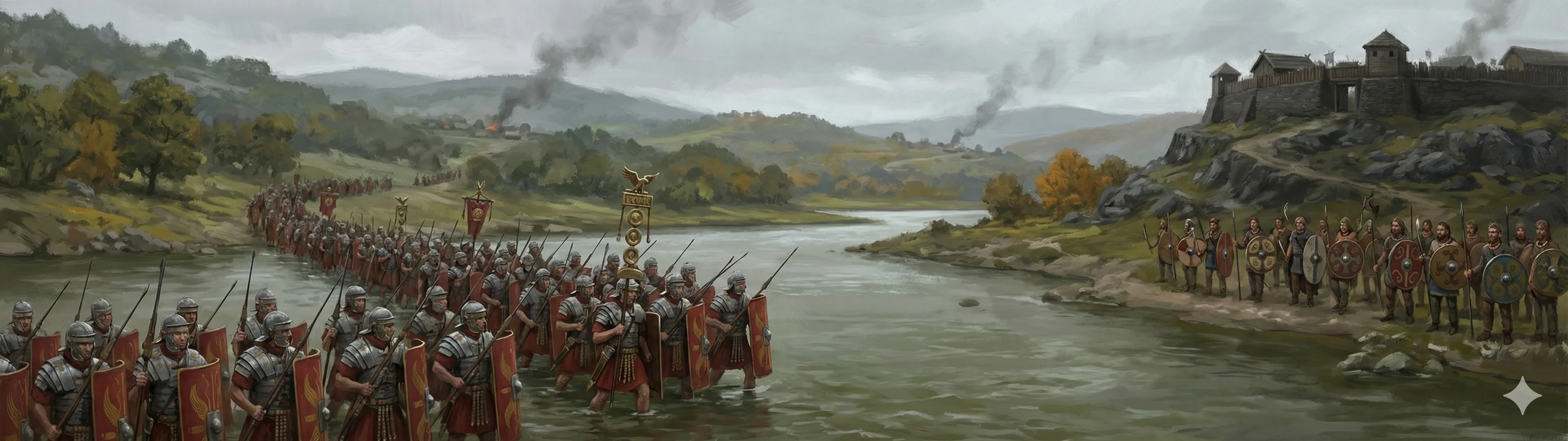
In 137 BC, the Roman general Decimus Junius Brutus crossed the Miño river — a boundary that the native Gallaeci considered inviolable. His campaign against the Celtic tribes of the northwest earned him the cognomen "Callaicus," and it marked the first time Roman legions penetrated the heartland of what would become Gallaecia. The crossing likely occurred near the middle Miño valley — the ancestral territory of the Querquerni and Coelerni tribes in what is now Ourense province. For the communities of Castrelo de Miño, Cartelle, and Ribadavia, this was the beginning of a transformation that would reshape every aspect of life.
Over a century of intermittent warfare followed. In 61 BC, Julius Caesar, then governor of Hispania Ulterior, launched a naval expedition to Brigantium (modern A Coruña), establishing Roman authority along the Atlantic coast. The decisive conquest came during the Cantabrian Wars (29–19 BC), when Augustus dispatched legions to subjugate the last free peoples of Iberia. The Gallaeci resisted fiercely — Strabo recorded that the women of the Gallaeci fought alongside the men, and mothers killed their own children rather than see them enslaved. By 19 BC, Rome controlled all of Gallaecia. The territory of the Querquerni around the Miño and Limia valleys was incorporated into the Conventus Bracarensis, administered from Bracara Augusta (modern Braga).
- Decimus Junius Brutus crossed the Miño in 137 BC — the first Roman general to penetrate the Gallaeci heartland
- The Querquerni occupied the middle Miño valley; the Coelerni held the Arnoia valley — both in the direct path of Roman expansion
- Julius Caesar sailed to Brigantium (modern A Coruña) in 61 BC, establishing coastal Roman authority
- The Cantabrian Wars (29–19 BC) under Augustus completed the conquest of all of northwestern Iberia
- The Conventus Bracarensis, administered from Bracara Augusta (Braga), governed the Ourense region
- Gallaecia became a full Roman province under Diocletian (c. 284 AD), with capital at Bracara Augusta
The Via Nova & the Bridges of Ourense
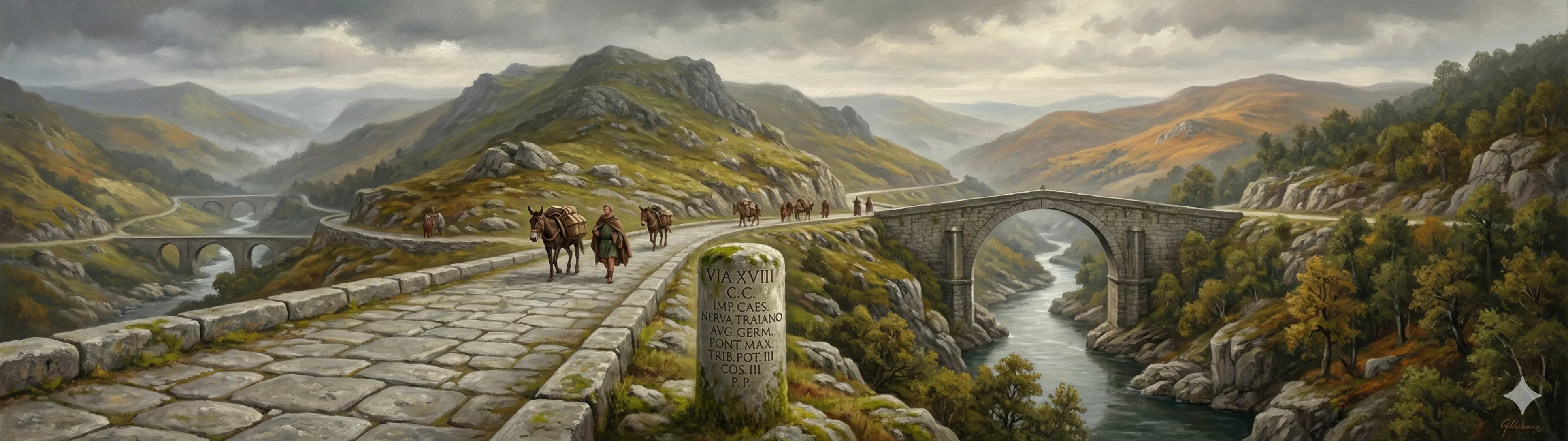
Rome's most enduring gift to Gallaecia was its network of roads. The Via Nova (Via XVIII), built under Titus and Domitian between 79 and 89 AD, connected Bracara Augusta (Braga) to Asturica Augusta (Astorga) across the mountainous interior of Gallaecia. This 345-kilometre highway crossed diagonally through Ourense province — from Aquis Querquennis at Bande through Sandías, Baños de Molgas, and A Pobra de Trives before entering León. Secondary branch roads connected the Via Nova to the Miño valley towns of Ribadavia, Castrelo de Miño, and Cartelle, integrating them into the broader Roman road network. Milestones found along its route — including several in the Ourense area — record the names of the emperors who built and maintained it: Titus, Domitian, Hadrian, and Maximinus Thrax. A second major road, Via XIX, connected Bracara Augusta to Lucus Augusti (Lugo) through the western valleys, creating a grid that opened the interior to trade, administration, and cultural exchange.
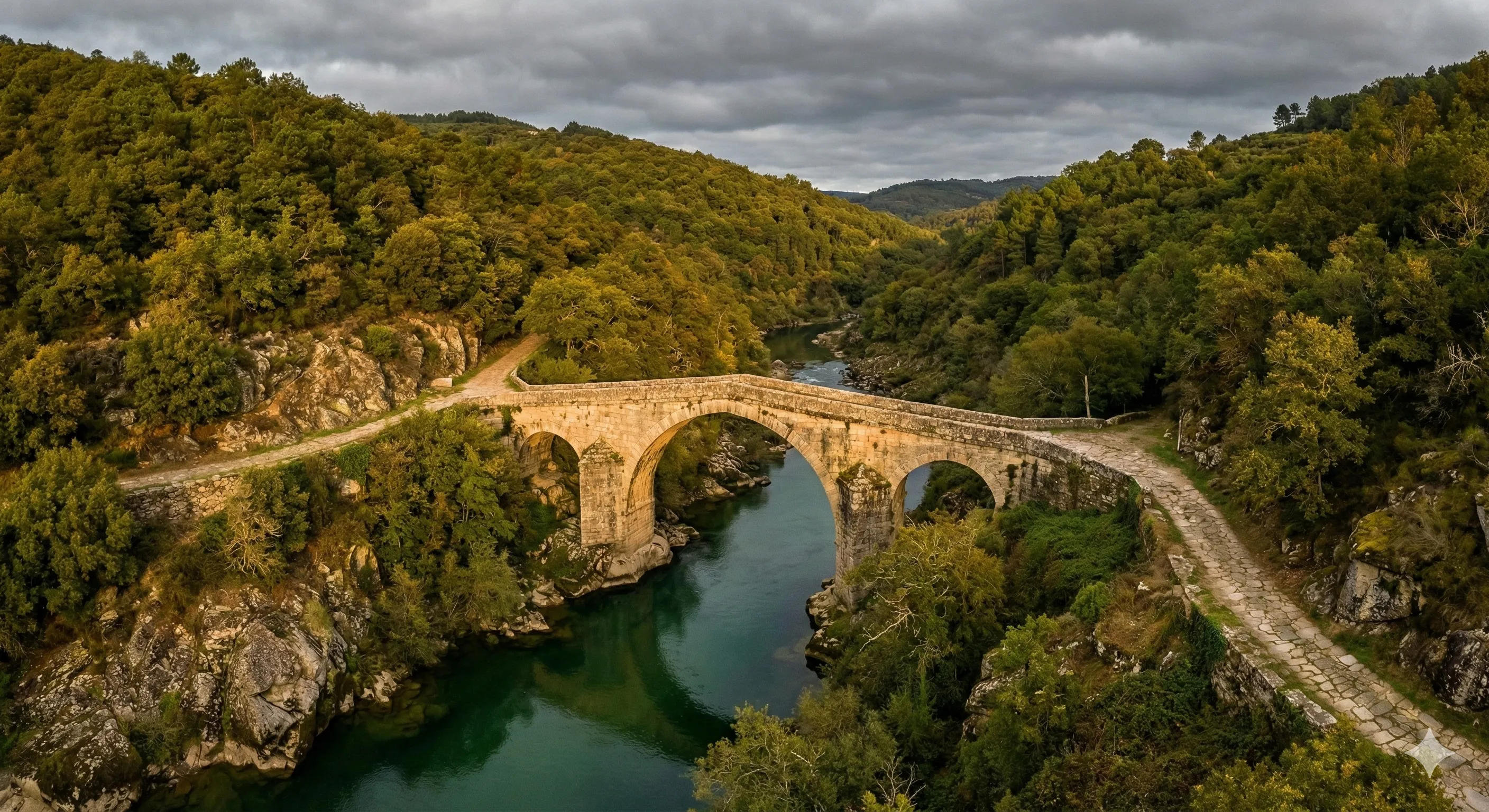
The roads demanded bridges, and the Romans built them to last millennia. Ponte Bibei, over the river Bibei near Puebla de Trives — a single-arch granite bridge still standing today — is the finest surviving Roman bridge in Galicia. Ponte Navea carried the Via Nova over the Navea river in the same region. Ponte Freixo crossed the Bibei further south, and the ancient Roman crossing at Ourense itself — predecessor to the medieval Ponte Vella — served as the principal gateway across the Miño. Together, these bridges transformed the isolated valleys of Castrelo de Miño, Cartelle, and Ribadavia from remote Celtic territory into nodes on an imperial network that stretched from Rome to the Atlantic.
- The Via Nova (Via XVIII) from Bracara Augusta to Asturica Augusta crossed directly through Ourense province — 345 km of engineered roadway
- Ponte Bibei: single-arch Roman granite bridge near Puebla de Trives, still standing after nearly 2,000 years
- Via XIX connected Bracara Augusta (Braga) to Lucus Augusti (Lugo), creating a grid that opened the interior to trade
- Roman milestones along the Via Nova record the names of emperors Titus, Domitian, Hadrian, and Maximinus Thrax
- Ponte Navea and Ponte Freixo carried the road network across the mountain rivers of eastern Ourense
Ourense: City of Scalding Waters
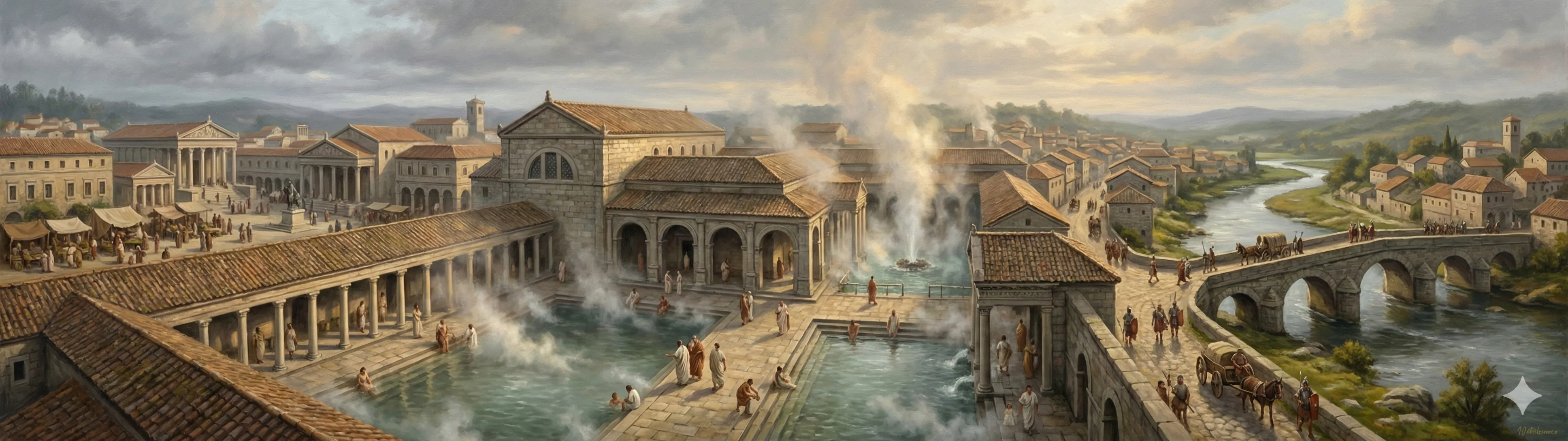
At the heart of the road system stood Ourense, known to the Romans as Aquae Urentes ("Scalding Waters") or Aquae Aurienses — named for the thermal springs of As Burgas that still pour steaming water at 67°C in the city center. The Romans recognized the springs' value immediately and developed them into public bathhouses — thermae — in the 1st and 2nd centuries AD. Bathing was central to Roman civic life: the baths were not merely places to wash but social institutions where citizens conducted business, exercised, and debated. In the provincial town of Aquae Urentes, the thermae anchored an emerging urban center on the Via Nova, drawing travellers, merchants, and administrators passing between Bracara Augusta and Asturica Augusta.
The thermal springs gave Ourense its identity and its name. The city grew from a modest way-station into a prosperous settlement, with a forum, markets, and residential quarters radiating outward from the baths. The proximity of As Burgas to the Miño crossing made Ourense the natural administrative hub for the surrounding territory — including the rural communities of Castrelo de Miño, Cartelle, and Ribadavia in the wine-rich valleys to the south. Today, the Burgas fountains still flow at their ancient temperature, a living link to the Roman city that rose around them.
- As Burgas thermal springs in Ourense — 67°C waters that the Romans developed into public thermae (Aquae Urentes)
- The Roman name Aquae Urentes means "Scalding Waters"; Aquae Aurienses may relate to gold (aurum) from nearby mining operations
- Roman bathhouses (thermae) were social institutions: exercise, commerce, and civic life centered around the baths
- Ourense grew from a way-station on the Via Nova into the administrative hub for the Miño valley settlements
- The Burgas fountains still flow at 67°C today — among the hottest inhabited thermal springs in the Iberian Peninsula
Aquis Querquennis: Fortress on the Limia
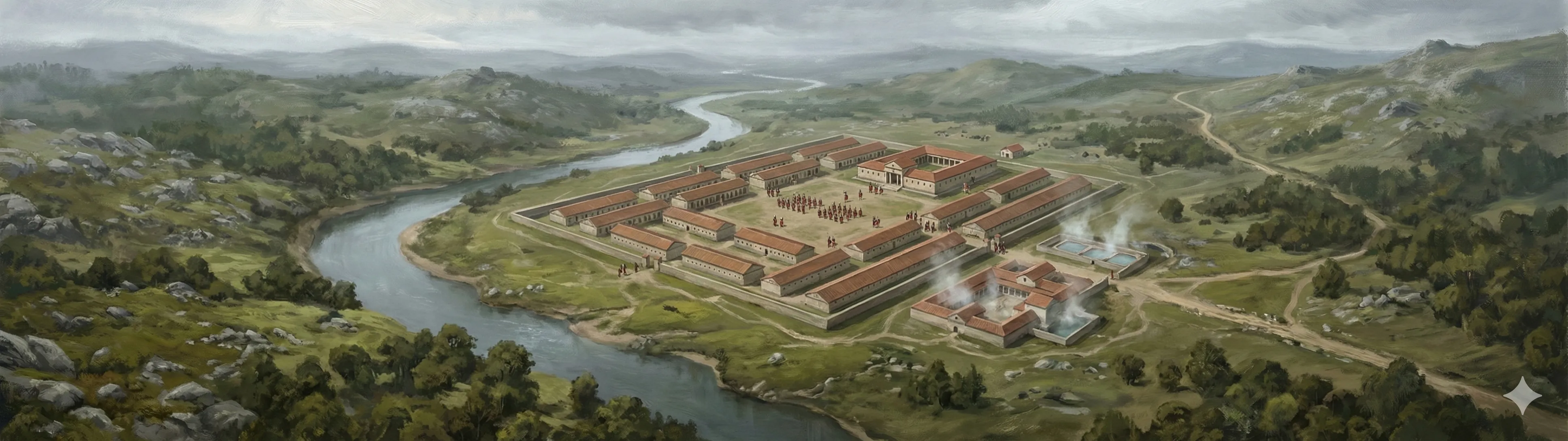
On the banks of the Limia river at Bande, some 50 kilometres west of Ribadavia, the Romans built Aquis Querquennis — a 2.5-hectare military camp established during the reign of Vespasian (c. 69–79 AD) to garrison the soldiers building the Via Nova and control the territory of the Querquerni tribe. The camp garrisoned the Cohors I Gallica, an auxiliary cohort of approximately 500 soldiers. Excavations have revealed barracks for the troops, a headquarters building (principia), granaries (horrea), officers' quarters, and a sophisticated drainage system — all laid out on the standard Roman military grid. The camp's thermal baths, fed by nearby hot springs, provided the garrison with the comforts of Roman civilization even on this remote frontier.
The Querquerni whose territory the camp controlled were the Celtic tribe that had inhabited the middle Miño and Limia valleys — the same valleys where Castrelo de Miño, Cartelle, and Ribadavia stand today. Under the watchful eye of the garrison, the Querquerni gradually adopted Roman customs, language, and law. Aquis Querquennis was active until the late 1st or early 2nd century AD, when the frontier moved and the legion was redeployed. The camp was partially submerged when the As Conchas reservoir was built in the 20th century, but excavations during low-water periods have made it one of the best-studied Roman military sites in northwestern Iberia.
- Aquis Querquennis (Bande): 2.5-hectare Roman military camp on the Limia river — home to the Cohors I Gallica (~500 soldiers)
- Camp layout includes barracks, principia (headquarters), horrea (granaries), officers' quarters, and thermal baths
- The Querquerni tribe occupied the middle Miño and Limia valleys — the ancestral territory of Castrelo de Miño and Cartelle
- The camp protected the Via Nova as it crossed Querquerni territory between Bracara Augusta and Asturica Augusta
- Partially submerged by the As Conchas reservoir — excavated during low-water periods, revealing one of the best-preserved Roman camps in Iberia
Birth of the Ribeiro: Rome's Gift to the Land
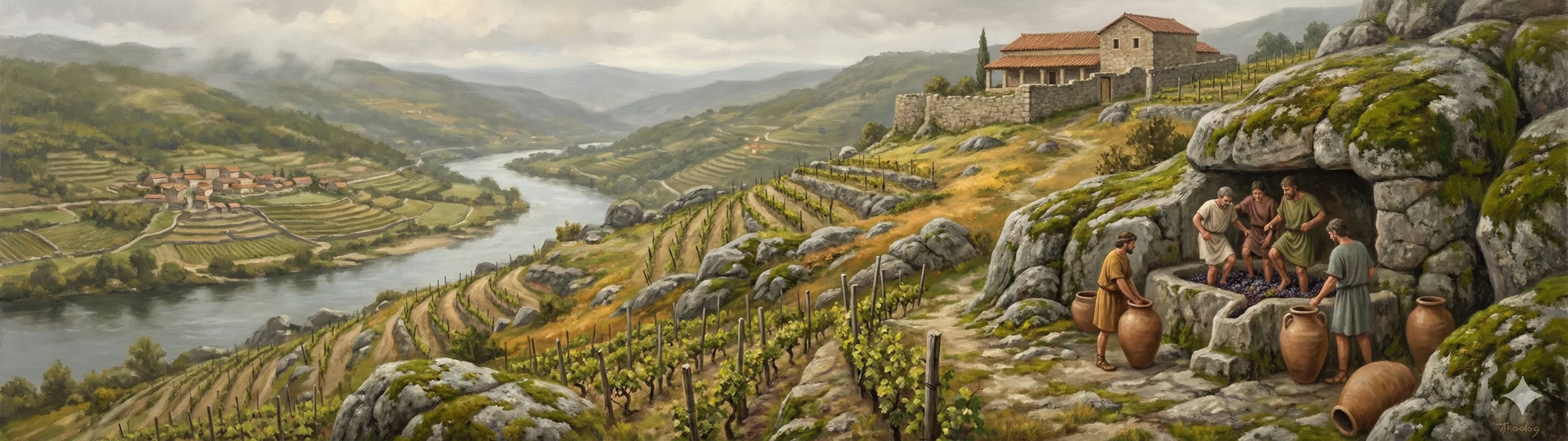
Of all the changes Rome brought to the Miño valley, none proved more lasting than the vine. The Romans introduced systematic viticulture to Gallaecia, planting the sheltered river valleys with grape varieties and applying the winemaking techniques of the Mediterranean. The earliest physical evidence of this transformation was found at Castro de Santa Lucía in Astariz, a parish of Castrelo de Miño: a rock-cut wine press (lagar rupestre) dated to approximately 235 AD, discovered during University of Vigo excavations in 2016. This is the oldest known evidence of winemaking in the entire Ribeiro region — and it was found in the family's ancestral parish. The warm microclimate of the Miño, Avia, and Arnoia river valleys, with their granite soils and south-facing slopes, proved ideal for the vine. What the Romans planted would grow into the Ribeiro Denominación de Origen, one of the oldest and most celebrated wine regions in all of Spain.
Beyond the vine, Rome transformed the economy of the interior. The gold mines of Ourense province — worked through techniques including ruina montium (hydraulic mining) — fed the Imperial treasury. While the colossal Las Médulas in León was the largest Roman gold mine in the Empire, smaller but significant operations dotted the Ourense landscape, exploiting alluvial gold from the Sil and Miño rivers and their tributaries. Tin mining — the same cassiterite deposits that had drawn Phoenician traders centuries earlier — continued under Roman management on an industrial scale. The agricultural landscape was reshaped as well: Roman settlers and Romanized Gallaeci introduced new crops and techniques, established market-oriented farming along the road network, and began the transition from the subsistence agriculture of the castro period to the diversified farming of Roman villas.
- Rock-cut wine press (lagar rupestre) at Castro de Santa Lucía, Astariz (Castrelo de Miño) — dated c. 235 AD, the oldest evidence of winemaking in the Ribeiro
- The Ribeiro DO, centered on Ribadavia, traces its wine heritage directly to Roman-era plantings in the Miño, Avia, and Arnoia valleys
- Las Médulas (León) was the largest Roman gold mine in the Empire — Ourense province hosted smaller but significant gold operations
- Hydraulic mining (ruina montium) and alluvial gold extraction from the Sil and Miño rivers supplied the Imperial treasury
- Tin (cassiterite) mining continued under Rome on an industrial scale — the same deposits Phoenicians had traded for centuries earlier
- Roman villas replaced castros as the primary settlement pattern, introducing market-oriented agriculture along the road network
From Celtic to Latin: The Names on the Land
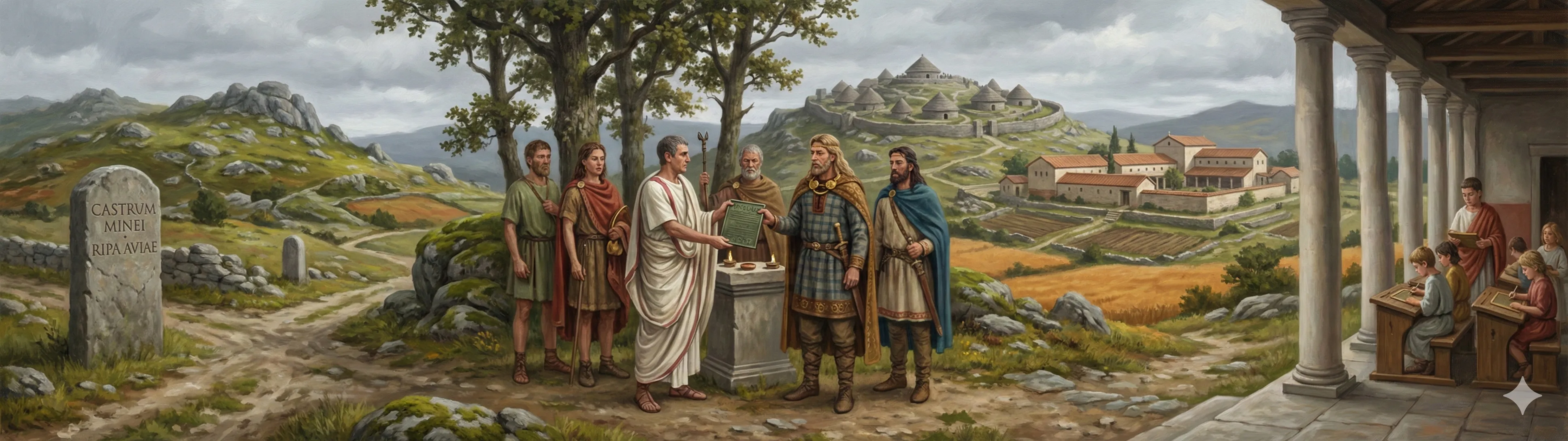
The most profound Roman legacy in Galicia is the one we speak every day. Latin replaced the Celtic languages of the Gallaeci over centuries — not by decree, but through commerce, law, military service, and intermarriage. The transition was gradual: bilingual inscriptions from the 1st and 2nd centuries show Celtic names written in Latin script, and place names across Ourense preserve both Celtic and Latin roots. The very names on the land encode Roman memory: Ribadavia from Ripa Aviae ("bank of the Avia river"), Ourense from Aurienses, Castrelo de Miño from Castrum Minei ("fort on the Miño"). Over time, Latin evolved into Galician-Portuguese, which emerged in the medieval period and later diverged into Galician and Portuguese — two of the world's great languages, spoken today by over 260 million people.
The Romanization of the Miño valley was not only linguistic. In 132 AD, the Coelerni tribe of the Arnoia valley — neighbours of Cartelle — sealed a Tabula Hospitalitatis (hospitality pact) in bronze with the Roman prefect Gaius Antonius Aquilus at Castromao near Celanova. This pact, discovered in the 19th century, testifies to the formal integration of native communities into Roman administrative life. In 212 AD, the Constitutio Antoniniana granted Roman citizenship to all free inhabitants of the Empire — including the descendants of the Querquerni and Coelerni in the Miño valley. They were no longer conquered subjects but Roman citizens, with legal rights, property protections, and access to the courts. Parish boundaries in the rural Ourense countryside often follow limits first drawn by Roman administrators; the legal concept of the municipality, the grid of roads connecting villages — all are Roman foundations.
- Latin evolved into Galician-Portuguese, which diverged into Galician and Portuguese — spoken today by over 260 million people worldwide
- Ribadavia derives from Latin Ripa Aviae ("bank of the Avia river"); Ourense from Aurienses; Castrelo de Miño from Castrum Minei
- Tabula Hospitalitatis of Castromao (132 AD) — bronze hospitality pact between the Coelerni and Roman prefect Gaius Antonius Aquilus, near Celanova
- The Constitutio Antoniniana (212 AD) made all free inhabitants of the Empire — including the Gallaeci — Roman citizens
- Roman parish and municipal boundaries in Ourense province persist as the framework of modern administrative divisions
- Forum Limicorum near Xinzo de Limia served as the Roman administrative center for the Limici tribe
The Roman World Lives On
Christianity arrived in Gallaecia during the later Roman centuries. By the 4th century, the faith had taken root, and the Council of Elvira (c. 305 AD) — which included bishops from Gallaecia — is the earliest recorded church council in Iberia. The Romanized tribal structure provided the framework for the first dioceses: Ourense, Braga, and Lugo became episcopal seats that endure to this day. In the late 4th century, Priscillian — bishop of Ávila, whose movement found its greatest following in Gallaecia — led a Christian reform movement that became the first heresy to result in a death sentence by secular authorities, evidence of how deeply Christianity had penetrated Galician society.
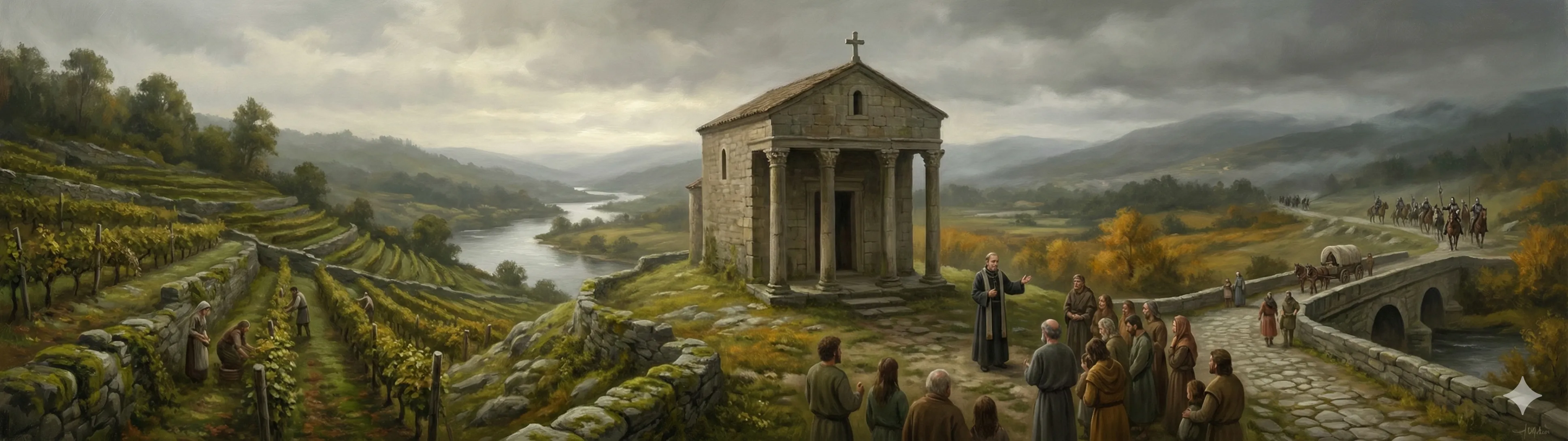
When the Suevi crossed the Pyrenees in 409 AD and established their kingdom in Gallaecia, they inherited a thoroughly Romanized landscape — Latin-speaking, Christian, connected by roads, cultivating vines in the Miño and Avia valleys, and organized into the administrative units that would become the parishes and municipalities of modern Galicia. The bridge crossings of the Miño still carried traffic. The thermal baths of As Burgas still steamed. The vineyards that the Romans had planted around Ribadavia and Castrelo de Miño still bore fruit. Rome's legions had departed, but the world they built endured — in the language spoken in the fields of Cartelle, in the wine pressed from the hillsides of the Ribeiro, in the parish church that would rise where a Roman altar once stood.
- Christianity reached Gallaecia by the 3rd–4th century; Ourense, Braga, and Lugo became episcopal seats
- Council of Elvira (c. 305 AD) — earliest recorded church council in Iberia, with bishops from Gallaecia attending
- Priscillian, bishop of Ávila, led a Christian reform movement whose strongest following was in Gallaecia — evidence of deep Christian roots in the province
- When the Suevi arrived in 409 AD, they inherited a Latin-speaking, Christian, road-connected, vine-cultivating Gallaecia
- Roman foundations — roads, bridges, vineyards, parishes, language — endure in Ribadavia, Castrelo de Miño, and Cartelle to this day
Heritage Sites
Roads, bridges, camps, and archaeological sites preserving the Roman heritage of Ourense province.
Key Dates
“Aquae Urentes — as augas ferventes que deron nome á nosa terra.”— Scalding Waters — the boiling springs that gave our land its name.