Suevi Heritage
The Germanic kingdom that shaped Galicia
Suevi Heritage
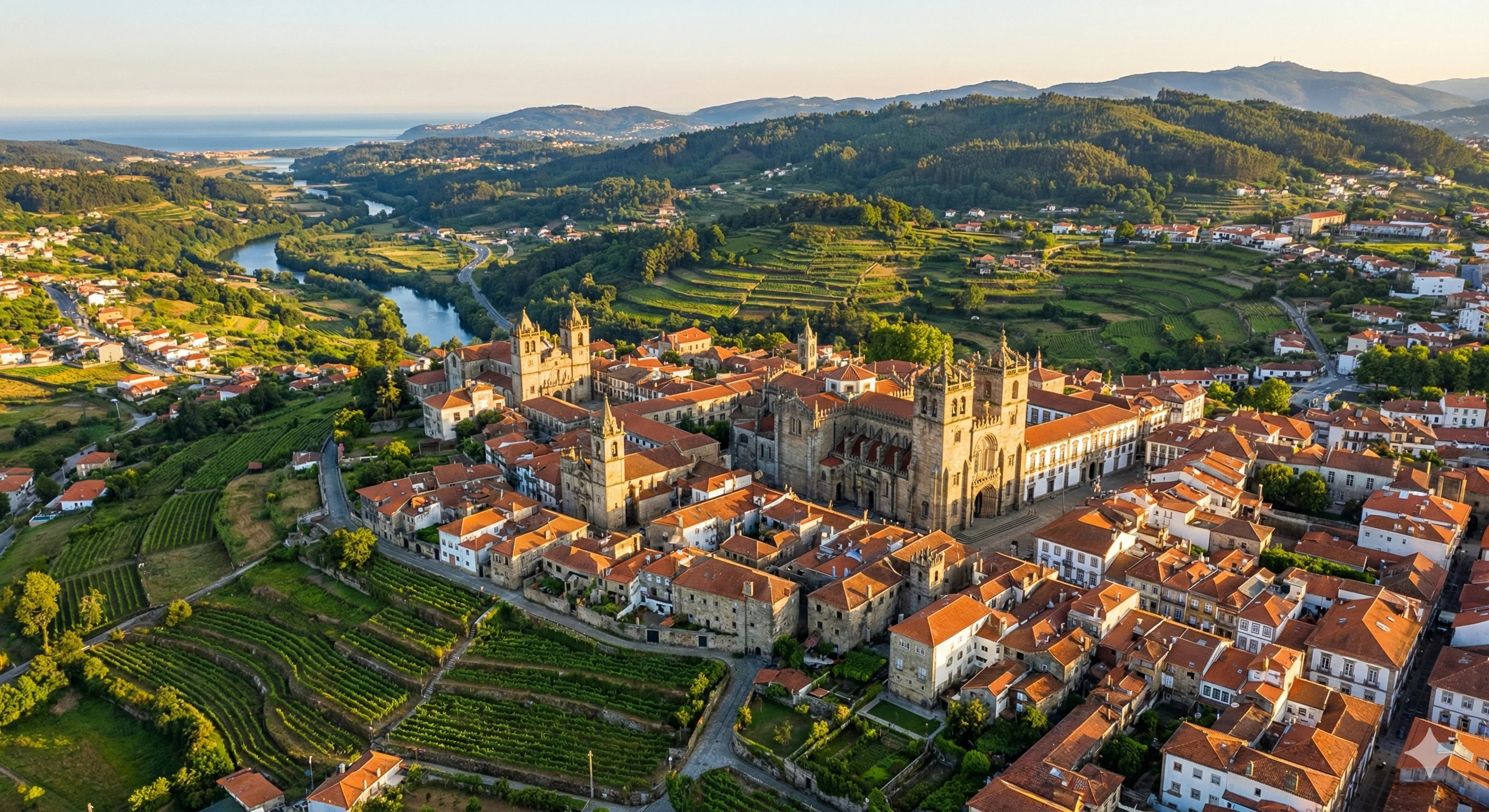
In 409 AD, the Suevi crossed the Pyrenees and founded the first Germanic kingdom in western Europe — right here in Gallaecia. For 176 years they ruled from Braga, converted to Christianity, created the parish system that still organises Galician life, and blended with the Gallaeco-Roman people of the Miño valley to forge the culture we inherit today.
“Cursing their swords, they turned to the plough and cherished the remaining Romans as allies and friends.”— Orosius, Historiae Adversum Paganos, VII.41 (c. 417 AD)
The First Germanic Kingdom in Western Europe
In 409 AD, the Suevi — a confederation of Germanic peoples from the regions around the Elbe River and modern Bohemia — crossed the Pyrenees into Roman Hispania alongside the Vandals and Alans. By 411, the barbarian groups divided the western provinces among themselves. The Suevi received the western portion of Gallaecia — the Atlantic-facing lands stretching from modern Porto to Pontevedra. They chose Bracara Augusta (modern Braga) as their capital, establishing what scholars now recognise as the first independent Germanic kingdom in post-Roman Western Europe — predating even the Frankish and Visigothic kingdoms.
The Kingdom of the Suebi endured for 176 years under a succession of kings. Hermeric (c. 409–438) consolidated control over Gallaecia and made peace with the local Gallaeco-Roman population. His son Rechila (438–448) expanded the kingdom dramatically, conquering Seville and Mérida. Rechiar (448–456) became the first Germanic king in post-Roman Europe to convert to Catholicism. After a period of civil war and a "dark century" of sparse records (c. 470–550), the kingdom emerged renewed under Ariamir and Theodemir, who convened the great church councils and reorganised the kingdom into dioceses. King Miro (c. 570–583) presided over the kingdom's golden age before the Visigothic conquest under Leovigild ended Suevi independence in 585 AD.
- An estimated 20,000–50,000 Suevi settlers arrived among a much larger Gallaeco-Roman population — historian Orosius wrote that they "cursed their swords and turned to the plough"
- Bracara Augusta (Braga) served as the Suevi capital — already the seat of the Roman Conventus Bracaraugustanus
- Rechiar (448–456) was the first Germanic king in post-Roman Europe to embrace Catholicism
- The Chronicle of Hydatius, bishop of Aquae Flaviae (Chaves), is our only continuous narrative source for the 5th-century Suevi kingdom
- King Miro convened the Second Council of Braga (572) — a high point of Suevi civilisation
- Leovigild conquered the Suevi kingdom in 585, making it the sixth province of the Visigothic Kingdom
From Paganism to Christendom: The Apostle of the Suevi
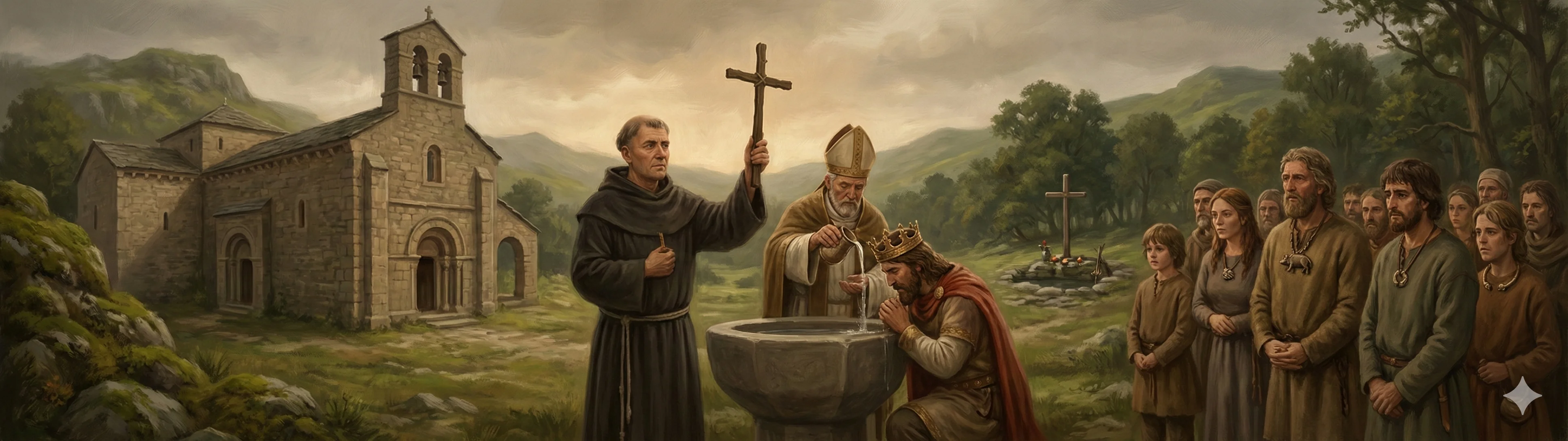
The religious journey of the Suevi passed through three phases: initial paganism (409–449), a brief Catholic period under Rechiar, then conversion to Arianism around 466 when a missionary named Ajax was sent by the Visigothic king. For roughly a century, the Suevi remained Arian Christians. The transformation came in the 550s with the arrival of Martin of Braga — born in Pannonia (modern Hungary), educated in the Holy Land, and one of the most remarkable missionaries of late antiquity. Martin founded the Monastery of Dumium near Braga, became its first bishop, and ultimately rose to Metropolitan Archbishop of Gallaecia.
Martin's influence was profound. He attended the First Council of Braga (561) and shaped the final conversion of the Suevi from Arianism to Catholic orthodoxy. His treatise De correctione rusticorum ("On the Correction of Country Folk") — written as a letter to Bishop Polemius of Astorga — is an invaluable window into daily life in rural Gallaecia, describing pagan survivals among the countryside population: lighting candles at crossroads, offering food to sacred springs, divinations by birds, and observance of days dedicated to Roman and Germanic gods. Martin used persuasion rather than coercion, and his patient work transformed the spiritual landscape of the entire kingdom. He died in 580 at Dumium, having shaped the Christianity that would endure in Galicia for the next millennium and a half.
- Martin of Braga (c. 520–580): born in Pannonia, trained in the Holy Land, became Metropolitan Archbishop of Gallaecia
- Founded the Monastery of Dumium near Braga — the spiritual centre of the Suevi conversion
- De correctione rusticorum describes pagan practices surviving in rural Gallaecia: sacred springs, crossroad rituals, divinations
- The First Council of Braga (1 May 561) formally established Catholic orthodoxy across the Suevi kingdom
- Martin was a rare Greek-literate scholar in the Latin West — he translated the Sayings of the Egyptian Fathers into Latin
- The conversion ensured that every parish needed sacramental wine — linking Christianity directly to the continuation of viticulture in the Ribeiro
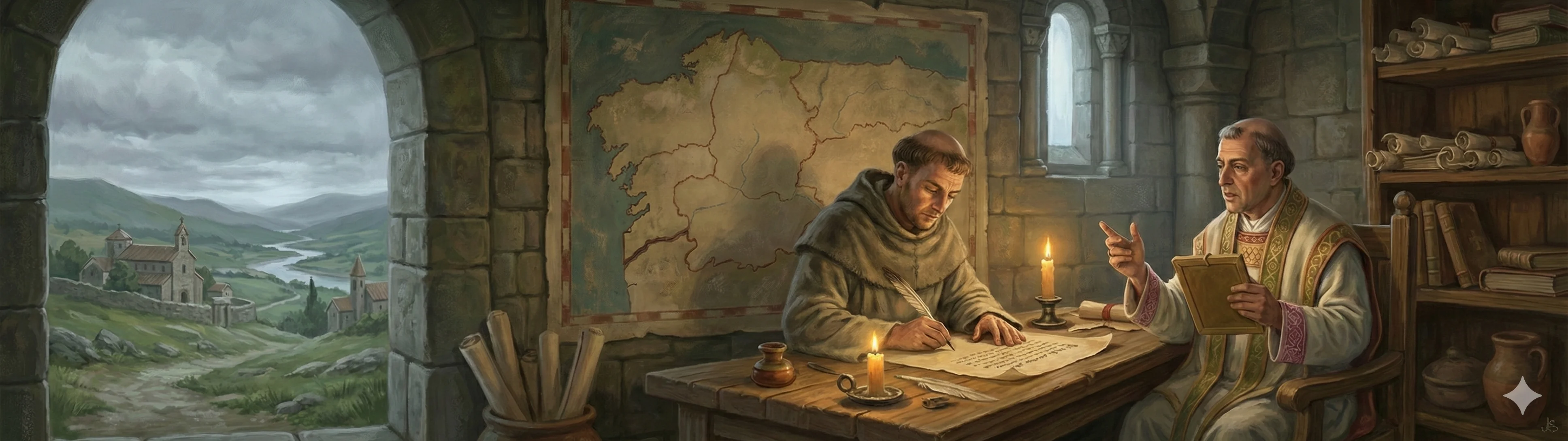
The Parochiale Suevorum: A Kingdom Mapped in Parishes
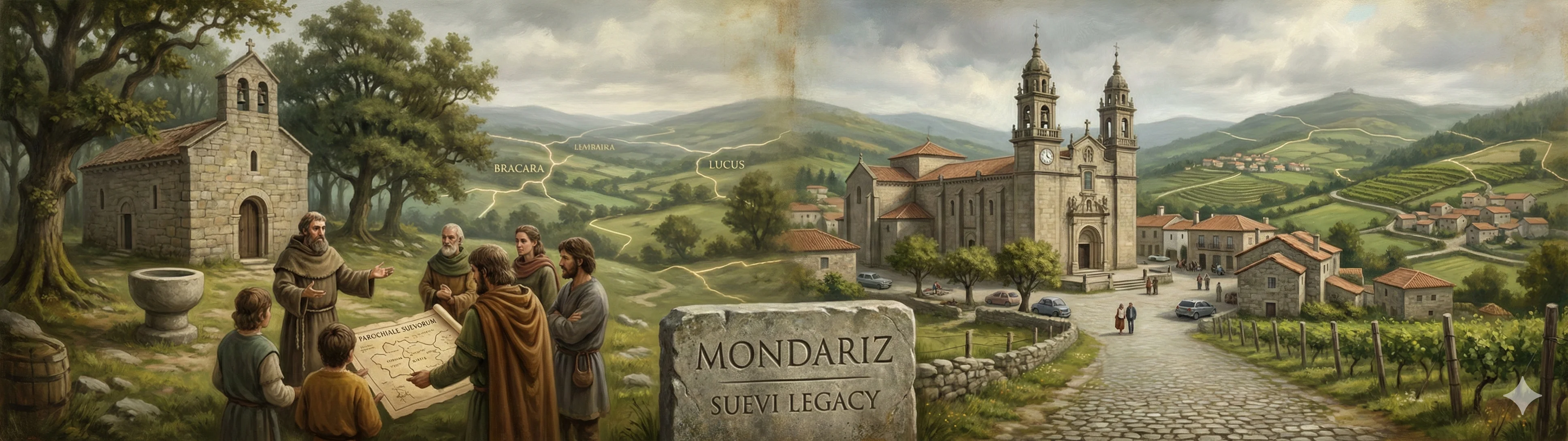
Between 572 and 582, the Suevi produced a document unique in all of early medieval Europe: the Parochiale Suevorum, also known as the Divisio Theodemiri after King Theodemir who ordered its creation. This extraordinary text lists 134 parishes — 107 ecclesiae and 27 pagi — organised into 13 dioceses across two metropolitan provinces: Braga in the south and Lugo in the north. It is the single most important document for locating peoples and settlements in post-Roman Gallaecia, and it has no equivalent in any other region of the former Western Empire.
The Diocese of Ourense (Auriense) — one of five new episcopal sees created specifically under the Suevi — fell under the Metropolitan of Lugo. Its named parishes included Palla Aurea (Ourense itself), Bibalos (identified with Temes in the Ribeiro area), Verugio, Teporos, Geurros, Pincia, Cassavio, Verecanos, Senabria, and Calapacios. The parish of Bibalos — covering the Ribeiro heartland — is the most likely administrative unit that encompassed the territories of Ribadavia, Castrelo de Miño, and Cartelle in the 6th century. The Parochiale created the framework that would evolve into the modern Galician parish (parroquia) system — arguably the oldest continuously functioning administrative structure in Western Europe derived from a specific political act.
- The Parochiale Suevorum (c. 572–582) lists 134 parishes across 13 dioceses — a document unmatched in early medieval Europe
- The Diocese of Ourense was one of five new episcopal sees created under Suevi rule — it received its formal status because of the Suevi kingdom
- The parish of Bibalos (Temes) in the Ribeiro is the most likely administrative unit covering Ribadavia, Castrelo de Miño, and Cartelle
- The Council of Lugo (1 January 569) reorganised the kingdom into two metropolitan provinces: Braga and Lugo
- Ourense province today contains 735 parishes — a direct organisational descendant of the Suevi system
- Scholar Pierre David authenticated the Parochiale as genuine in 1947, confirming its 6th-century origin
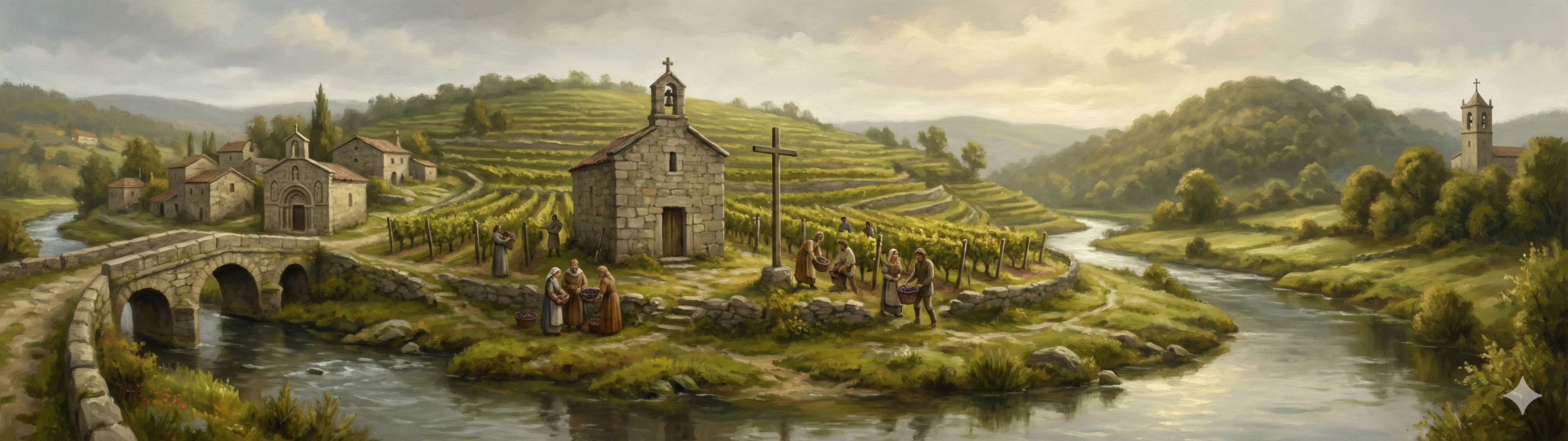
The Ribeiro Under the Suevi: Vineyards, Monks, and Sacramental Wine
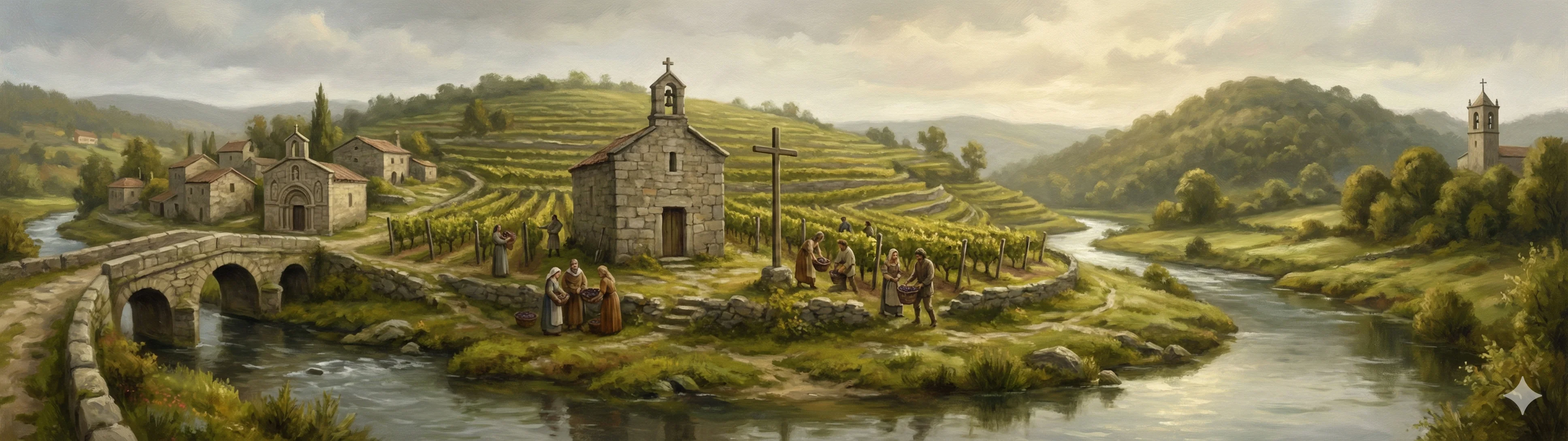
When the Suevi arrived in 409, they inherited a landscape already shaped by four centuries of Roman viticulture. The sheltered valleys of the Avia, Miño, and Arnoia rivers — where Ribadavia, Castrelo de Miño, and Cartelle lie — had produced wine since at least the 3rd century AD. Though no specific Suevi-era documents mention the Ribeiro's wines, viticulture almost certainly continued: vines are a long-term agricultural investment, and the Suevi had every incentive to maintain the productive landscape they had inherited.
The conversion to Catholicism added a powerful new driver for winemaking. With 134 parishes established under the Parochiale Suevorum, each requiring sacramental wine for the Eucharist, the demand for wine became woven into the fabric of Christian governance. Martin of Braga's monastic foundations needed wine for liturgical purposes, and the monastic tradition he established would later flourish in the Ribeiro. The Monastery of San Clodio in Leiro, adjacent to Ribadavia — possibly founded as early as the 6th century, though more securely documented from 928 — would become the epicentre of medieval winemaking in the region. The Benedictine and later Cistercian monks of San Clodio were pioneers of vineyard cultivation, producing wines that reached northern Europe via merchants on the Camino de Santiago.
- Roman viticulture was well established in the Ribeiro before the Suevi arrived — the wine press at Castro de Santa Lucía dates to c. 235 AD
- Orosius (c. 417) reported the barbarians "cursed their swords and turned to the plough" — adopting existing agriculture including viticulture
- The Parochiale Suevorum's 134 parishes each needed sacramental wine, linking Christianity to the continuation of winemaking
- The Monastery of San Clodio in Leiro (near Ribadavia) may have origins in the 6th century; it became central to Ribeiro winemaking
- Martin of Braga's monastic foundations established the tradition that would drive viticulture in the Ribeiro for centuries
- The Ribeiro DO — one of Spain's oldest wine regions — traces an unbroken viticultural tradition through the Suevi period
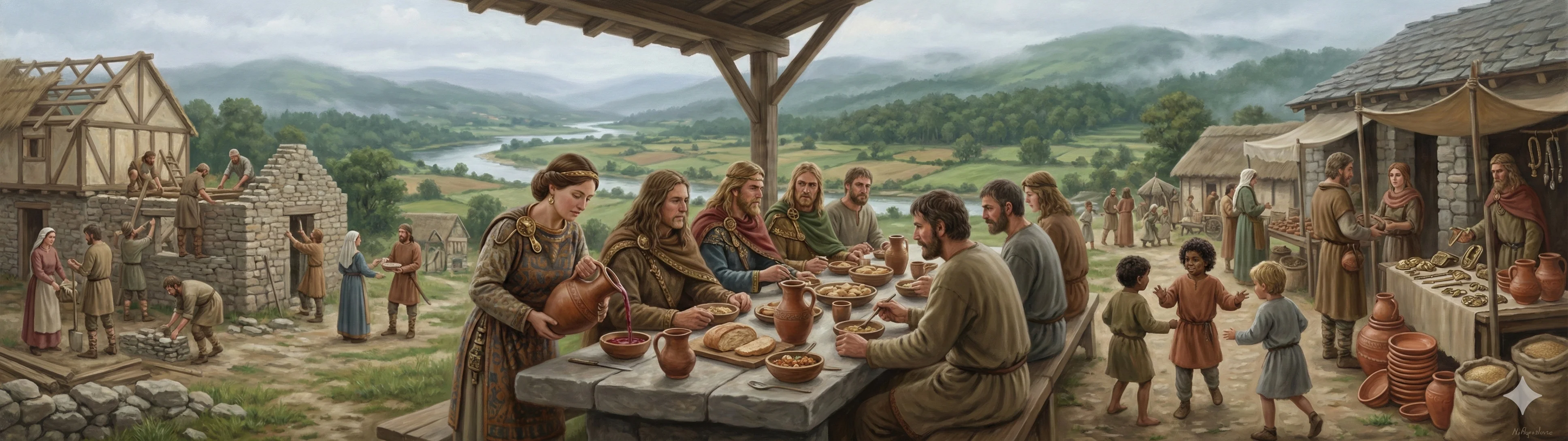
Swords into Ploughs: A People Reborn
The integration of the Suevi with the existing Gallaeco-Roman population is one of the most remarkable stories of cultural fusion in early medieval Europe. Unlike many Germanic migrations marked by displacement and conflict, the Suevi settlement in Gallaecia was characterised by relatively rapid assimilation. The historian Orosius, a native of Gallaecia writing just eight years after the Suevi arrived, wrote that they "cursed their swords and turned to the plough" once settled. No conflict between the local population and the Suevi is recorded between 411 and 430, though Hermeric's raids after 430 provoked fierce Gallaecian resistance before peace was restored in 438. The Suevi settled mainly in urbanised zones — Braga, Porto, Lugo, Astorga — while gradually dispersing into rural areas like the Miño valley, where Ribadavia, Castrelo de Miño, and Cartelle lie.
The Suevi rapidly adopted the local Vulgar Latin, abandoning their Germanic tongue within a few generations. They embraced Christianity — first Catholic, then Arian, then Catholic again — and merged their governance with the existing Roman administrative framework. In the countryside, settlement patterns shifted: people gradually moved from lowland Roman villas to higher ground, and burial practices transitioned from extra-mural Roman cemeteries to churchyard burials near newly built basilicas. The Miño River served as a major communication corridor within the kingdom, making the river valley communities of Castrelo de Miño and Cartelle integral to the kingdom's internal geography. The essential temper of Galician culture — its parish-centred rural life, its Atlantic orientation, its blend of Latin Christianity with older traditions — was shaped decisively in the blending of Ibero-Roman and Suevi worlds.
- Orosius, a native Gallaecian writing c. 417, described the Suevi as peaceful settlers who adopted local agriculture
- The Suevi abandoned their Germanic language within a few generations, adopting Vulgar Latin — the ancestor of Galician and Portuguese
- Settlement shifted from lowland Roman villas to higher ground — consistent with the "castrum" toponymy of Castrelo de Miño
- The Miño River was a major communication corridor within the Suevi kingdom, connecting Lugo, Ourense, and the Atlantic coast
- The Diocese of Britonia was created for Brythonic Christians from Britain who emigrated to Gallaecia — showing the kingdom's ethnic diversity
- After the Visigothic conquest (585), the Third Council of Toledo (589) saw four Arian bishops from Gallaecian sees renounce Arianism under King Reccared
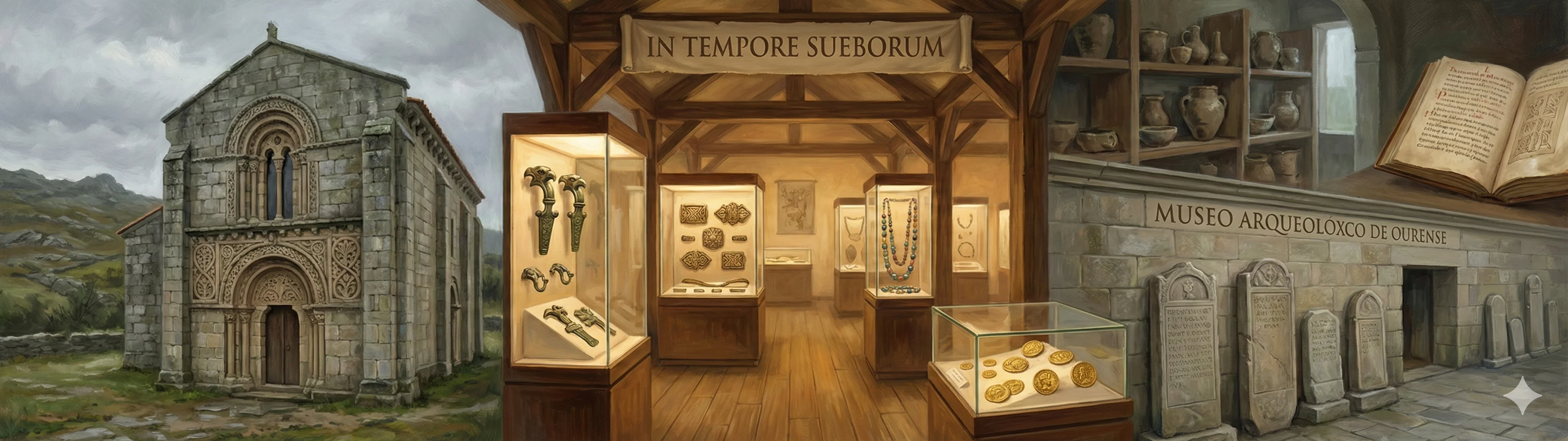
In Tempore Sueborum: Stones and Silence
The landmark exhibition In Tempore Sueborum — "The Time of the Suevi in Gallaecia (411–585 AD)" — held in Ourense from December 2017 to May 2018, was the first exhibition dedicated to the Suevi anywhere in the world. Organised across three venues — the Marcos Valcárcel Cultural Centre, the Church of Santa María Nai, and the Municipal Museum of Ourense — it brought together approximately 300 objects from 30 museums in 10 countries. Coordinated by archaeologist Jorge López Quiroga of the Autonomous University of Madrid, the exhibition revealed a kingdom far more sophisticated than popular imagination had supposed: gold diadems, elaborate belt buckles, fine metalwork, and liturgical objects testified to a vibrant culture at the crossroads of Germanic, Roman, and Christian traditions.
In the Ourense countryside — including the territory of Ribadavia, Castrelo de Miño, and Cartelle — the Suevi period left subtle but significant traces. Iron Age castros that had been abandoned during Romanisation show evidence of reoccupation in the 5th and 6th centuries, as rural populations sought defensive positions during uncertain times. The Church of San Xes de Francelos — just 2 km from Ribadavia — though dating in its present form to the late 8th or early 9th century, preserves pre-Romanesque decorative elements that may represent continuity of religious use from the Suevi period. It was declared a historic-artistic monument for its exceptional early medieval carved stonework. The Ourense Cathedral, according to tradition, occupies the same site as a basilica that King Chararic is said to have built in honour of St. Martin of Tours — though the sole source for this is Gregory of Tours, and the archaeological link remains unproven.
- In Tempore Sueborum (Ourense, 2017–2018): first exhibition on the Suevi in the world — ~300 objects from 30 museums in 10 countries
- The Church of San Xes de Francelos (2 km from Ribadavia): pre-Romanesque carved stonework, declared a historic-artistic monument
- Ourense Cathedral: traditionally said to occupy the site of a Suevian basilica attributed to King Chararic (c. 550s), dedicated to St. Martin of Tours
- Iron Age castros across Ourense show reoccupation in the 5th–6th centuries — defensive responses to the instability of the post-Roman transition
- The municipality of Castrelo de Miño — whose name derives from Castrum Minei — reflects the pattern of fortified hilltop settlement that intensified during the Suevi period
- The Church of Santa Baia de Anfeoz in Cartelle bears a dedication to St. Eulalia — a cult extremely popular in Gallaecia during the Suevi and Visigothic periods
Parish, Place Name, and the Galician Soul
The Suevi's most enduring legacy is invisible yet omnipresent: the Galician parish system. The 134 parishes of the Parochiale Suevorum evolved into the modern parroquias that still organise rural life in Galicia and the freguesias of northern Portugal. Ourense province alone contains 735 parishes today — each centred on a church, composed of hamlets and their lands — a direct organisational descendant of the system the Suevi codified in the 6th century. The dispersed settlement pattern of Cartelle, with its scattered rural parishes each centred on a church — Santiago, Santa María, San Miguel, San Salvador, Santa Baia — is characteristic of the pattern that crystallised during Suevi rule.
Germanic place names number in the thousands across Galicia and northern Portugal. Toponyms derived from Germanic personal names follow distinctive patterns: Mondariz (from Munderici), Gondomar (from Gundemari), Guitiriz (from Witterici), Baltar (from Baltarii). The element "Sa/Saa/Sas" — from Germanic *sala ("house, hall") — appears in hundreds of place names concentrated around Braga, Porto, and the Miño valley. Four parishes and six towns in modern Galicia are still named Suevos or Suegos — direct references to Suevi settlements. Genetically, Galicia shows the highest prevalence of haplogroup I1 (M253) in Iberia — the Y-DNA subclade most specifically associated with Germanic and Scandinavian populations — accounting for approximately 3–4% of the male population, consistent with the estimated scale of Suevi settlement. The Galician language itself carries Germanic loanwords: guerra (war), roubar (to steal), ganso (goose), orgulho (pride), britar (to break). The Suevi kingdom's boundaries roughly defined the territory within which Galician-Portuguese would later emerge, though the distinctive phonetic changes that separated western Iberian Romance from Castilian are generally dated to the 8th–10th centuries.
- The Galician parroquia system — 735 parishes in Ourense alone — descends directly from the Parochiale Suevorum's 6th-century organisation
- Thousands of Galician and Portuguese place names derive from Germanic personal names: Mondariz, Gondomar, Guitiriz, Baltar
- Four parishes and six towns in Galicia are still named Suevos or Suegos — marking the sites of old Suevi settlements
- Galicia shows the highest prevalence of haplogroup I1 (M253) in Iberia — the subclade tied to Germanic populations — at approximately 3–4% of males
- Germanic loanwords in Galician: guerra (war), roubar (steal), ganso (goose), orgulho (pride), britar (break), frasco (flask)
- The Suevi kingdom defined the territory where Galician-Portuguese would later take shape — though the key phonetic divergence from Castilian dates to the 8th–10th centuries
Heritage Sites
Churches, documents, and archaeological sites preserving the Suevi heritage of Gallaecia and Ourense province.
Key Dates
“O máis vello dos reinos xermánicos naceu nas nosas terras.”— The oldest of the Germanic kingdoms was born in our lands.