Sephardic Origins
Galicia · Ribadavia · Sepharad
Sephardic Origins
For five centuries, Jewish communities shaped the intellectual, economic, and spiritual life of Galicia. From the wine merchants of Ribadavia to the illuminators of A Coruña, the Sephardim wove themselves into the fabric of the Atlantic world — until the fires of the Inquisition drove them into silence or exile.
"And the exiles of Jerusalem who are in Sepharad will possess the cities of the south."— Obadiah 1:20
Between Legend and Stone
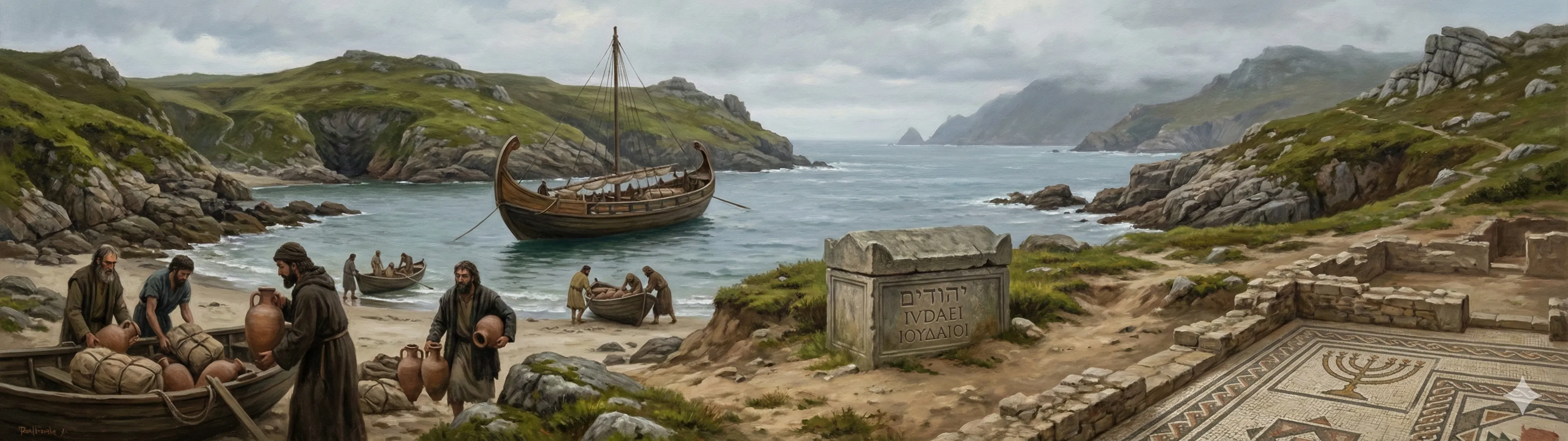
Jewish tradition has long held that the Sephardim — the Jews of the Iberian Peninsula — arrived in the land they called Sepharad in the most distant antiquity. The great scholar Isaac Abravanel claimed — in his commentary on Zechariah — that his family had come to the Peninsula after the destruction of the First Temple, a tradition placing them in Seville for nearly two thousand years. The Malbim identified the biblical Tarshish — the place to which Jonah fled, the westernmost point of the known world — with Tartessos in southern Spain, an identification now widely supported by archaeology, though earlier rabbinical authorities (Ibn Ezra, Rashi) had placed it in North Africa. If Jewish traders accompanied the Phoenician merchants who sailed to Gadir and the tin coast of Galicia, then the roots of Sepharad may intertwine with the very dawn of Mediterranean commerce in the Atlantic.
Yet between legend and archaeology lies a vast silence. The earliest tangible evidence of Jewish presence in Iberia is modest: a trilingual inscription — in Hebrew, Latin, and Greek — on a child's sarcophagus found in Tarragona, dating to the Roman imperial period; a mosaic at Elche from the first century that almost certainly decorated a synagogue floor; a tombstone from Adra inscribed with the name of a Jewish infant, Annia Salomonula, from the third century. In the far west, a marble slab discovered near Silves in the Algarve bearing the Hebrew name Yehiel provides some of the oldest archaeological evidence from the western Peninsula — remarkably, found in a Roman villa, evidence of Jewish life in rural Lusitania.
The Apostle Paul himself expressed his intention to travel to Hispania in his Epistle to the Romans — a passage that early Jewish commentators interpreted as confirmation that organized Jewish communities already existed there. The Council of Elvira, convened around 300 AD near Granada, issued canons specifically regulating relations between Jews and Christians — proof that by the late Roman period, the Jewish population was substantial enough to alarm the priesthood. Canon 16 prohibited intermarriage with Jews in terms more severe than those applied to pagans. The severity of these canons reveals the reality they sought to suppress: that in Roman Hispania, Jews and the earliest Christians were neighbors, dinner companions, and marriage partners — communities not yet fully separated, likely drawn from the same diaspora stock.
In Galicia specifically, the documentary trail does not begin until the eleventh century. But the region's deep integration into Phoenician and Roman trade networks — the same tin routes, the same river corridors, the same Atlantic ports — makes it plausible that Jewish merchants and settlers reached the northwest long before any parchment recorded their names. What is certain is this: by the time the medieval documents begin, the Jews of Galicia were already there, already essential, already woven into the economic sinew of the land.
- Isaac Abravanel claimed his family came to Iberia after the destruction of the First Temple — a tradition placing them in Seville for nearly two thousand years
- The Malbim identified the biblical Tarshish with Tartessos in southern Spain — an identification now widely supported by archaeology
- The earliest tangible evidence: a trilingual inscription (Hebrew, Latin, Greek) on a child's sarcophagus in Tarragona, dating to the Roman imperial period
- The Council of Elvira (c. 300 AD) issued canons regulating Jewish-Christian relations — Canon 16 prohibited intermarriage with Jews in terms more severe than those applied to pagans
- A marble slab near Silves in the Algarve bearing the Hebrew name Yehiel provides some of the oldest evidence from the western Peninsula
- The Apostle Paul expressed his intention to travel to Hispania — interpreted by early commentators as confirmation of existing Jewish communities
The Jewish Communities of Galicia
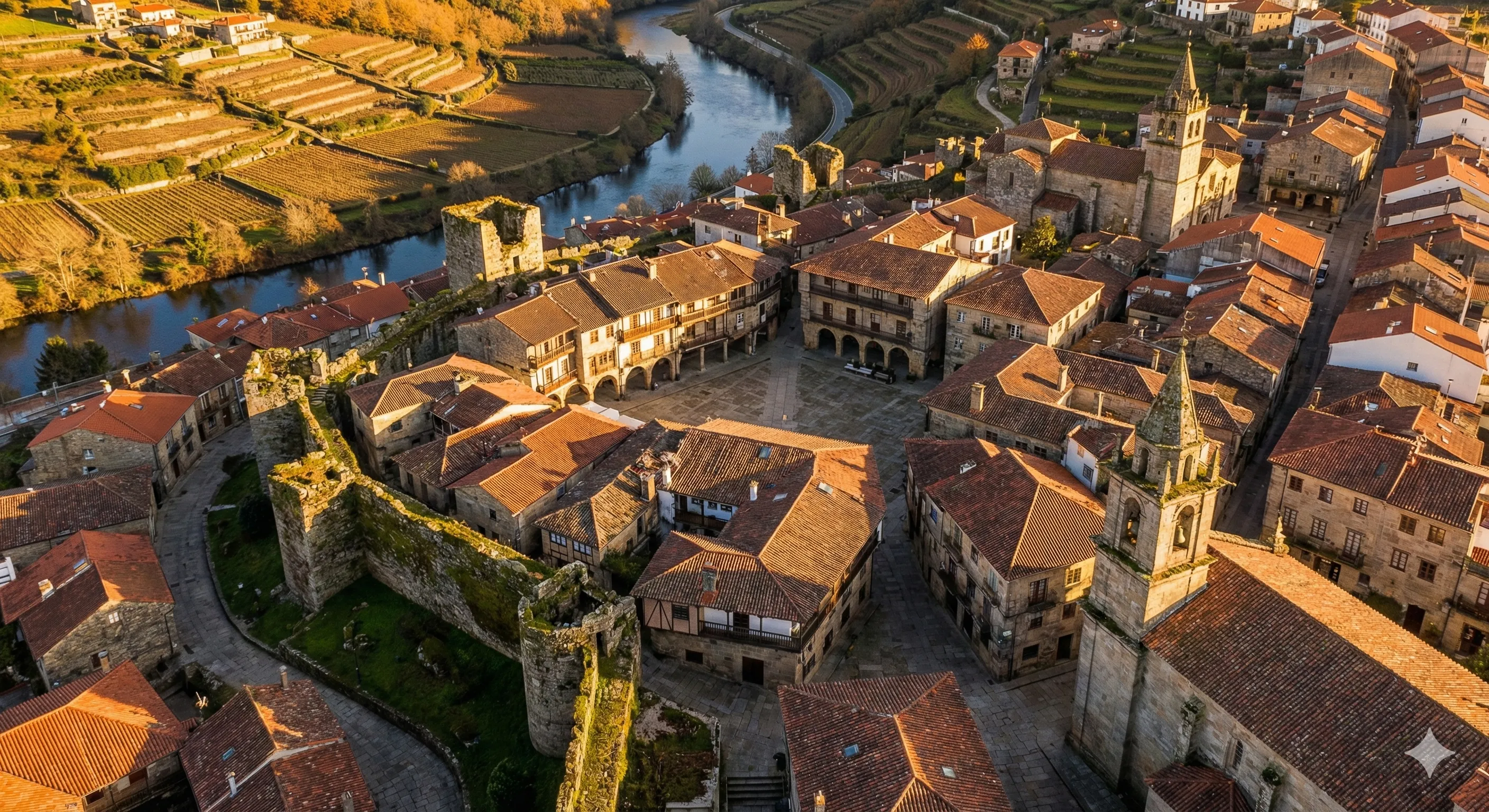
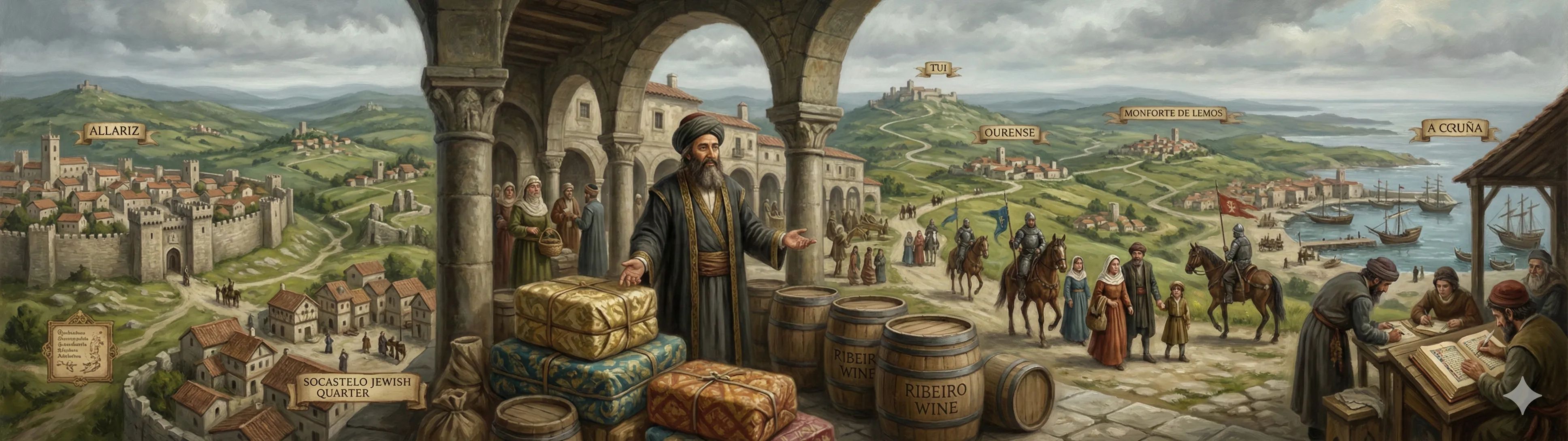
By the high Middle Ages, Jewish communities — known as aljamas — had established themselves across Galicia. The 1906 Jewish Encyclopedia lists settlements at Allariz, Coruña, Orense, Monforte, Pontevedra, Rivadavia, and Rivadeo, besides individual Jews scattered throughout the territory. In most towns these were modest communities of a few dozen families, though Ribadavia — the Jerusalem of Galicia — grew into a major center whose economic weight rivaled towns many times its size. Across the region, Jews served as tax collectors and financial administrators for the Galician nobility, as wine merchants exporting Ribeiro to the courts of Europe, and as intermediaries in the trade networks connecting the Atlantic coast to the interior.
The earliest documented incident in Galician Jewish history dates to 1044, when Jewish merchants — probably from Allariz — were attacked by one Arias Oduariz while traveling under the protection of the nobleman D. Menéndez González. Menéndez raised an armed force, pursued the attackers, and recovered the silks and other goods that had been taken. This small episode reveals much: Jews were already engaged in luxury trade, they moved under noble patronage, and their protection was considered worth a military expedition. Over time, the relationship deepened — Jewish families married into the Galician minor nobility, forging bonds of blood as well as commerce. These alliances would prove dangerous: when the Inquisition arrived, converso lineages entangled with hidalgo houses made the question of limpieza de sangre a matter not only of faith but of inheritance and honor.
The formal establishment of juderías accelerated under royal charters. Fernando II granted Ribadavia its Foro Real in 1164, creating the conditions for a merchant class — including Jewish traders — to flourish. By the twelfth and thirteenth centuries, Ribadavia's judería had crystallized into the quarter that still survives today, centered on the street formerly known as Rúa da Xudería.
Ribadavia — known as the Jerusalem of Galicia — was the most prosperous aljama in the northwest. Its judería, formed in the 12th–13th centuries, was sustained by the Ribeiro wine trade and export to Italy, Flanders, England, and Germany. In 1386, when the Duke of Lancaster besieged the town, Christians and Jews fought side by side to defend it.
A Coruña was home to Europe's largest school of Jewish illuminators, including the master Abraham ben Judah ibn Hayyim. The first documentation of Jewish presence dates to 1375, though the community grew rapidly as refugees from Castilian persecution arrived. Here, in 1476, the Kennicott Bible was created — the most magnificent Hebrew manuscript of the Middle Ages.
Allariz had a flourishing community in the Socastelo district, outside the town walls. In 1289, the prior of the monastery complained, and Isaac Ishmael — head of the aljama — was ordered to keep Jews within the quarter.
Tui, on the Portuguese border, had a Jewish presence dating from at least the 11th century. A seven-branched menorah carved into the Gothic cloister of the cathedral remains as a permanent witness. The nuclei of the judería were on Oliveira Street and Canicouva Street, where the 15th-century house of Salomón Caadia still stands. The Torre do Xudeu (Tower of the Jew) marks the quarter's boundary.
In Ourense, Jews settled by the 11th century, with 30–40 families by the medieval period. In 1489, a writ of protection was issued against knights attempting to attack the community. The judería originally bordered the Rúa Nova but was relocated in 1488 to a site near the Fuente del Obispo.
Monterrei and Verín stood at the gateway to Portugal, seat of the powerful Counts of Monterrei. Inquisition records place converso families here, including Felipe Álvarez, described as "natural de Tamaguelos — Verín." The fortress town served as both a haven and a corridor for Jewish families moving between Galicia and northern Portugal.
Monforte de Lemos had an initially sparse Jewish population that grew after 1147 as refugees fled the Almohad invasion of southern Iberia. By the 14th century, Jews served at the court of the Counts of Lemos. After the massacres of 1391, Monforte sheltered refugees from Castile. Stars of Solomon are engraved in the ashlars of the Torre da Homenaxe.
Pontevedra was a port city with documented Jewish merchants and tax collectors. Inquisition records later placed converso families here, including Beatriz Gómez, born in Ribadavia, married to the wealthy merchant Francisco Denis. The Falagueira street connected the judería between the Porta Nova and the Pescadería.
- The 1906 Jewish Encyclopedia lists settlements at Allariz, Coruña, Orense, Monforte, Pontevedra, Rivadavia, and Rivadeo
- In 1044, Jewish merchants from Allariz were attacked by Arias Oduariz — the nobleman D. Menéndez González raised an armed force to recover their goods, the earliest recorded incident in Galician Jewish history
- Fernando II granted Ribadavia its Foro Real in 1164, creating conditions for the formation of a merchant class and Jewish quarter
- A Coruña was home to Europe's largest school of Jewish illuminators, including the master Abraham ben Judah ibn Hayyim
- In Tui, a seven-branched menorah carved into the Gothic cloister of the cathedral remains as a permanent witness to Jewish presence
- Stars of Solomon are engraved in the ashlars of the Torre da Homenaxe at Monforte de Lemos — a silent record of the Jewish craftsmen who built it
Ribadavia: Wine, Faith, and Commerce
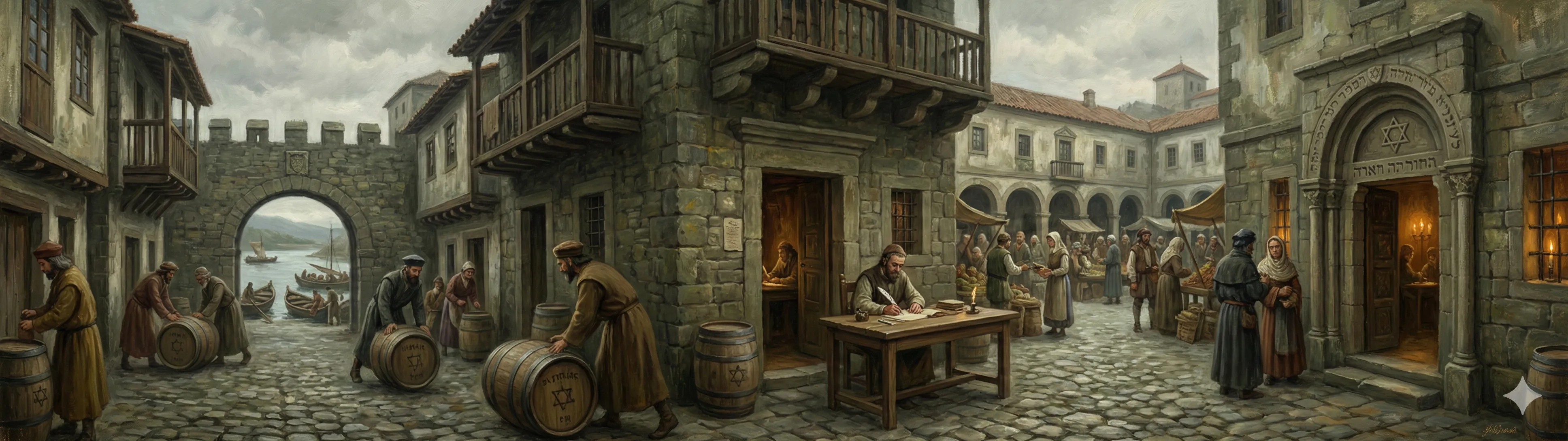
In the Middle Ages, the town of Ribadavia was rich, endowed with political and economic importance in which Jewish traders played a major role. Their community supported its economy through the Ribeiro wine trade — exporting the prized white wine of the Avia and Miño valleys to the peninsular kingdoms and beyond: to Italy, the Netherlands, Germany, Ireland, and England. The judería was not merely a ghetto but a thriving commercial district, and its inhabitants excelled in the administration of goods, in craft trades, and above all as the intermediaries who connected Galician viticulture to the markets of Europe.
The Jewish quarter formed around the 12th and 13th centuries, benefiting from the settlement of Jews since the 10th century in the neighboring lands of Celanova and from the presence of a powerful group of merchants following Fernando II's charter of 1164. The nucleus of the judería extended from the Plaza Mayor to the medieval wall. The main artery was the street formerly known as Rúa da Xudería — later renamed Merelles Caula — running from the Plaza Mayor to the Praza da Madalena, where the synagogue is believed to have stood. From there, through the Praza de Buxán, the quarter descended to the Porta Nova de Abaixo, the southern gate through which one reached the Miño river.
The most dramatic episode of the medieval judería came in 1386, when the Duke of Lancaster — married to the eldest daughter of the late King Pedro I — invaded Galicia, claiming the Castilian throne. Ribadavia was besieged by more than 2,000 English spearmen and archers under Sir Thomas Percy. According to the contemporary chronicle of Froissart, both Christians and Jews fought together to defend the town. The English took Ribadavia using a spectacular siege tower on wheels, and upon entering, looted the Jewish houses in particular. Froissart claimed there were quinze cens — fifteen hundred — Jews in Ribadavia.
This cohabitation — convivencia — appears to have been largely amicable. Jews and Christians shared the defense of their town. Even after the expulsion decree of 1492, many Jews in Ribadavia chose to convert rather than leave, and the community continued, transformed but not destroyed, into the converso networks of the sixteenth and seventeenth centuries.
The judería of Ribadavia is one of the best-preserved Jewish quarters in Spain and a member of the Red de Juderías — Caminos de Sefarad. The Centro de Información Xudía de Galicia (Sephardic Museum of Galicia) is housed in the Pazo de los Condes on the Plaza Mayor. Every August, the Festa da Istoria commemorates the town's medieval heritage, including a reenactment of a Jewish wedding. The Casa de la Inquisición stands at 25 Rúa de San Martiño — five heraldic shields on its façade proclaim the power of the Puga, Mosquera, and Bahamonde lineages. Until recently, A Tafona da Herminia (Herminia's Bakery) sold traditional Sephardic confections from old family recipes — almond flour, dates, sesame, and cardamom.
- The judería formed around the 12th-13th centuries, extending from the Plaza Mayor to the medieval wall along Rúa da Xudería
- Ribeiro wine was exported to Italy, the Netherlands, Germany, Ireland, and England — Jewish merchants served as key intermediaries
- In 1386, Christians and Jews fought side by side to defend the town against the Duke of Lancaster's siege of over 2,000 English soldiers
- Froissart claimed 1,500 Jews in Ribadavia
- The judería of Ribadavia is one of the best-preserved Jewish quarters in Spain and a member of the Red de Juderías — Caminos de Sefarad
- A Tafona da Herminia sold traditional Sephardic confections from old family recipes — almond flour, dates, sesame, and cardamom
The Kennicott Bible
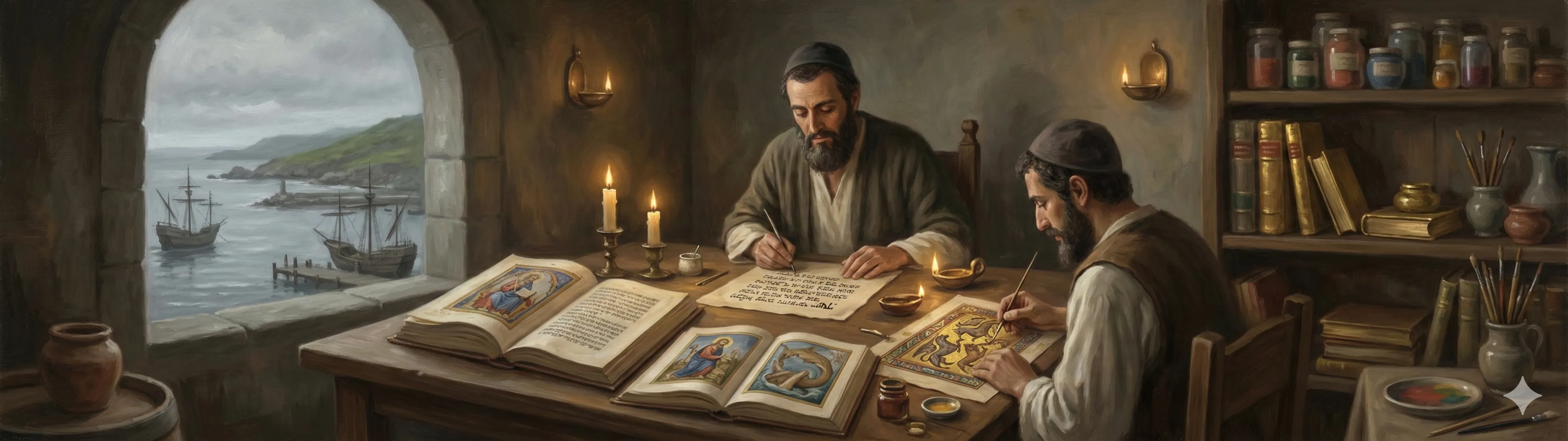
On Wednesday, the third day of the month of Av in the year 5236 of Creation — 24 July 1476 — the scribe Moses ibn Zabarah finished the most magnificent Hebrew Bible of the Middle Ages. He completed it in the city of A Coruña, in the province of Galicia, on the northwestern coast of Spain. The commission had come from Isaac, son of the late Don Salomón de Braga — a silversmith from a Portuguese Jewish family settled in Galicia. The illuminations were the work of Joseph ibn Hayyim, considered the most distinguished master of Jewish manuscript art in all of Europe.
The Kennicott Bible is a complete manuscript of the Hebrew Bible (Tanakh) — the five books of the Torah, the Prophets, and the Hagiographers — together with the grammatical treatise Sefer Mikhlol by Rabbi David Kimhi. It comprises 462 folios of vellum, nearly 30 centimeters in height, written in impeccable Sephardic square script with full Masoretic apparatus. More than 200 pages blaze with illuminations: lavish carpet pages, gold leaf silhouettes, marginal decorations that integrate Jewish symbolism with Iberian Gothic influences, and extraordinary zoomorphic and anthropomorphic letters in the artist's colophon. King David on his throne. Jonah swallowed by the great fish. Balaam consulting an astrolabe. The collaboration between scribe and illuminator was, according to the historian Cecil Roth, exceptionally close — rare in this type of work.
What makes the manuscript even more extraordinary is its timing. It was created just sixteen years before the Alhambra Decree of 1492, which expelled all Jews from Spain. The Kennicott Bible is the last great act of a civilization about to be destroyed. Isaac de Braga, who had commissioned this treasure, was among those who left. The Bible's subsequent journey through North Africa, Gibraltar, and eventually into the hands of the English Hebraist Benjamin Kennicott at Oxford remains partially mysterious. It now resides in the Bodleian Library, where it is recognized as the most lavishly illuminated Hebrew Bible to survive from medieval Spain.
A Coruña was not a marginal outpost of Jewish culture — it was home to the largest school of Jewish illuminators in Europe. Abraham ben Judah ibn Hayyim, active in the mid-15th century, was considered the continent's foremost master in the art of mixing colors for manuscripts. The city's Jewish population had grown rapidly through the late Middle Ages, swelled by refugees fleeing persecution in Castile and Portugal. In this crucible of displacement and cultural resilience, the Kennicott Bible was born — a defiant masterpiece created at the edge of the world, at the edge of time.
In November 2019, the Bible was loaned back to Galicia for the first time in 527 years and displayed at the Museo Centro Gaiás in Santiago de Compostela. The Centro de Información Xudía de Galicia in Ribadavia has a digital system allowing visitors to browse the manuscript page by page. A facsimile is held by the Real Academia Galega de Belas Artes in A Coruña. The Comunidade Xudía Bnei Israel de Galiza has campaigned since 2015 for the Bible's permanent return to A Coruña.
- Completed 24 July 1476 in A Coruña by scribe Moses ibn Zabarah and illuminator Joseph ibn Hayyim — considered Europe's foremost master of Jewish manuscript art
- Commissioned by Isaac, son of Don Salomón de Braga — a silversmith from a Portuguese Jewish family settled in Galicia
- 462 folios of vellum with over 200 illuminated pages — gold leaf, carpet pages, zoomorphic and anthropomorphic letters in impeccable Sephardic square script
- Created just sixteen years before the Alhambra Decree of 1492 — the last great act of a civilization about to be destroyed
- Now resides in the Bodleian Library, Oxford — recognized as the most lavishly illuminated Hebrew Bible surviving from medieval Spain
- In November 2019, the Bible was loaned back to Galicia for the first time in 527 years, displayed at the Museo Centro Gaiás in Santiago de Compostela
The Malsín and the Auto de Fe
After the expulsion decree of 1492, the Jewish community of Ribadavia did not vanish — it transformed. Many Jews accepted baptism and remained as conversos (New Christians), outwardly practicing Catholicism while privately maintaining the faith of their ancestors. For nearly a century, they lived in relative peace. The Inquisition tribunal nearest to Galicia was in Valladolid, far enough away that its reach rarely extended to the remote northwest. Portuguese conversos fleeing the persecution of the Inquisition of Coimbra in 1522 found refuge in the Ribeiro, attracted by the booming wine economy. By the 1570s, a second wave of Portuguese conversos had arrived, quickly integrating into the town's civic life. Some rose to positions of prominence — Felipe Álvarez became Procurador General of Ribadavia; Juan López Hurtado served as Regidor of the town.
This fragile equilibrium shattered in 1575, when the Tribunal of the Inquisition was established in Santiago de Compostela, bringing the machinery of persecution directly to Galicia's doorstep. Even then, two more decades passed before catastrophe struck.
In 1606, a man named Jerónimo Bautista de Mena — himself a converso, born in Ribadavia — delivered a list to the Tribunal of Santiago naming approximately two hundred people as practitioners of Jewish rites. He accused his own mother, Ana Méndez, his sister Ana de Mena (aged 17), and his brother Nicolás (aged 7 or 8). The motive, according to local tradition, was revenge — he had received a smaller inheritance than his brothers. Jerónimo Bautista de Mena was found dead in the street in 1607, assassinated by an unknown hand.
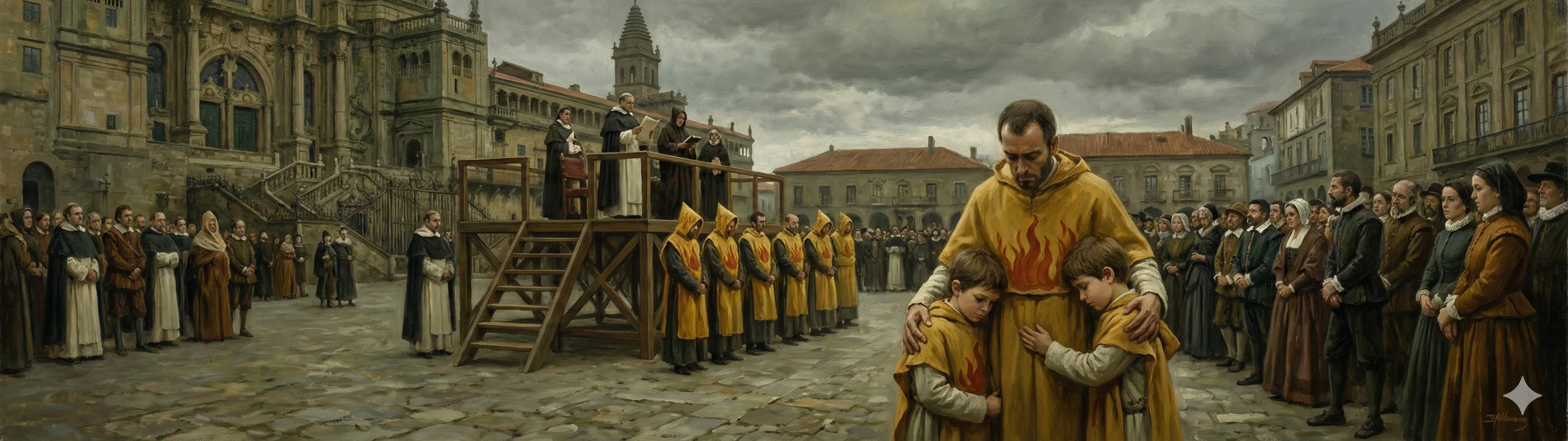
But the damage was done. On 11 May 1608, in the Plaza de la Quintana in Santiago de Compostela, an auto de fe was held. Forty-two persons from Ribadavia and the surrounding region were condemned to penalties ranging from confiscation of property to imprisonment to death. The charges were identical in every case: living according to the Law of Moses, observing Shabbat, fasting on Yom Kippur, preparing kosher meat, and reciting psalms without the Gloria Patri.
The condemned were not marginal figures — they were the civic and commercial backbone of Ribadavia. Felipe Álvarez, the town's Procurador General, was arrested alongside four of his sons. Xerónimo de Morais, a sixty-year-old councilman, endured torture without confessing. Xoán López Hurtado, Regidor and scribe, was shown leniency only because he had young children — two of them blind — while his wife Beatriz Méndez received the harsher sentence in his place. Fernando Gómez, a merchant from Vila Flor who had lived in the Law of Moses for nearly thirty years, also overcame the rack without adding to his confession. Among the women, Leonor Gómez — sixty-eight years old, widow of the lawyer Marcos López, whom the Inquisition called "the master of the judaizantes" — defeated the torture entirely. Xinebra Vázquez, seventy-two, was put on the rack despite her frailty and confessed nothing. María Vázquez, sixty, crippled, was stripped and given two turns of the wheel — and held. The Inquisition's machinery broke bodies, but it did not always break silence.
Behind the list of names lay distinct family networks, each with its own history. The Morais clan constituted a second dynasty of converso power in Ribadavia, parallel to the Álvarez. Xerónimo de Morais was a councilman; his brother Antonio "the walker" lived off his estate; his son Antonio had come from Mirandela in Portugal; his daughter Isabel, a widow of twenty-six from Salvaterra, confessed eight years in the old law, taught by her mother. Their father, Alonso Rodríguez de Morais, was already dead by 1608 — but the Inquisition opened proceedings against his memory, accusing him of having cursed a servant who invoked the name of Jesus. A separate network radiated from Vila Flor in Portugal: Marcos López, the lawyer whom the Inquisition called "the master of the judaizantes," had taught the Law of Moses with a Hebrew Bible and funded the escape of judaizantes from Spain. His widow Leonor Gómez survived him and survived the rack. Fernando Gómez and Manuel Gómez, also from Vila Flor, were merchants — the commercial sinew of the Portuguese converso migration into the Ribeiro.
Perhaps the most intimate tragedy was the household of Fernando Álvarez "the old one" and Catalina de León. Catalina, aged thirty-two, from Ourense, had taught the Law of Moses to her daughters Isabel (fifteen) and Felipa (seventeen) — and had been taught it herself by her mother and grandmother. In the second auto de fe on 22 February 1609, all three were condemned. All three had been denounced by Catalina's own husband.
Duarte Coronel of Salvaterra — aged thirty, denounced among others by his own wife, Ana de Mena, the malsín's sister — confessed three years in the Law of Moses. Simón Pereira, a medical student from Pontevedra, admitted to seven years as a public Jew in Pisa, where he had been circumcised and taken the name Isaac — and in 1609, he exchanged his sentence for immediate freedom through a financial agreement with the Holy Office. The elderly tailor Álvaro Vázquez of Valença do Miño — sixty-nine, ill — was subjected to the rack despite his condition, and received two hundred lashes on top of perpetual prison. Then, on 8 September 1610, the Inquisition staged a final auto particular: four already-dead judaizantes were burned in effigy, their memory and reputation formally destroyed. Among them was Marcos López, the man who had kept the Hebrew Bible. And among them was the malsín himself — Jerónimo Bautista de Mena — accused by sixteen former accomplices of the very rites he had denounced.
"Everything in Ribadavia proceeded normally — the crypto-Jewish community coexisted harmoniously with the other inhabitants of the town. But suddenly, the foundations of coexistence trembled, and a bolt of dread ran through the bodies of its people upon learning that the Inquisition was preparing a publication of an edict of faith." — José Ramón Estévez Pérez, "La tumba de Felipe Álvarez, judaizante" (2017)
- In 1575, the Tribunal of the Inquisition was established in Santiago de Compostela, bringing the machinery of persecution directly to Galicia
- In 1606, Jerónimo Bautista de Mena — himself a converso from Ribadavia — delivered a list of approximately 200 names, including his own mother, sister (aged 17), and brother (aged 7)
- His motive was revenge: he had received a smaller inheritance than his brothers. He was found dead in a Ribadavia street in 1607, assassinated by an unknown hand
- On 11 May 1608, an auto de fe was held in the Plaza de la Quintana in Santiago — 42 persons from Ribadavia and the surrounding region were condemned
- Charges were identical in every case: observing Shabbat, fasting on Yom Kippur, preparing kosher meat, reciting psalms without the Gloria Patri
- Portuguese conversos fleeing the Inquisition of Coimbra in 1522 had found refuge in the Ribeiro — some rose to positions of prominence before the catastrophe struck
Felipe Álvarez, Judaizante
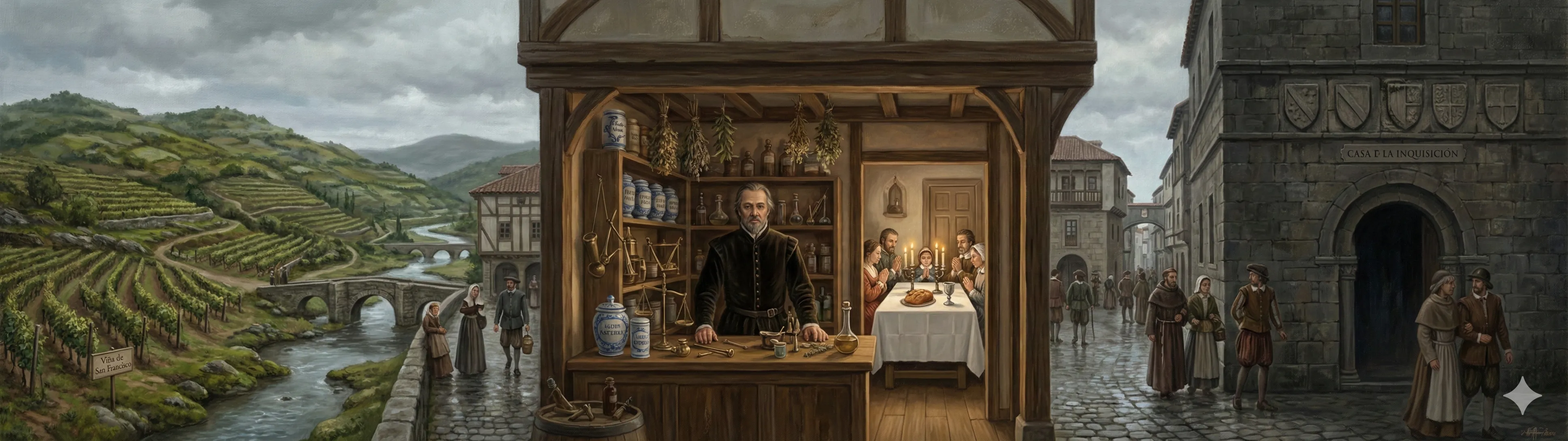
Felipe Álvarez, born around 1549 in Tamaguelos, Verín (Ourense), was an apothecary (boticario), tax farmer on foodstuffs (arrendador de la sisa), and merchant who rose to become Procurador General of Ribadavia — effectively the town's chief financial officer. He was a man of considerable means, owning vineyards, urban properties on the Plaza Mayor, and maintaining a household of some standing. He was also, as he would confess under interrogation, a man who had lived in the Law of Moses for twenty-three years.
Felipe married twice. His first wife was Isabel Méndez, by whom he had at least seven children: Francisco Méndez (a Licentiate), Gaspar Álvarez (a law student at Salamanca), Antonio Méndez, Baltasar Méndez, Ana, Isabel Méndez the younger, and María Álvarez. His second wife was Justa Rodríguez de Dueñas, by whom he had Pedro Álvarez de Dueñas and possibly other unnamed children. One of his sons, Fernando Álvarez de Morais ("the young," a cloth merchant), married Bárbara Enríquez — whose sister Ana Rodríguez married Enrique Coronel, connecting the family to the illustrious Coronel lineage.
When the Inquisition arrested Felipe, they found a man unapologetic in his faith. In his interrogation, he admitted to being a descendant of the Hebrew nation. He confessed to observing kashrut — purifying, draining, and de-veining the meat his family ate. He had fasted on Yom Kippur (the "Day Grande," the tenth of September) without eating or drinking until nightfall. He had kept Shabbat, wearing clean shirts and refraining from work. He recited the psalms of penitence without the Gloria Patri, and he prayed the Amidah (the standing prayer) and the Shema Israel. He had taught these practices to his four sons — all of whom were arrested alongside him.
His sons' testimonies reveal the texture of converso life. Fernando Méndez, aged 23, said his father had taught him the Law of Moses nine years earlier. He prepared kosher meat with his own hands, "with the greatest dissimulation he could manage." He dreamed of fleeing to Turkey with his cellmate Simón Pereira to live freely as Jews — he would take the name David, and Simón would become Isaac. Gaspar Álvarez, aged 20, a law student at Salamanca, confessed that on Holy Thursday 1605, he and other judaizantes had refused to walk the Stations of the Cross. He had decided he wished to be circumcised.
The Inquisition's verdicts were devastating: Antonio Méndez, aged twenty-one, was relaxed — handed to the secular authority for execution. Fernando Álvarez de Morais and Gaspar Álvarez received perpetual prison; Fernando later died in confinement alongside his wife Bárbara Enríquez. Francisco Méndez was imprisoned. Felipe himself — the most named by all the others, the man the Inquisition regarded as the rabbi of the Jews of Ribadavia — was sentenced to death. He was to be relaxed in person. But Felipe bought his life: in 1612, after his persecutors, the inquisitors Ochoa and Cuesta, had been expelled from Galicia, he negotiated a pact with the Holy Office, paying 11,000 reais to commute his sentence.
The litigation that followed — documented in AHN, Inquisición, Leg. 2029, Exp. 9 — reveals both the brutality and the resilience of the family. Pedro Álvarez de Dueñas, Felipe's son from the second marriage — himself still a minor in 1624, assigned his own curador ad litem, Diego de Villar — negotiated a composición of 150 ducats to buy back the confiscated vineyards. Gaspar Álvarez, legally declared loco furioso and mentecato (insane and simple-minded) — though some historians suspect he feigned madness to escape harsher punishment — required a legal curator. Fifteen years later, the Licenciado Francisco Méndez launched a renewed offensive, arguing that his mother Isabel Méndez's dowry properties had been illegally seized, since under Castilian law, a wife's dowry took precedence even over the Inquisition's confiscatory rights.
The inventory of confiscated assets reads like a cadastral map of 17th-century Ribadavia: the Corredera de San Francisco (90 jornales — a massive commercial holding), the Viña de la Pedreira, the Viña de la Costa, the Viña de San Lázaro, and the family house on the Plaza Mayor, bordering the Calle de la Zapatería. Four hundred reales in silver had been hidden before the confiscation agents arrived. Felipe Álvarez was a man of considerable means — a major wine producer and landowner in the Ribeiro, brought to ruin by the machinery of the Holy Office.
Having escaped the pyre, Felipe endured confiscation of property, the penitential habit (sanbenito), and perpetual prison. He was eventually released, negotiating the return of part of his estate through further financial compositions with the Inquisition. He died before November 1624 — old enough to petition the Holy Office for a guardian for his grandchildren Jerónimo and Mariana, the orphaned children of Fernando Álvarez de Morais.
The fate of those orphans is documented in a civil lawsuit that dragged on from 1640 to 1649 (AHN, Inquisición, 4552, Exp. 8). After the deaths of both their parents, the children Mariana Enríquez and Jerónimo de Morais were taken to Ferreiros, near the Portuguese border, to live under the care of their uncle and aunt — Enrique Coronel and Ana Rodríguez. Their curator ad litem, Diego de Pardiñas, fought for years to recover their mother Bárbara Enríquez's dowry of 2,000 ducats — funded from the estate of Bárbara's brother, Capitán Manuel Rodríguez, and formalized in the 1608 deed by Ana Rodríguez and Enrique Coronel. The minors argued that this dowry was a privileged debt, owed before the Inquisition's confiscatory claims. Opposing them was the Fiscal of the Holy Office, Fernando de Valmayor, and two private creditors from Vilanova dos Infantes. The court ruled in favor of the orphans: the mother's dowry had precedence even over the Royal Fisc. It was a small victory — but it proved that Castilian law, when pressed, could still shield a family from the full weight of the Inquisition's greed.
Felipe was buried in the Iglesia de Santo Domingo de Ribadavia — the same church where Pedro Vázquez de Puga and Sancha Vella Mosquera, the local familiars of the Inquisition, lay in their heraldic tombs. The Inquisition considered that a reconciled man, having served his sentence, was returned to the bosom of the Church. His tombstone, measuring 1.90 meters by 0.64 meters, is the only known burial marker of a confessed judaizante in a Galician church.
- Born c. 1549 in Tamaguelos, Verín — apothecary, tax farmer, wine merchant, and Procurador General of Ribadavia
- Confessed to living in the Law of Moses for twenty-three years: observing kashrut, keeping Shabbat, fasting on Yom Kippur, praying the Amidah and Shema Israel
- His son Fernando dreamed of fleeing to Turkey to live freely as a Jew — he would take the name David; his cellmate Simón Pereira would become Isaac
- Son Gaspar, a law student at Salamanca, confessed that on Holy Thursday 1605 he refused to walk the Stations of the Cross — he wished to be circumcised
- Antonio Méndez was "relaxed" (relajado) — handed to the secular authority for execution. Fernando died in prison alongside his wife Bárbara Enríquez
- Felipe's tombstone (1.90 × 0.64 m) in the Iglesia de Santo Domingo is the only known burial marker of a confessed judaizante in a Galician church
Family Tree of Felipe Álvarez
From Ribadavia to the New World
The auto de fe of 1608 did not destroy Ribadavia's converso community — it trapped it. Most families had no choice but to stay. To flee was to invite the death penalty and to endanger every relative left behind. The condemned served their sentences, paid their compositions, and returned to a town that now watched them. Many dispersed into the villages and parishes surrounding Ribadavia — away from the Casa de la Inquisición on Rúa de San Martiño, away from the sanbenitos hanging in the churches, but never far from the vineyards that sustained them. The stigma of condemnation followed these families for generations. In a society obsessed with limpieza de sangre, a converso surname was a mark that closed doors — to cathedral chapters, military orders, university colleges, and advantageous marriages with Old Christian houses. The result was predictable: converso families married within their own networks, generation after generation, producing densely endogamous clusters bound by the same surnames, the same parishes, and the same silence.
Yet even before the Inquisition struck, some conversos had quietly maintained connections abroad. Simón Pereira, Felipe Álvarez's cellmate, had already been circumcised in Pisa, where his uncle Antonio Núñez lived. Fernando Méndez, Felipe's son, dreamed of fleeing to Turkey to live freely as a Jew under the name David. These were not idle fantasies — they were threads in a clandestine network that had long connected Galician conversos to the open Sephardic communities of Italy, the Ottoman Empire, and eventually the Atlantic world.
The most illustrious — and most genealogically tangled — example is the Senior Coronel family of Amsterdam. The Amsterdam branch descends from the brothers Duarte and António Saraiva, who upon returning to Judaism took the names David and Salomon Senior Coronel. Their family almost certainly came from the converso networks of Salvaterra de Miño and the Galician-Portuguese border, where both the Saraiva and Coronel surnames are densely documented. Among the Coronels of Salvaterra there existed a tradition of descent from Abraham Senior, the last Rab Mayor of Castile, who had converted under pressure in 1492 and taken the name Fernando Pérez Coronel. Whether the Saraiva brothers were direct patrilineal descendants of Abraham Senior or connected through the female line — or simply adopted the prestigious name upon returning to Judaism, as others in their milieu did — remains an open question. What is certain is that Duarte Saraiva reached Amsterdam by 1604, traded with Lisbon for years, and by 1636 had established himself in Recife, Pernambuco, where he owned sugar mills and leased tax farms. His son Isaac Senior Coronel even spent time in Pontevedra — suggesting the family still had direct kin in Galicia. A later descendant, Nahmán Natán Senior Coronel, emigrated to Jerusalem in 1820 and became a prominent religious author. His great-grandson, David Coren, served in the Israeli Knesset and founded the kibbutz Bet HaAravá on the Dead Sea — his roots in the border country of Salvaterra unknown to him.
The Enrique Coronel who married Ana Rodríguez — Bárbara Enríquez's sister — lived in Ferreiros, near the Portuguese border. It was there that Mariana Enríquez and Jerónimo de Morais were later documented under the care of Enrique and Ana, and from there emerged the 2,000-ducat dowry claim that Diego de Pardiñas pursued in court decades later. This places the Coronel-Rodríguez kin group at the center of Ribadavia's converso legal and property networks in the mid-seventeenth century.
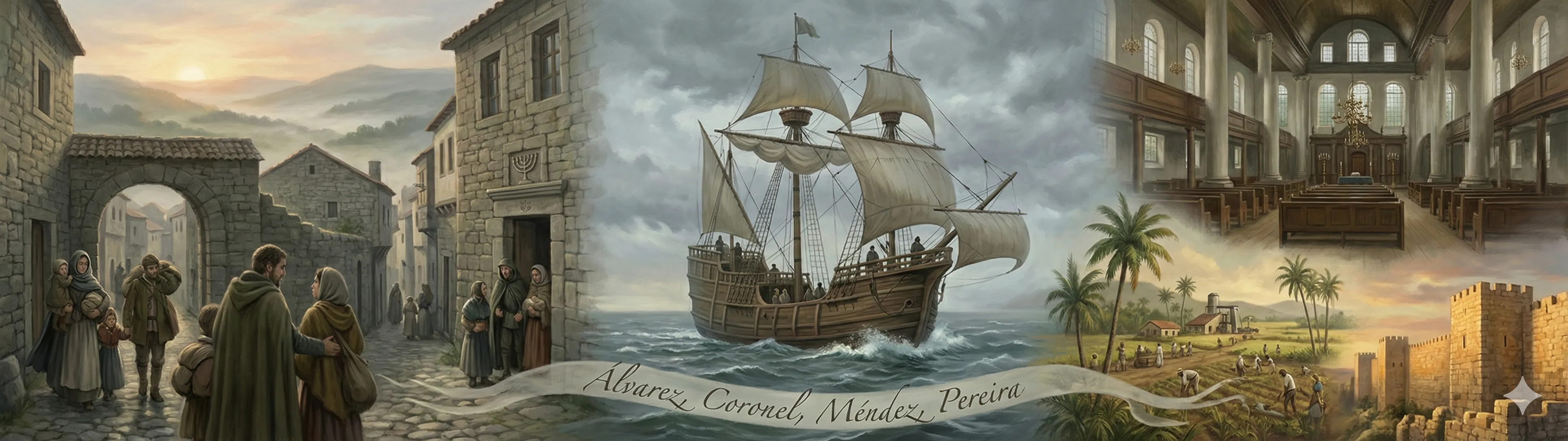
The surname networks that emerge from the Inquisition records of 1608 — Álvarez, Méndez, Rodríguez, Gómez, Fernández, Coronel, Morais, Enríquez, Pereira — read like a map of the Sephardic diaspora itself. These same names appear in the Jewish communities of Amsterdam, the Azores, Brazil, the Caribbean, and colonial Spanish America. The conversos of Ribadavia were not an isolated pocket — they were nodes in a vast Atlantic network, connected by blood, trade, and the shared memory of the Law of Moses.
- Simón Pereira, Felipe's cellmate, had already been circumcised in Pisa, where his uncle António Núñez lived — evidence of an active clandestine network
- The Senior Coronel family of Amsterdam descends from converso networks of Salvaterra de Miño and the Galician-Portuguese border
- Duarte Saraiva reached Amsterdam by 1604 and by 1636 had established himself in Recife, Pernambuco, owning sugar mills and tax farms
- A later descendant, Nahmán Natán Senior Coronel, emigrated to Jerusalem in 1820 and became a prominent religious author
- David Coren, a great-grandson, served in the Israeli Knesset and founded kibbutz Bet HaAravá on the Dead Sea — his roots in Salvaterra unknown to him
- Converso surnames — Álvarez, Méndez, Rodríguez, Gómez, Coronel, Enríquez, Pereira — appear across the Sephardic diaspora from Amsterdam to Brazil to the Caribbean
Sanctuaries, Stones, and Silences
Juderías, synagogues, tombstones, and the carved menorah that survives in a cathedral's cloister.
A Timeline of Sepharad in Galicia
"O viño do Ribeiro viaxou polos mesmos camiños ca a fe dos que o cultivaron."— The wine of the Ribeiro traveled the same roads as the faith of those who cultivated it.