Visigothic Heritage
Galicia as the Sixth Province of Toledo
Visigothic Heritage
In 585 AD, the Visigoths conquered the Suevi kingdom and made Gallaecia the sixth province of the most powerful Germanic state in post-Roman Europe. For 126 years, Galicia lived under the rule of Toledo — inheriting a unified legal code, monastic traditions that transformed the countryside, and stone churches that still stand among the oldest in Spain.
“Leovigild devastates Gallaecia and deprives Audeca of the totality of the kingdom; the nation of the Sueves, their treasure and fatherland are conduced to his own power and turned into a province of the Goths.”— John of Biclar, Chronica (c. 590 AD)
The Fall of the Suevi: Gallaecia Becomes a Gothic Province
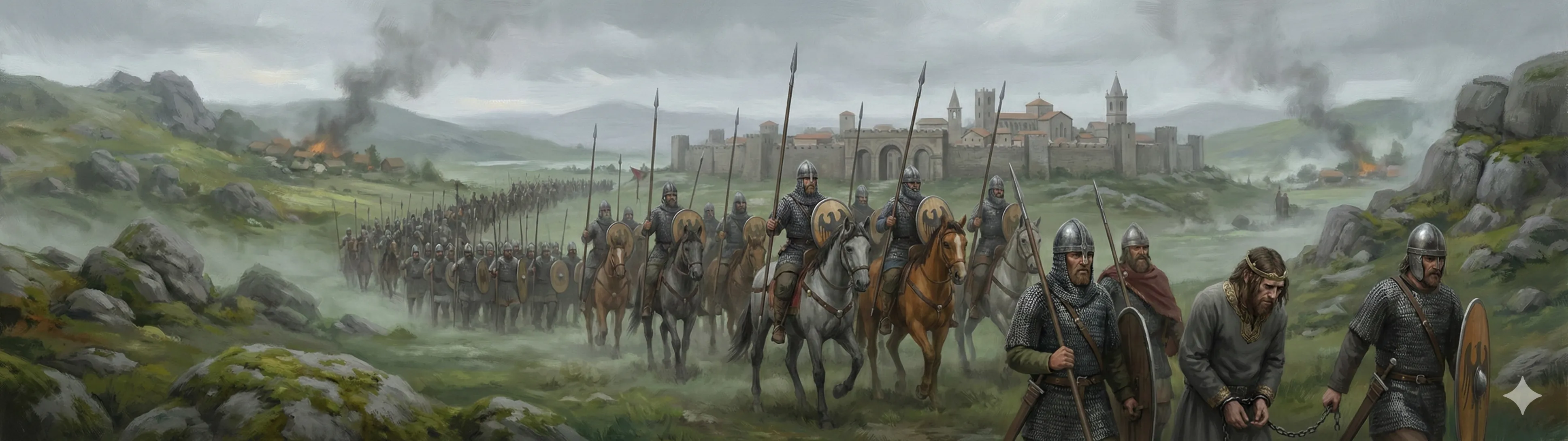
The end of Suevi independence came not through a clash of civilisations but through a dynastic crisis that handed Leovigild the pretext he needed. When King Miro died in 583 — Gregory of Tours attributes his death to illness contracted during the campaign — after a disastrous military expedition near Seville, his young son Eboric inherited the throne. Within a year, Eboric's brother-in-law Audeca seized power, married Miro's widow Siseguntia, and confined the legitimate king to a monastery. The usurpation gave Leovigild — the most formidable Visigothic king of his age, who had spent a decade methodically encircling the Suevi realm — precisely the justification he sought.
In 585, Leovigild launched a decisive campaign into Gallaecia. His forces devastated the region and defeated the Suevi in open battle before advancing on Braga. The Chronicle of John of Biclar, a contemporary source, records that Leovigild deprived Audeca "of the totality of the kingdom," capturing the last Suevi king along with the royal treasury and the leading nobles. Audeca was tonsured and exiled to Beja in the south. That same year, a man named Malaric rose in rebellion and claimed the Suevi throne, but he was swiftly defeated and captured by Leovigild's generals, who delivered him in chains to the Visigothic king. The Kingdom of the Suebi — which had endured for 176 years as the first Germanic kingdom in post-Roman Western Europe — became the sixth province of the Visigothic Kingdom of Toledo.
Key Facts
- Leovigild exploited the usurpation of Eboric by Audeca as his pretext for invasion in 585 AD
- The Chronicle of John of Biclar provides the principal contemporary account of the conquest
- Audeca was captured, tonsured, and exiled to Beja; Malaric's subsequent rebellion was crushed
- Gallaecia became the sixth province of the Visigothic Kingdom, governed from Toledo
- Leovigild had spent years encircling the Suevi realm — founding Villa Gothorum (modern Toro) on the Duero as a frontier stronghold
- No major Visigothic immigration occurred; the existing Suevi, Roman, and Galician population remained largely undisturbed
Toledo's Distant Province: Dukes, Bishops, and Continuity
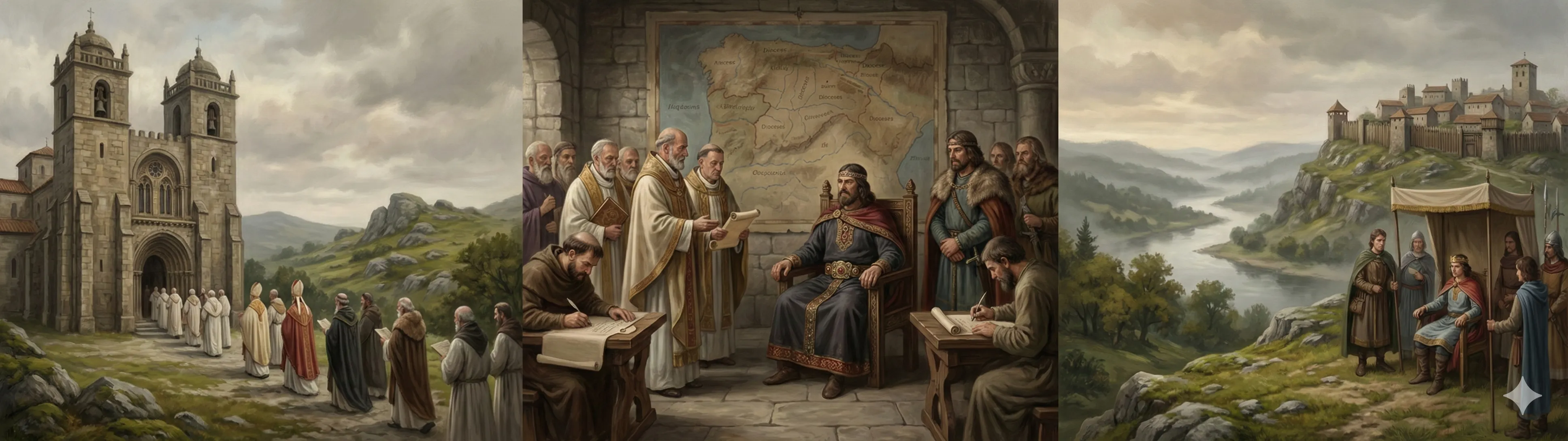
The Visigothic conquest did not shatter Galician society — it absorbed it. The territorial and administrative organisation inherited from the Suevi was incorporated into the new provincial structure. The Suevi Catholic dioceses — Braga, Dumio, Porto, Tui, Iria, Britonia, Lugo, Ourense, Astorga, Coimbra, Lamego, Viseu, and Idanha — continued to operate normally. The local cultural, religious, and aristocratic elite accepted new monarchs while preserving the institutions that had governed their lives for generations. No major Visigothic settlement occurred in Gallaecia during the 6th and 7th centuries; the peasantry remained a collective of freemen and serfs of Celtic, Roman, and Suevi extraction.
Galicia was governed by a dux provinciae — a military governor appointed by Toledo — while the day-to-day administration of justice and civil affairs fell increasingly to the comes civitatis (count) in each major city and to the bishops, who wielded enormous influence in both spiritual and temporal matters. Braga retained its status as metropolitan see, while Lugo was reduced to an ordinary bishopric subordinate to Braga. Under Recceswinth's administrative reforms, the Lusitanian dioceses that the Suevi had annexed to Galicia — Coimbra, Idanha, Lamego, Viseu, and parts of Salamanca — were restored to the province of Lusitania. The same reform reduced the number of mints in Galicia from several dozen to just three: Lugo, Braga, and Tui. Yet Galicia persisted as a differentiated province within the realm, as evidenced by the acts of several Councils of Toledo, the Chronicle of John of Biclar, and military laws such as King Wamba's mobilisation decree incorporated into the Liber Iudiciorum.
Leovigild initially imposed Arianism on the conquered Suevi, installing Arian bishops alongside the existing Catholic ones in Lugo, Porto, Tui, and Viseu. This dual episcopal system lasted only a few years — ending definitively at the Third Council of Toledo in 589. In the final years of the Visigothic period, Galicia's special status was underscored when King Egica sent his son Wittiza to govern the province from Tui around 701 — effectively ruling the old regnum Suevorum as a sub-king, a remarkable echo of the region's independent past.
Key Facts
- Galicia was governed as a distinct province under a dux provinciae appointed by Toledo
- All thirteen Suevi Catholic dioceses continued to function normally under Visigothic rule
- Leovigild installed Arian bishops alongside Catholic ones in Lugo, Porto, Tui, and Viseu — a short-lived dual episcopate
- Recceswinth's reforms restored the Lusitanian dioceses to Lusitania and reduced Galician mints to three (Lugo, Braga, Tui)
- King Wittiza governed Galicia as sub-king from Tui (c. 701), ruling the old regnum Suevorum
- No major Visigothic immigration occurred — the population remained Celtic, Roman, and Suevi in composition
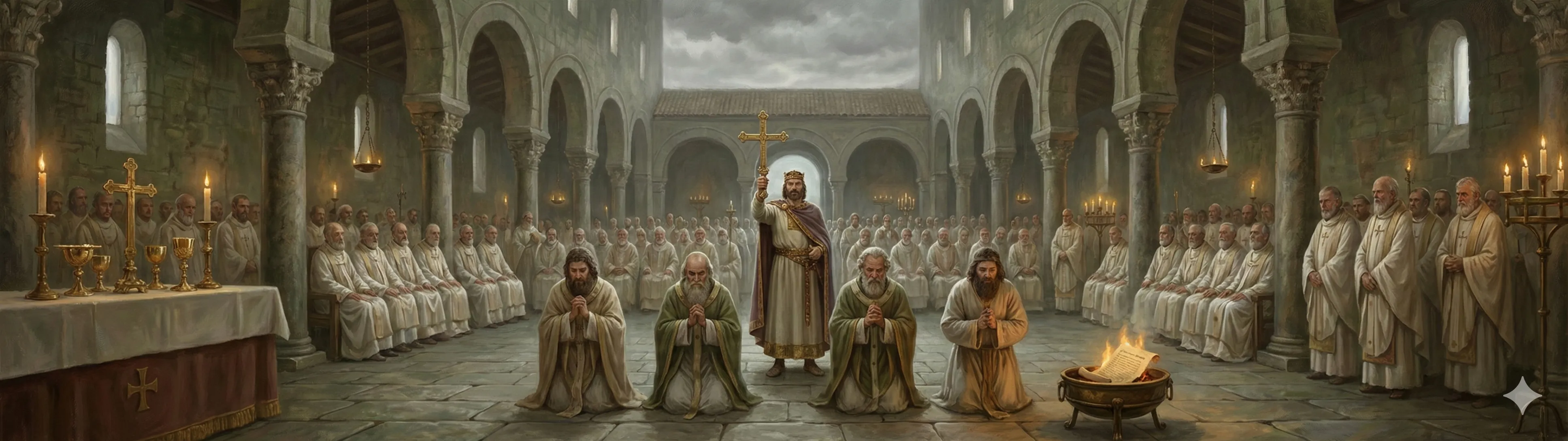
From Arianism to Orthodoxy: Reccared and the Third Council of Toledo
Leovigild's conquest brought Arianism back to a land that Martin of Braga had painstakingly converted to Catholic orthodoxy just decades earlier. The Visigothic king reinstated Arian clergy across the province, placing Arian bishops in cities like Lugo, Porto, Tui, and Viseu alongside the existing Catholic hierarchy. For the people of Gallaecia, who had witnessed Martin's patient conversion within living memory, this reversal must have been deeply unsettling. But the Arian restoration proved brief. According to Gregory of Tours, Leovigild may have embraced Catholicism on his deathbed in 586 — though no Iberian source corroborates this — and within three years his son Reccared would transform the religious landscape of the entire kingdom.
On 8 May 589, Reccared convened the Third Council of Toledo — one of the most consequential church councils in Western European history. Before an assembly of seventy-two bishops from Hispania, Gaul, and Gallaecia, the king publicly renounced Arianism and proclaimed his conversion to Catholic Christianity. The Visigoths and Suevi would follow. Among the bishops who formally abjured their Arianism at the council were four from Gallaecia's Suevi dioceses: Beccila of Lugo, Gardingus of Tui, Argiovittus of Porto, and Sunnila of Viseu. The conversion was not without resistance — an Arian conspiracy was uncovered, and its leader Segga was punished by amputation of his hands and exiled to Galicia. But the outcome was decisive: the Catholic faith was restored as the sole orthodoxy of the kingdom, uniting Visigoths, Suevi, and Hispano-Romans under a single creed. The conversion cemented the authority of the Catholic Church in Galicia and ensured that the diocesan and parish structures created under the Suevi would endure — and indeed strengthen — under Visigothic rule.
Key Facts
- Leovigild reinstated Arianism in Galicia after 585, installing Arian bishops in Lugo, Porto, Tui, and Viseu
- Reccared convened the Third Council of Toledo (8 May 589) with seventy-two bishops in attendance
- Four Arian bishops from Gallaecian sees formally renounced Arianism: Beccila of Lugo, Gardingus of Tui, Argiovittus of Porto, and Sunnila of Viseu
- The Arian conspirator Segga was punished by amputation and exiled to Galicia
- The conversion united Visigoths, Suevi, and Hispano-Romans under Catholic orthodoxy for the first time
- The Diocese of Ourense — first documented under Bishop Witimir (571), friend of Martin of Braga — maintained its Catholic continuity throughout the Arian interlude
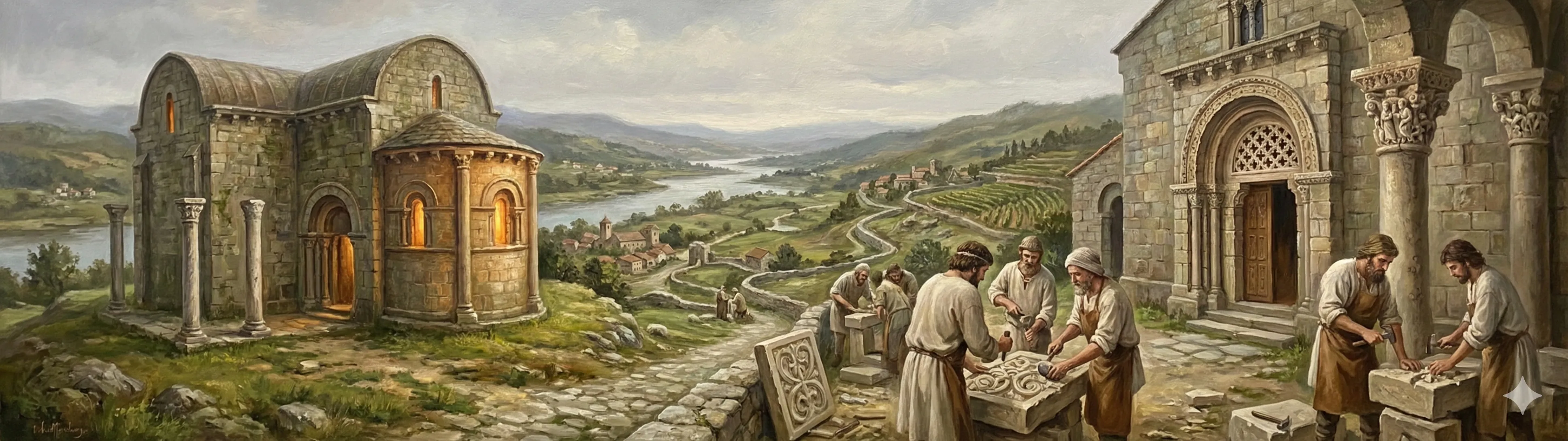
Santa Comba, San Xes, and the Architecture of Belief
The Visigothic period gave Ourense province two of the most remarkable pre-Romanesque monuments in all of Spain — churches whose horseshoe arches, carved stonework, and austere beauty speak of a faith built to endure in stone.
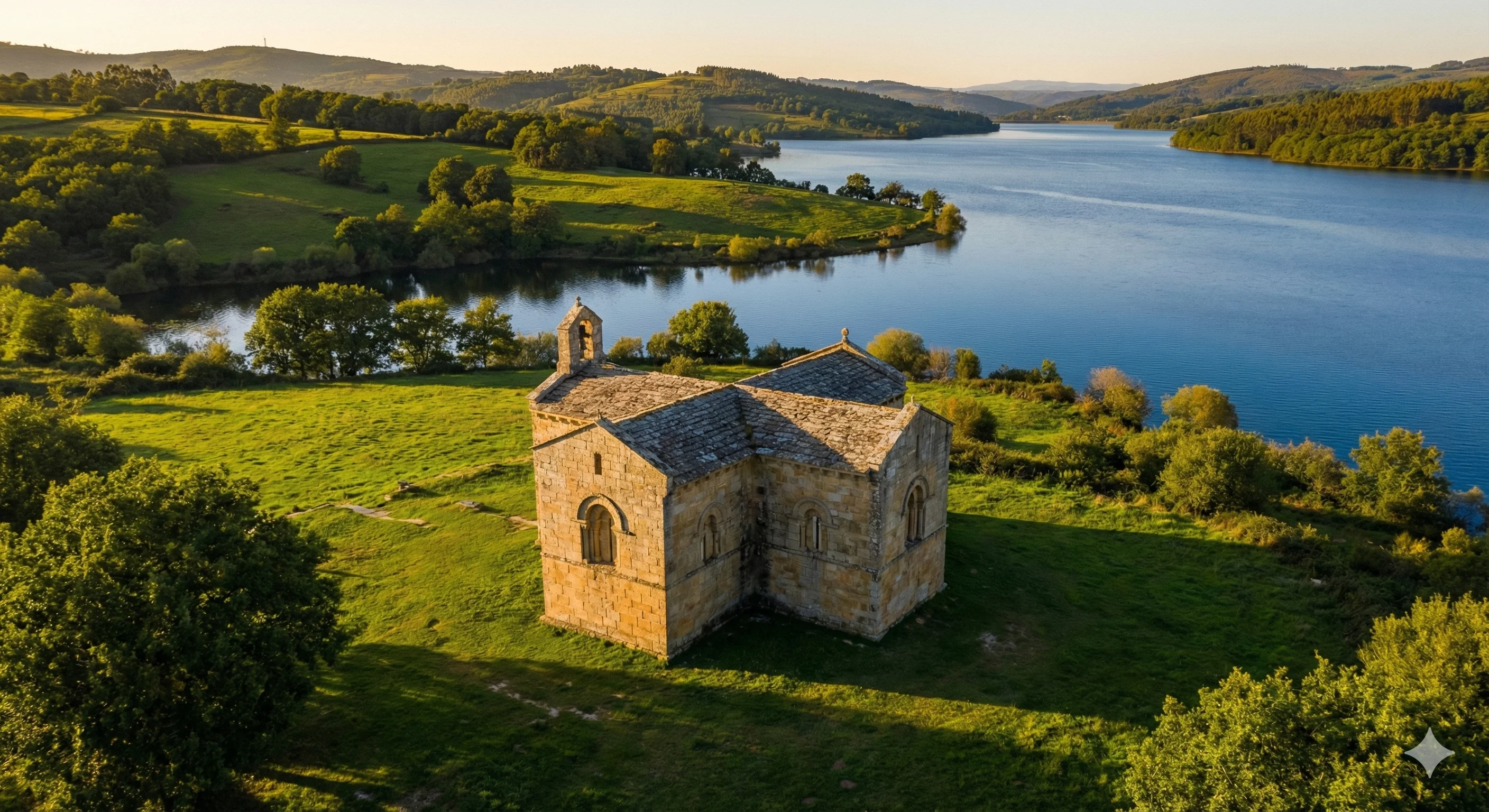
Santa Comba de Bande, located in the Limia River valley approximately 70 kilometres south of Ourense, has long been considered one of the most important early medieval churches in Galicia and one of the oldest surviving in all of Spain. Built on a Greek cross plan inscribed within a rectangle measuring 12 by 18 metres, the church features barrel vaults in the nave and transept, a horseshoe-arched apse, and a raised lantern at the crossing illuminated by windows on each side. Four marble columns reused from the nearby Roman baths of Bande support the triumphal arch with capitals in a Corinthian style — two refined, two rougher in execution. Documents from the Monastery of Celanova record the existence of a church dedicated to Santa Columba on this site by 675, when it was entrusted to a man named Odoymo for restoration. The church was declared a National Monument in 1921. Recent chronological studies have dated construction to approximately 751–789 AD, suggesting it may represent an extremely early example of Mozarabic architecture rather than a purely Visigothic creation — evidence of the dynamic circulation of influences between Islamic and Christian Iberia in the 8th century.
The Chapel of San Xes (San Ginés) de Francelos — just 2 kilometres from Ribadavia — is a small single-nave structure measuring barely 8.6 by 5.75 metres, built of granite blocks with a later wooden roof and bell tower. Though the present building dates to the 9th century, it was part of an older Visigothic monastery that has since disappeared — a Benedictine community that later relocated to the Monastery of Celanova. The chapel's extraordinary façade preserves pre-Romanesque elements of the highest quality: a horseshoe arch of Visigothic influence, half-columns decorated with stylised vine stocks ending in palm leaves, Corinthian capitals, and two carved biblical scenes — the Flight into Egypt and Jesus's Entry into Jerusalem. Its celebrated lattice window, decorated with eight-petal flowers surrounded by three horseshoe bows, has been compared to the transenna of Santa Cristina de Lena in Asturias. San Xes de Francelos was declared a National Monument in 1951.
Key Facts
- Santa Comba de Bande: Greek cross plan, horseshoe arches, marble columns from Roman baths — National Monument since 1921
- Recent dating (2017) places Santa Comba's construction at c. 751–789 AD, possibly making it an early Mozarabic example
- San Xes de Francelos (2 km from Ribadavia): façade with Visigothic horseshoe arch, biblical stone carvings, celebrated lattice window — National Monument since 1951
- Ourense Cathedral: traditionally said to occupy the site of a Suevian basilica attributed to King Chararic (c. 550s), maintained throughout the Visigothic period
- Santa Baia de Anfeoz (Cartelle): dedicated to St. Eulalia, whose cult was extremely popular in Visigothic-era Gallaecia
- The horseshoe arch — the defining element of Visigothic architecture — appears in both churches and influenced later Mozarabic and even early Islamic building in Iberia
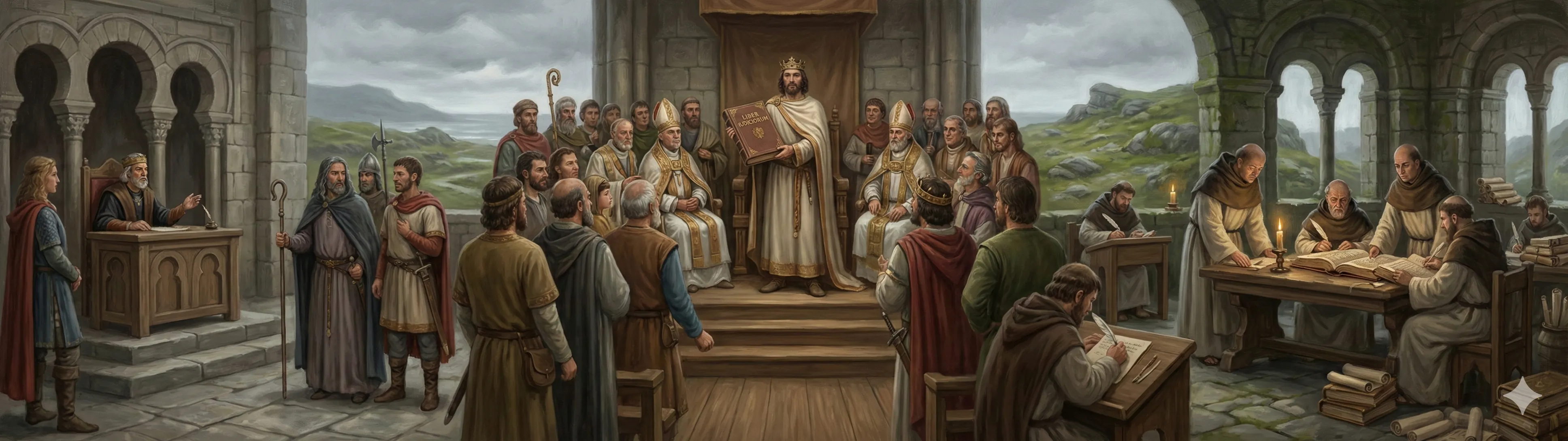
The Liber Iudiciorum: One Law for All Peoples
In 654, King Recceswinth promulgated the Liber Iudiciorum — the Book of Judgements — at the Eighth Council of Toledo. It was the first law code in post-Roman Western Europe to apply equally to all subjects regardless of ethnic origin, abolishing the centuries-old practice of maintaining separate legal systems for Romans and Goths. The code replaced all previous legislation — including the Breviarium Alarici, which had governed the Hispano-Roman population, and the customary Gothic law that had applied to the Visigoths — with a single, comprehensive territorial system covering every free inhabitant of the kingdom.
The Liber Iudiciorum was a monumental work: twelve books containing over 500 laws addressing civil and criminal matters, property and inheritance, marriage and family, contracts, judicial procedure, military obligations, ecclesiastical affairs, and the regulation of Jews. Though called "Visigothic," the code was written in Latin and drew heavily on Roman legal tradition, particularly the Theodosian Code and elements of Justinianic law, blended with Germanic customs and canon law. Its compilation was a royal initiative begun under Chindaswinth, with Bishop Braulio of Zaragoza playing a key editorial role in correcting and reorganising the manuscript during Chindaswinth's reign. Braulio died in 651, three years before the final version was promulgated by Recceswinth. The code was subsequently revised under King Erwig in 681, with further additions by later kings.
For Galicia, the Liber Iudiciorum had profound and lasting consequences. It formally ended any remaining legal distinction between the Suevi and their Hispano-Roman neighbours, creating a unified legal identity — hispani — across the province. The code's provisions on property, inheritance, and the rights of widows and orphans governed daily life in communities like Ribadavia, Castrelo de Miño, and Cartelle for centuries. Its influence extended far beyond the fall of the Visigothic kingdom: in 10th-century Galicia, monastic charters from Celanova, Samos, and other foundations still cited the Liber Iudiciorum as binding law. The code continued to be used by Christian judges in Muslim Spain and formed the basis of medieval Iberian legal systems during the Reconquista.
Key Facts
- The Liber Iudiciorum (654 AD) abolished separate laws for Romans and Goths — the first unified territorial code in post-Roman Western Europe
- Over 500 laws across twelve books covering civil, criminal, ecclesiastical, and military matters
- Compiled under King Recceswinth, building on Chindaswinth's earlier drafts; Braulio of Zaragoza (d. 651) edited the manuscript before the final promulgation in 654
- The code was written in Latin and drew primarily on Roman legal tradition with Germanic and canonical elements
- In 10th-century Galicia, monastic charters from Celanova and Samos still referenced the Liber Iudiciorum as authoritative law
- The code's provisions on property, inheritance, and women's rights governed communities like Ribadavia, Castrelo de Miño, and Cartelle for centuries
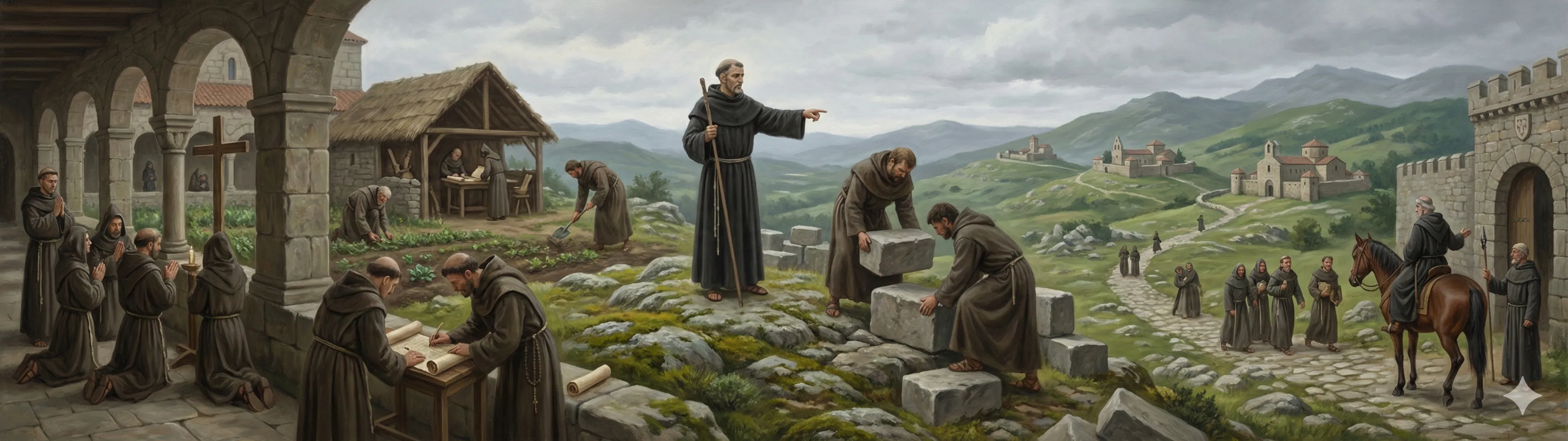
Fructuosus of Braga: The Great Monastic Founder
If Martin of Braga was the apostle of the Suevi, Fructuosus of Braga was the architect of Galician monasticism under the Visigoths — and the most remarkable figure in 7th-century Gallaecia. Born around 600 AD, Fructuosus was the son of a Visigothic dux — a military governor — in the region of Bierzo. As a young man he accompanied his father on official tours across the province, witnessing firsthand the landscapes that would later become the settings for his monastic foundations. After his parents' death, he gave away his wealth, freed his slaves, and retired as a hermit to the rugged wilderness of Galicia.
His reputation for holiness drew so many disciples that he was compelled to found his first monastery — Compludo in El Bierzo — and serve as its first abbot. When the community overflowed, he appointed a successor and withdrew again into solitude, only to attract yet more followers. Over the course of his life, Fructuosus founded at least ten monasteries across Gallaecia, Lusitania, Asturias, and as far south as the island of Cádiz — including a nunnery for eighty virgins under the abbess Benedicta. His monastic rule, the Regula Monachorum, governed life in his foundations with extraordinary strictness: monks were required to confess all their thoughts, visions, and dreams to their superiors, and were forbidden even to look at one another. A second rule, the Regula Communis, addressed the governance of entire networks of monasteries under an abbot-bishop — an innovative model that anticipated later Benedictine federations. His Pactum, or act of religious profession, shows the strong influence of Germanic legal traditions on monastic governance.
So many men flocked to Fructuosus's communities that the Visigothic king grew alarmed at the depletion of men available for military service and restricted entry to his monasteries. When Fructuosus planned a pilgrimage to the Holy Land, the king had him arrested — Chindaswinth's laws forbade leaving the kingdom without royal permission. In 654, Fructuosus was consecrated Bishop of Dumio — the same see where Martin of Braga had once served — and in 656, the Tenth Council of Toledo elevated him to Archbishop of Braga. He died on 16 April 665, having transformed the monastic landscape of western Iberia. His relics were transferred to Santiago de Compostela in 1102, before being returned to Braga in 1966.
Key Facts
- Fructuosus of Braga (c. 600–665): son of a Visigothic dux in Bierzo, he founded at least ten monasteries across Gallaecia and beyond
- His Regula Monachorum governed monastic life with extraordinary strictness; the Regula Communis organised networks of monasteries
- The king restricted entry to his monasteries, fearing the depletion of men for military service
- Fructuosus was arrested for planning to leave the kingdom — a violation of Chindaswinth's emigration laws
- He served as Bishop of Dumio (654) and Archbishop of Braga (656) — both sees with deep connections to the earlier Suevi conversion
- His monastic rules were observed in Galicia and Portugal until the 11th century, when they were replaced by Cluniac and Cistercian reforms
- The São Frutuoso Chapel (Montélios, Braga) — built in the Visigothic period — may be connected to his cult and mirrors the Greek cross plan of Santa Comba de Bande
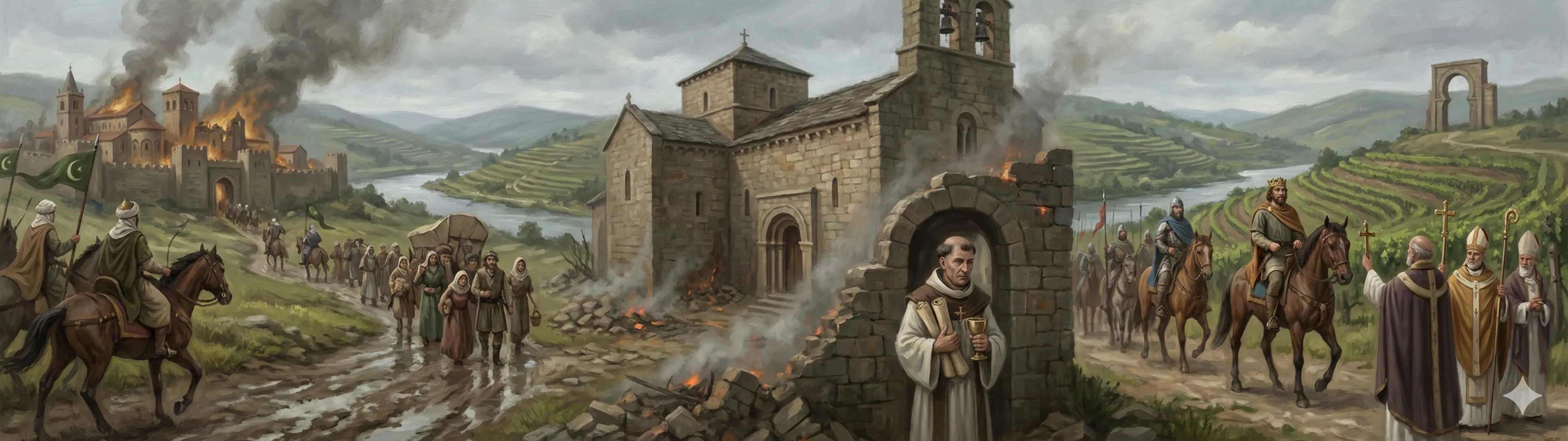
The Fall, the Parish, the Vine: What the Visigoths Left Behind
The Visigothic period in Galicia ended not with a second conquest but with a distant catastrophe. In 711, Arab and Berber forces under Tariq ibn Ziyad crossed the Strait of Gibraltar and destroyed the Visigothic army at the Battle of Guadalete, killing King Roderic. The Muslim advance reached Galicia between 713 and 716. Braga fell. Tui was assaulted and sacked, its bishop and many inhabitants enslaved. Ourense, according to later chronicles, was stormed and destroyed. Lugo, the only fortified city in the region, surrendered and was occupied, its leading citizens sent to Africa. The diocese of Britonia disappeared from the record — its see eventually relocated to Mondoñedo. Yet Muslim control over Galicia was limited and brief — Berber garrisons occupied only the major cities, while the mountainous heartland of western and central Galicia never came under the authority of Córdoba. Many refugees from the south, including the bishops of Lamego, Tui, and Coimbra, took shelter in the lands around Iria Flavia.
The occupation lasted barely a generation. In 740, the Berber garrisons north of the Douro rebelled against the Caliphate and abandoned their positions. Alfonso I of Asturias — son-in-law of the legendary Pelagius — seized the moment, launching campaigns into Galicia in 741 or 742. Lugo was reoccupied without resistance. Tui and Ourense were reconquered. The diocese of Iria Flavia recognised Alfonso's authority. After approximately twenty-eight years of intermittent Muslim presence, Galicia was restored to Christian rule — and the continuity that the Visigoths had preserved now passed into the hands of the new Kingdom of Asturias.
What survived was more enduring than any dynasty. The parish system codified by the Suevi and maintained under the Visigoths continued to organise Galician life — the 735 parishes of modern Ourense province descend directly from these early medieval structures. The Liber Iudiciorum remained the law of the land for centuries after Toledo fell. Viticulture in the Ribeiro continued unbroken — the Church's need for sacramental wine, established under the Suevi and reinforced under Visigothic governance, ensured that vines were never abandoned in the sheltered valleys of the Avia, Miño, and Arnoia. The monastic foundations of Fructuosus and his successors laid the groundwork for the great medieval houses — San Clodio, Celanova, Oseira — that would become the engines of winemaking and agriculture in the Ribeiro. Parish dedications across Cartelle — Santa Baia (Eulalia), San Salvador, Santiago, Santa María — preserve the devotional patterns of the Visigothic era. The horseshoe arch of San Xes de Francelos, the stone walls of Santa Comba de Bande, and the foundational layers of Ourense Cathedral are the visible testimony of a period that shaped the landscape, the law, and the soul of Galicia.
Key Facts
- The Umayyad conquest reached Galicia between 713 and 716 — Ourense was reportedly stormed and destroyed; Lugo surrendered
- Muslim presence was limited to major cities and lasted only ~28 years before the Berber revolt (740) and Alfonso I's reconquest (741–742)
- The Liber Iudiciorum continued to be cited as law in 10th-century Galician monastic charters
- Viticulture in the Ribeiro continued unbroken from the Roman period through the Visigothic era and Muslim interlude
- Parish dedications in Cartelle (Santa Baia, San Salvador) reflect Visigothic-era Christianisation patterns
- The monastic tradition of Fructuosus laid the groundwork for the great medieval houses — Celanova (founded 936), San Clodio, Oseira — that would drive Ribeiro winemaking
- Castrelo de Miño — whose name derives from Castrum Minei — maintained continuous settlement from the Roman through Visigothic periods, with Roman roads and mining continuing under Gothic rule
Heritage Sites
Monuments, documents, and places tied to the Visigothic legacy in Galicia.
Key Dates
“Secundum legem Gothorum”— "According to the law of the Goths" — formula from 10th-century Galician monastic charters