Place context
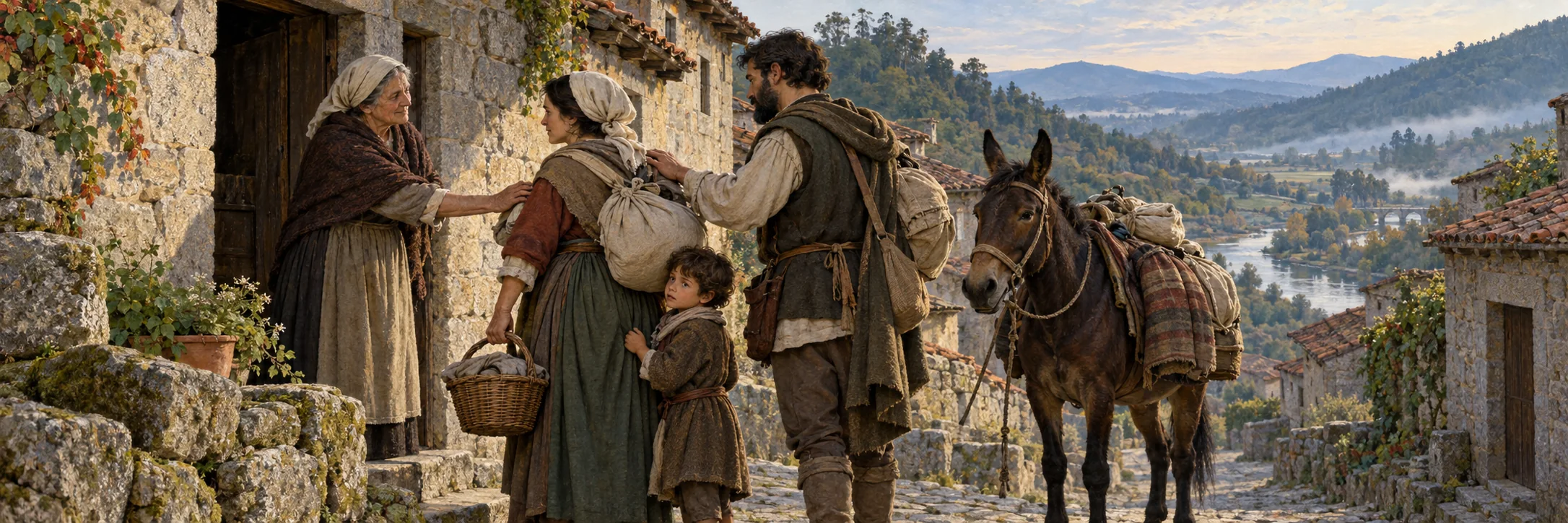
Regional setting for the reviewed R26 material. Map position is a town context, never a residence or parcel.
Existing archive atlas: Ribadavia castle context point; used only to orient the town.
 Galicia
Research
Regional setting for the reviewed R26 material. Map position is a town context, never a residence or parcel.
Explore
Regional setting for the reviewed R26 material. Map position is a town context, never a residence or parcel.
Existing archive atlas: Ribadavia castle context point; used only to orient the town.
A source-stated family in the opening charges of the Cámara case, 1611. A secondary list of the 1609 auto names the same couple and a second daughter, Isabel.
The Cámara case reports this family in a charge and a proposed defence question; no final judgment has been read. A secondary 1609 list adds Isabel, Felipa’s sister. Barros names Isabel Rodríguez as her grandmother without identifying the intervening parent. Matching people across sources remains a candidate identity, not proof. No established connection to our family tree.
A family from Vila Flor catalogued in a Coimbra process of 1575–1583, with a sister, a brother-in-law, another sister and a merchant uncle living in Ribadavia.
Catalogue metadata only; documented means explicit in the catalogue description, not a reading of the damaged folios. Every relationship is stated relative to Violante, so the siblings are not drawn as children of her parents. Luís Álvares and Fernão de Álvares are not connected to any other Álvarez in this archive or to our own family.
A reconciled Ribadavia couple and their son-in-law Antonio Pereyra, the bailiff named in the 1611 case against Pedro de la Cámara.
Three source-local occurrences in the reviewed charges and later defence questions of AHN INQUISICIÓN,2143,Exp.6. Name expansions in brackets are uncertain. Pereyra’s wife appears under conflicting names, so she is shown only as an unnamed daughter. Witness depositions are not among the reviewed images, and no link is drawn to the Pedro Fernández of the fiscal lawsuit or to our own family. A secondary list of the 1608 auto names a Pedro Fernández “the old one” whose wife is Xinebra Vázquez; those entries are compared as candidates, not merged.
The apothecary of Ribadavia, his wives Justa Rodríguez and Isabel Méndez, their sons, four further children named in an inheritance claim, and Justa’s family of Lamego. The likely reconstruction adds Xorxe and the older Gaspar as Felipe’s brothers, with Gaspar’s proposed household.
The documented core comes from the heirs’ lawsuit: a 1624 joint power naming each son’s mother, and the 1578 marriage settlement naming Justa’s parents and her brother Enrique Fernández. The 1608 autos list adds Fernando and Antonio Méndez as sons, and Justa’s Coimbra catalogue and Clara de Donas’s Évora entry are compared as candidates. The order of the marriages is unresolved, the mother of four children is disputed, and Fernando Álvarez de Morais is left out because his parentage is disputed. The named brothers and older Gaspar’s household are a likely reconstruction, with candidate relationships marked in the tree. The published brother references supply no name; they do not create an additional brother card. Violante and María are respectively wife and daughter of a Gaspar Alvarez; their residence at “Fees” supports the inferred identification with the merchant. The viewer shows Francisco and a wife whose name is unknown as proposed shared parents; this is hypothetical and leaves the archival claims unchanged. María’s mother remains unassigned.
The Rey and Álvarez de Verea family of San Salvador de Arnoia, with Isabel Fernández de Lama, also identified as Isabel Álvarez de Verea, connected to her parents and paternal grandparents from a candidate genealogy.
The core comes from parish entries copied and authenticated in the 1743 file, sworn testimony and the Ribadavia council’s recognition; the file’s public catalogue entry is not yet matched. Following the family researcher’s identification, the tree combines Isabel Fernández de Lama, the blog’s Isabel Fernández Álvarez da Lama and the 1713 widow Isabel Álvarez de Verea. Archival confirmation of the identity remains pending. Her parents, paternal grandparents and earlier Verea ancestors follow a heraldry blog and retain candidate links; her maternal grandparents are not named. The 1752 Doña Josefa Rey remains a separate candidate match. A Pedro Álvarez Berea of Ribadavia records is not linked.
The Puga branches of Louredo, Poedo, Roucos and Quiñones, with Pedro Vázquez de Puga and Sancha Vella / Bello Mosquera’s Regodeigón family. Links from the compilation remain candidates.
The existing Regodeigón study and its 1571 deed comparison are retained. The supplied text, matched to the 23 November 2011 blog compilation, adds the three Puga lines and the Roucos, Abraldes, Prado and Quiñones branches. Its bibliography does not identify a primary record for each link. Traditional early ancestry, disputed parentage and alternative names remain attributed proposals. The Pedro–Sancha couple and their Baamonde descendants are candidate matches across sources, not independent proof. Pedro married to Violante is placed under two different parental couples in the compilation; those accounts remain distinct. Stepchildren are not drawn as biological children; unnamed intervening generations are not invented. Plácido’s placement and the founder of the Regodeigón entail remain unresolved. There is no assigned connection to our personal family.
Bernal Méndez and his children Francisco and Margarida, with the separate parties to a 2,000-ducat surety dispute involving the Count of Ribadavia and the bishop of León.
The court text names Bernal as father of both children and Francisco as his sister’s guardian. No mother or spouse is added. The Count is the principal debtor; the bishop is the creditor; Bernal, Pedro de Bande and Jácome Ruiz are sureties. These business relationships do not establish kinship. The separately recorded 1571 family and Felipe Álvarez’s son Francisco are not merged with this household.
Bernal Méndez and Costanza Afonso, their son Francisco, his wife Francisca de Abreu, and his sister and ward Margarida in a deed of 3 December 1571.
Family statements follow the working translation. Only Francisco receives the named parental pair; Margarida’s sibling and guardianship links do not supply a mother. No descendants or de Abreu ancestors are invented. The court-case names are a separate source comparison, and neither Francisco is identified with Felipe Álvarez’s son. The Baamonde buyer is a separate transaction party.
The Morais in the 1608–1610 autos and a household from a later lawsuit; links between records remain under review.
The 1608–1610 entries come from a secondary list, in which three different Antonio Morais appear without saying which was Alonso’s son. Whether Isabel’s father, Alonso’s son and the 1608 councillor named Xerónimo are the same person remains unresolved. AHN, INQUISICIÓN,4552,Exp.8 adds Fernando Álvarez de Morais, el moço, son of an Alonso de Morais, with his wife Bárbara Enríquez, their children, her parents and siblings, and a reconciled Ysabel de Morais; its kinship passages await a fresh image check. Matching the two Alonsos and the two Isabels is a candidate identity, and Fernando’s parentage remains disputed with Estévez Pérez, who makes him Felipe Álvarez’s son.
The secondary 1608 list identifies the councillor and scribe and his wife as a couple sentenced separately: Juan to two years in prison and Beatriz to habit and perpetual prison. It mentions unnamed young children, two of them blind. Her sentence was not substituted for his.
Two entries in the secondary 1608 list; the children are not named. Juan’s reported age and birthplace differ from other published accounts. Identification with the notary named in a 1600 record remains unverified; no cross-record identity is established here.
A Salvaterra-born man and Ana de Mena of Ribadavia are reported as spouses in the working 1608 list; published name and age readings differ.
Veiga calls Ana the wife of Duarte Coronel; Estévez (2000) prints Eduardo Coronel and separately lists Duarte. Chao reports Ana’s age as 17, while Veiga and Estévez give 19. The original proceedings and identities have not been checked; source dependence is unresolved.
A young merchant from Verín and his wife from Ribadavia, sentenced in 1608.
Two entries in the Barros list. Veiga prints Libeira in similar entries; identity and the differing readings remain unverified.
The Sarmiento, Mendoza, Cobos, Gayoso and Henestrosa families, from the medieval lords to the succession granted to Ignacio Medina in 2003. Explore the ancestors, spouses and collateral branches.
A sourced reconstruction of the principal county lineage, with nineteen titleholders in the numbering that includes Francisca Sarmiento. Earlier numbering varies. Parentage follows the cited catalogues and studies, with conflicting identifications noted. Title succession is separate from biological descent. Coverage includes the researched spouses and collateral links, not every descendant of every marriage. No connection to our personal family is established. The 2003 succession order is the latest legal grant included here.
Record
Arquivo da Deputación de Pontevedra, Familia Malvar / Palacete de Salcedo, sig. 12.930/2
A redeemable annuity sold at Ribadavia on 3 December 1571 before Juan de Balcázar. Family relationships are read from the supplied working translation; the original scan is linked, without claiming a complete palaeographic audit. The deed names Francisco’s parents, his wife Francisca de Abreu, and his sister and ward Margarida; it does not name Margarida’s mother. The buyer’s Baamonde household is a separate transaction party. Identification with the court-case Méndez family remains unverified.
Record
ARChV, Registro de Ejecutorias, Caja 1156, 46 · proceedings 1565–1569
Working edition and corrections reviewed against selected original images in a 14-page PDF, including the archival cover and Bernal’s children. The file concerns the bishop’s recovery of a 2,000-ducat debt guaranteed for the Count, not a debt owed by the Count to this family. The writ is dated May 1569, day unread; it copies earlier proceedings. No public catalogue entry has been matched. No mother is named for Francisco or Margarida. Financial parties are not relatives by implication.
Record
INQUISICIÓN,4548,Exp.1
No relationship edges are supplied. Allegations and testimony remain attributed statements; guilt, ancestry, religious identity and final judicial outcomes are not established.